
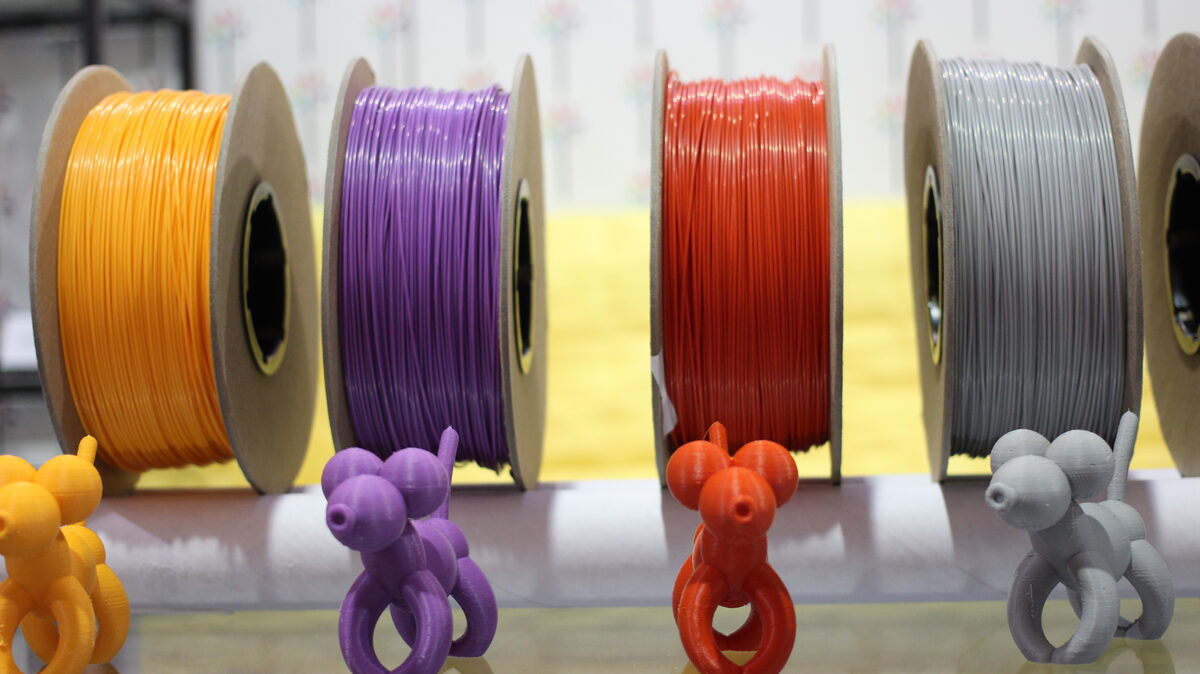
Markforged has introduced Onyx GF, a chopped glass-fiber-filled nylon for its FX10 and FX20 industrial printers that ships in six colors — red, yellow, blue, green, grey, and white — with pigment built directly into the material formulation rather than applied afterward with paint, tape, or labels. It's a small-sounding change with an outsized target: the FOD-prevention tooling, zone-segregation fixtures, and error-proofing jigs that keep aerospace, automotive, food, and pharmaceutical production lines from shipping a defect or, worse, a stray bolt.
If that use case sounds oddly specific for a materials launch, it's because Markforged isn't really selling a new nylon so much as a new way to communicate on a factory floor. Color has always been a proxy for meaning in manufacturing — red for danger, yellow for caution, blue for a specific zone or shift, green for cleared/verified. The problem has been printing that meaning permanently into a part strong enough for daily industrial abuse. Standard fiber-filled nylons print in a handful of neutral shades, so color coding a tool or fixture historically meant a second step: spray paint that chips, a label that peels, or a colored sleeve that eventually walks off with someone's toolbox.
What's Actually New Here
According to TCT Magazine's coverage of the launch, Onyx GF is engineered to match the mechanical profile of standard Onyx — the same tensile strength, stiffness, surface finish, dimensional accuracy, and print reliability the material is known for — while adding chopped glass fiber for reinforcement and factory-formulated pigment for color. Critically, that pigment is part of the material itself, not a coating, which means the color goes all the way through the part rather than sitting on its surface where it can wear off, scratch away, or get contaminated in a food or pharma environment where surface coatings raise their own compliance questions.
The material is also compatible with Markforged's Continuous Fiber Reinforcement (CFR) process, meaning a shop can lay continuous carbon fiber into an Onyx GF part to push its strength toward aluminum-level performance while keeping the color coding intact. That combination — colored-through nylon body plus continuous carbon fiber reinforcement — is the pitch: a fixture, jig, or tray that's both strong enough to survive the shop floor and instantly identifiable at a glance without anyone reading a label.
3D Printing Industry's report adds that Onyx GF is non-conductive, a property that matters for applications involving electrical isolation — think fixtures or covers used near live circuitry where a conductive fiber-filled material would be a liability rather than a convenience.
Why FOD Prevention and Zone Segregation, Specifically
Foreign object debris, or FOD, is one of the most persistent headaches in aerospace and automotive manufacturing: a tool, fastener, or fixture left inside an assembly can cause catastrophic failure long after the line has moved on. Standard practice already leans heavily on color and shadow boards to make missing tools immediately obvious, but tools and fixtures fabricated in a neutral gray or black don't help that system — they blend in. A bright red or yellow FOD-prevention fixture, molded in a color that's never mistaken for the part it's protecting, is easier to account for at shift change and easier to spot if it's ever left somewhere it shouldn't be.
Food, beverage, and pharmaceutical plants have a parallel problem: zone segregation. Equipment, trays, and handling fixtures used in a raw-ingredient zone can't cross into a finished-product zone without risking contamination, and color is the simplest, fastest visual control for enforcing that boundary on a busy floor. Markforged is explicitly positioning Onyx GF's color options around these two scenarios — FOD prevention and zone segregation — rather than as a general-purpose cosmetic upgrade. Markforged frames these use cases within broader visual-management and 5S workplace-organization frameworks, and both source reports note that color-coded, non-conductive parts also suit safety signaling near hazardous machinery or robotic work cells — another setting where a fixture's color needs to communicate instantly rather than after someone reads a tag.
Jon Bond, general manager of FFF at Markforged, framed the release around removing a long-standing tradeoff. "With Onyx GF, we are removing that compromise entirely," he said. "We are delivering the same trusted mechanical foundation our users rely on every day, but with the immediate communication benefits that functional colour provides," according to TCT Magazine's report. In a second quote carried by 3D Printing Industry, Bond went further on the stakes: "Bringing color to the factory floor is about far more than aesthetics; it is about unlocking a new level of operational velocity, safety, and error-proofing for our customers."
What It Means for Makers
Onyx GF is an FX10/FX20-only material, so this isn't a filament that's showing up on desktop printers or open-material third-party spools anytime soon — Markforged's industrial line remains a closed ecosystem tuned to its own hardware and software. For makers and small shops running desktop FDM or even open-platform industrial machines, the direct takeaway isn't "go buy this material" so much as "this is where the puck is going" for pigmented engineering plastics.
The functional-color argument Markforged is making — that color, embedded in the base resin, is itself a form of quality control and safety infrastructure rather than decoration — is a useful lens for anyone building tooling, jigs, or organizational fixtures on their own printers, regardless of brand. A shop that's been painting or taping color codes onto glass-fiber nylon parts printed on any machine can take the underlying idea (color as an integral, wear-resistant signal) and apply it with whatever colored filament stock is already available, even if it lacks Onyx GF's specific fiber reinforcement or CFR compatibility.
It's also a reminder that the industrial and desktop ends of the 3D printing market are increasingly diverging on what "material innovation" means. On the desktop side, headline news is often about new polymer chemistries or price drops. On the industrial side — where Markforged, Stratasys, and others compete for factory-floor budget — the news is as likely to be about workflow and communication as it is about raw mechanical properties. Onyx GF's tensile strength and stiffness are, by Markforged's own description, unchanged from standard Onyx. The entire pitch is the color.
