
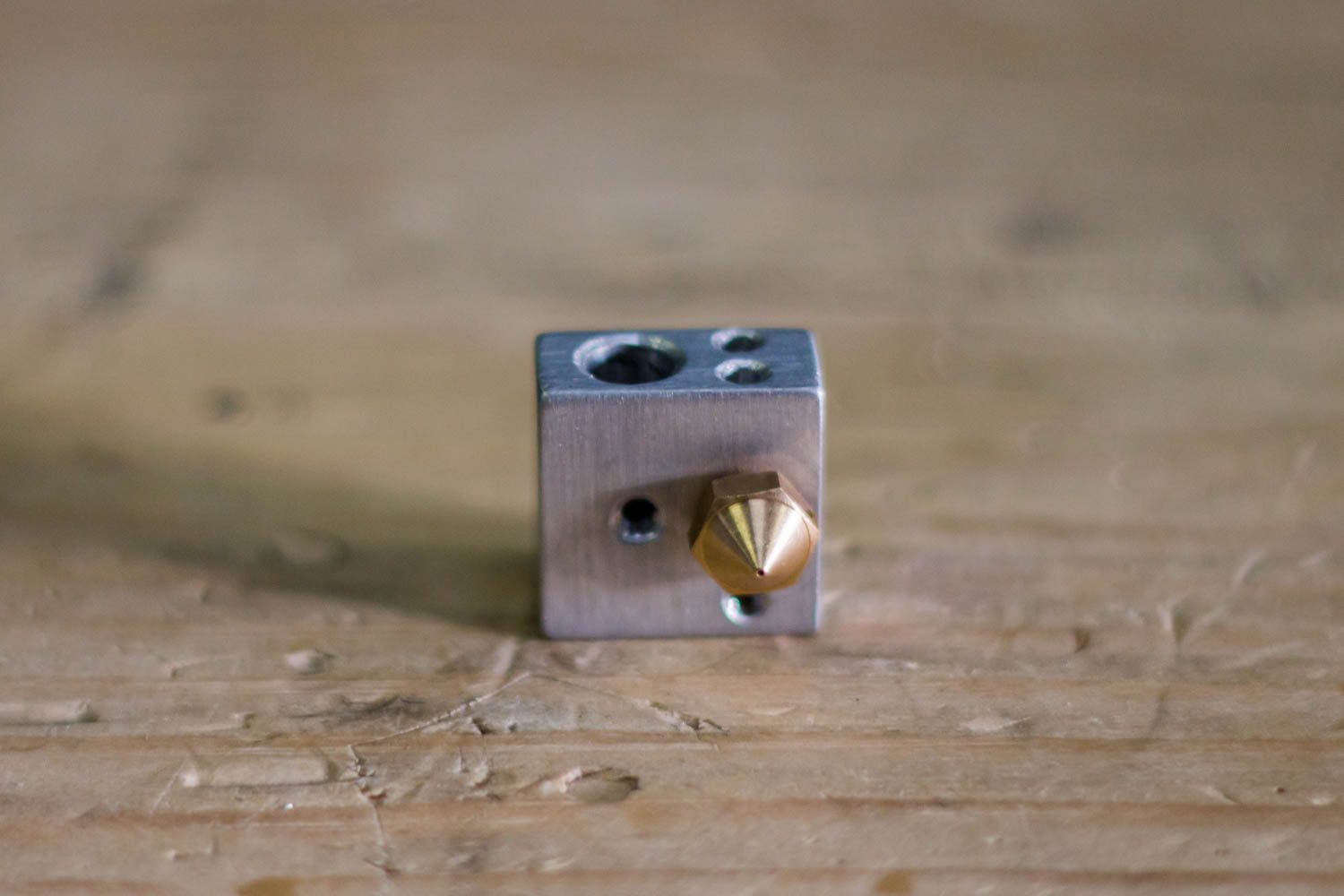
Every hot end box makes a promise: some flashy grams-per-hour or mm³/s figure meant to signal how fast you can print. Maker Robert Samples decided those numbers deserved a second opinion, so he built one and put it on GitHub for anyone to check his work. His project, MeltCalc, is an open-source database and calculator that pairs 79 hot ends with 36 printing polymers and runs the combination through a thermodynamic model to spit out a maximum flow rate — a number derived from physics rather than marketing copy.
The project surfaced publicly on August 18, 2026, when Hackaday's Zoe Skyforest profiled it, describing a tool that sets out to counter what she called "often-optimistic marketing numbers" from hot end and nozzle manufacturers. It's a familiar complaint among experienced FDM users: a vendor's headline flow-rate spec is usually measured under best-case conditions — a particular filament, temperature, and nozzle geometry — and rarely translates cleanly to whatever combination is actually loaded in your printer.
The Physics Behind the Numbers
Samples brings a polymer-chemistry background to the project, and it shows in the approach. Rather than crowdsourcing anecdotal "I got this fast at this temp" data points, MeltCalc's calculator works from first-principles thermodynamics. Melting a cubic millimeter of a given polymer costs a fixed amount of energy — based on its specific heat capacity and heat of fusion — and a hot end's melt zone can only couple so much power into the filament per millimeter of heated length. Those two numbers set a ceiling on volumetric flow, and the calculator works backward from that ceiling to estimate the heater wattage needed to sustain it, rather than starting from wattage as an input. Notably, the model deliberately stops at the melting stage. Samples has said there's no pressure-drop or melt-viscosity modeling built into MeltCalc, so a hot end that can melt a polymer fast enough may still fail to actually push it through the nozzle.
That distinction matters because flow rate isn't really a nozzle spec or a filament spec in isolation — it's a property of the pairing. A hot end that comfortably out-melts PLA can choke on a high-temperature engineering polymer with a much higher melting point and more melt energy per cubic millimeter to overcome. A calculator that lets users mix and match across 79 hot ends and 36 polymers effectively turns "what's my max speed" into a lookup rather than a guess-and-check exercise involving a lot of failed prints and under-extruded parts.
CHT Nozzles and the High-Flow Crowd
The database's coverage of Core Heating Technology (CHT) nozzles is a notable inclusion. Rather than adding physical length to the melt zone, a CHT-style nozzle splits the bore into multiple parallel channels, so the plastic contacts more hot metal per millimeter of travel — MeltCalc's model treats that as worth roughly the equivalent of 8.5 mm of extra heated melt-zone length. CHT and other high-flow geometries are popular because they promise higher flow than a standard round-bore nozzle at the same temperature, and modeling them alongside conventional nozzles lets users quantify that advantage for a specific polymer, rather than relying on the qualitative "it's better for high-speed printing" pitch that typically accompanies these products. For makers chasing print-farm throughput or trying to justify a CHT nozzle's price premium, having flow-rate estimates broken out per hot end/polymer/nozzle-style combination turns a marketing claim into a testable number.
How the Project Is Maintained
MeltCalc lives on GitHub, and Samples has structured it as a community-curated dataset rather than a closed, one-person database. New hot end or polymer entries come in as GitHub pull requests that add rows to the project's underlying hotend and material data files, which Samples reviews and merges — a workflow familiar to anyone who has contributed to an open hardware or open firmware project. That growth is already underway: the database counted 64 hot ends when Hackaday profiled it on August 18, and has since grown to 79.
That structure also means the database's accuracy is only as good as the submitted data and Samples' review process. By his own account, the backend models are entirely his own work, built on first-principles physics rather than a formal physical-testing pipeline, and he's flagged known weaknesses — the model can underestimate flow for some high-performance hot ends, and material property values are typical published figures rather than brand-specific measurements. A thermodynamic model is a prediction, not a measurement, and like any spec sheet it should be a starting point for tuning, not gospel.
What It Means for Makers
The practical use case is straightforward. Instead of starting a new hot end or polymer with the manufacturer's stated numbers — or no numbers at all — and tuning speed by trial and error, a maker can plug their actual hot end and filament combination into the live calculator at meltcalc.baconmilkshake.com and get a physics-grounded starting point for maximum flow rate. That's directly useful for:
- Speed tuning — setting a realistic upper bound on volumetric flow before slicing, instead of discovering the ceiling mid-print through under-extrusion or heat creep.
- Hot end shopping — comparing candidate upgrades against the specific polymers you actually print, rather than a single flagship-filament number on a product page.
- CHT nozzle evaluation — putting a number on whether a CHT nozzle's flow-rate premium is worth it for your material mix.
- Cost/performance comparison — weighing a hot end's price, including an extender or high-flow nozzle, against the flow rate it actually delivers.
- Print-farm throughput planning — modeling flow-rate ceilings across a fleet of machines running different hot ends before committing to a hardware standard.
None of this replaces the standard advice to still run a flow-rate calibration test on your own machine — ambient conditions, part cooling, and individual hot end wear all shift the real-world ceiling. But going in with a modeled estimate rather than a marketing number, or nothing, should shorten the tuning process and reduce the number of failed prints spent finding a printer's actual limits.
Because the project is open source and hosted on GitHub, makers whose hot end or filament isn't yet in the database aren't stuck waiting on Samples — the pull-request contribution path is open to anyone with data to submit. For a community that has long relied on scattered forum posts and spreadsheet folklore for this kind of tuning knowledge, a single structured, growing, physics-based reference is a meaningful upgrade — with the caveat that a model's output is a prediction to verify, not a substitute for calibrating your own printer.
