
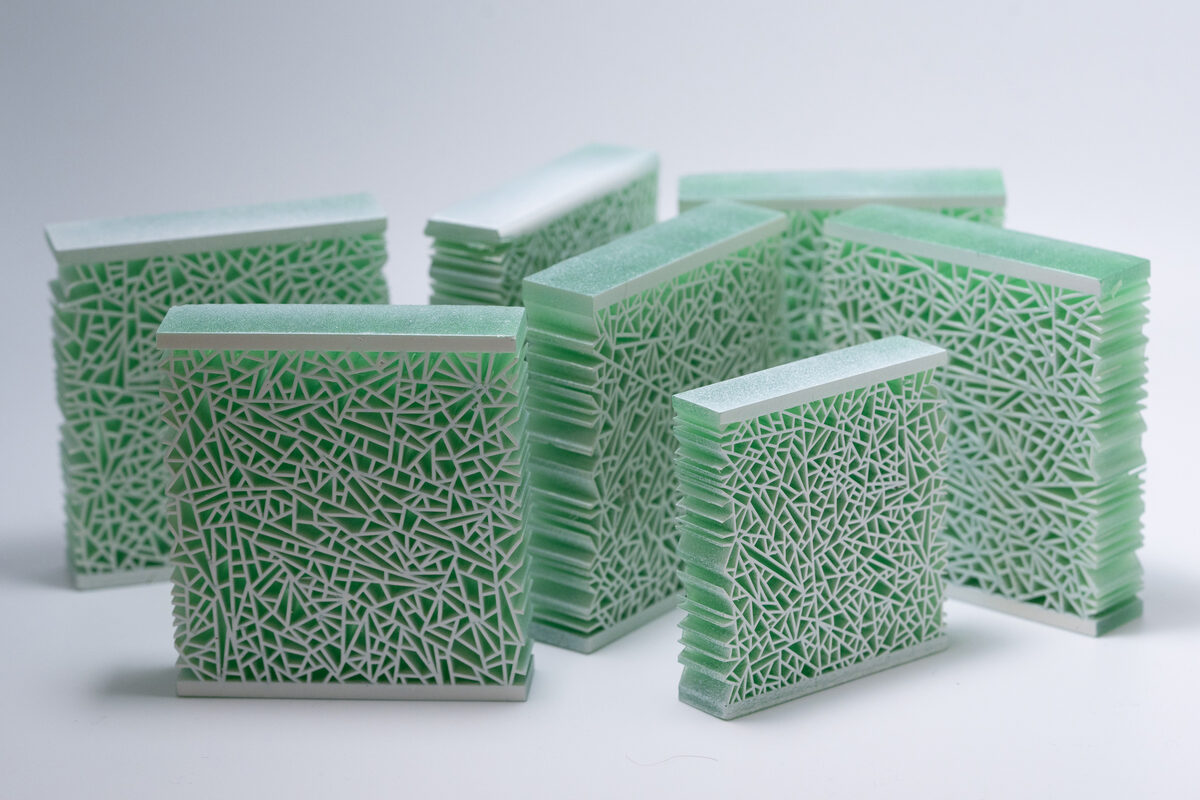
For most of the history of architected materials, the design recipe has been the same: pick a unit cell, tile it, and tune the struts. A new paper in Nature, "Scale-rich network-based metamaterials", throws out the repeating cell altogether. Co-authored by MIT's Carlos Portela and Northeastern network scientist Albert-Laszlo Barabasi, the work describes 3D-printed structures built from irregular, multiscale networks of beams whose lengths, thicknesses and connections vary by orders of magnitude. Despite that apparent disorder, the whole design space is governed by just two parameters, and in tests the printed samples withstood impacts better than ordered lattices.
That combination of messy-looking geometry and a compact design vocabulary is the interesting part. It suggests a way to get the mechanical benefits of heterogeneity without the explosion of design variables that usually comes with it.
Why Move Away From the Unit Cell?
Periodic lattices are popular for good reasons. They are easy to model, easy to generate in CAD or slicer-side infill tools, and their behavior can be predicted from a single cell. But regularity has a cost. According to the researchers, repeating-cell metamaterials such as square lattices and honeycombs fail quickly once cracked, because neighboring identical cells deform the same way. Portela describes this as a localization effect, one of several limitations and non-ideal responses his group saw in periodic and ordered microstructures.
The Nature paper takes a different starting point. Its abstract notes that even mechanical metamaterials remain defined by the homogeneity of their unit cells, pore sizes or repeating features. Rather than a tiled crystal, the authors embed what they call network heterogeneity: ligaments that range widely in length and thickness, and nodes with widely varying connectivity. The term "scale-rich" describes exactly that: the structure contains meaningful features at many scales at once, not just one. VoxelMatters reports that the team modeled the designs on networks found in leaf veins, dragonfly wings and social networks.
How the Networks Are Drawn
According to VoxelMatters' report on the work, the generating algorithm is surprisingly simple to describe. It draws progressively shorter, thinner lines through random points at random angles. The result is a hierarchy: a few long, heavy beams spanning the part, crossed by many medium beams, crossed in turn by far more small ones.
Because the process is defined by a small set of rules rather than an explicit geometry, the researchers can steer the outcome with just two parameters. VoxelMatters reports that these are the starting line thickness and its rate of decrease. "We see we can really tune the stiffness of a material just by changing these two parameters," Portela said. The paper reports highly tunable elastic anisotropy, meaning the material can be made stiffer in one direction than another, without redesigning anything by hand.
The printed samples were credit-card-sized polymer parts, with beams spanning from microns up to centimeters. That dynamic range is itself notable: it is the kind of geometry that only additive manufacturing makes practical, and it sits well outside what a conventional infill pattern would ever generate.
What the Tests Showed
The team compared its scale-rich samples against lattice and honeycomb designs in drop-weight and compression tests. The Nature abstract summarizes the results across simulation and experiment in four properties:
- Tunable anisotropy. The elastic response could be dialed in directionally via the two governing parameters.
- Delocalized deformation. The paper describes delocalized nonlinear deformation with high energy absorption.
- Better dynamic dissipation. Under dynamic loading, the networks showed enhanced energy dissipation.
- Programmable wave control. The same design freedom could be used to control elastic waves traveling through the material.
Portela offered a physical intuition for the result: "Because there is such a richness of length scales in these networked materials, if one part fails, there is a strong web of structures around it that keeps the entire material from failing catastrophically. It's more efficient at distributing damage and absorbing energy."
In a periodic lattice, every cell is nominally the same, so once one starts to fail, its neighbors tend to follow. In a scale-rich network, load is shared across beams of very different sizes, which is consistent with a structure that gives way more gradually and absorbs more energy along the way.
A Lesson From Citrus
One demonstration borrowed from biology. VoxelMatters reports that the researchers built a density-graded version based on pomelo rind and embedded a fragile object at its center. The structure cushioned that object.
That experiment matters because it shows the method is not limited to uniform blocks of material. Grading, with denser regions in some places and sparser ones in others, looks like a natural extension of a rule-based generator, and it is the kind of thing protective products tend to need.
Where It Could Go
VoxelMatters says the design is aimed at helmets, armor, packaging and acoustic lenses that focus sound or vibrations. The first three are applications where absorbing energy without a sudden, catastrophic collapse is the whole point. The wave-control result opens a less obvious door: acoustic lenses, in which the network geometry is tuned to steer or focus sound or vibration through a solid.
It is worth being clear about where this sits. These were laboratory specimens, credit-card-sized and printed in polymer, evaluated in controlled compression and drop-weight tests. The paper establishes a design principle and its mechanical advantages; it is not a product announcement. Neither source addresses scaling to larger sizes, manufacturability or long-term durability, so those remain open questions.
What It Means for Makers
For people who print functional parts, the takeaway is less about any specific geometry and more about a shift in thinking. Most of us treat infill and lattice design as a choice among regular patterns: grid, gyroid, honeycomb, maybe a TPMS from a plugin. This work argues that, at least for impact, the regularity itself may be a limitation, and that controlled randomness across many scales can outperform it.
The generating recipe, random points, random angles, successively shorter and thinner lines, is simple enough that it invites experimentation in tools like scripted CAD or procedural mesh generators. The practical catch is resolution: the published samples span microns to centimeters, and the finest features are likely well beyond what a typical FDM nozzle can lay down. Makers trying the idea on desktop machines would be working with a truncated range of scales, and it is an open question how much of the benefit survives that compression.
Still, the broader message is useful for anyone designing crash pads, drone bumpers, tool cases or protective mounts: when a part fails because identical cells deform together, the fix may not be a stronger cell. It may be no repeating cell at all.
