
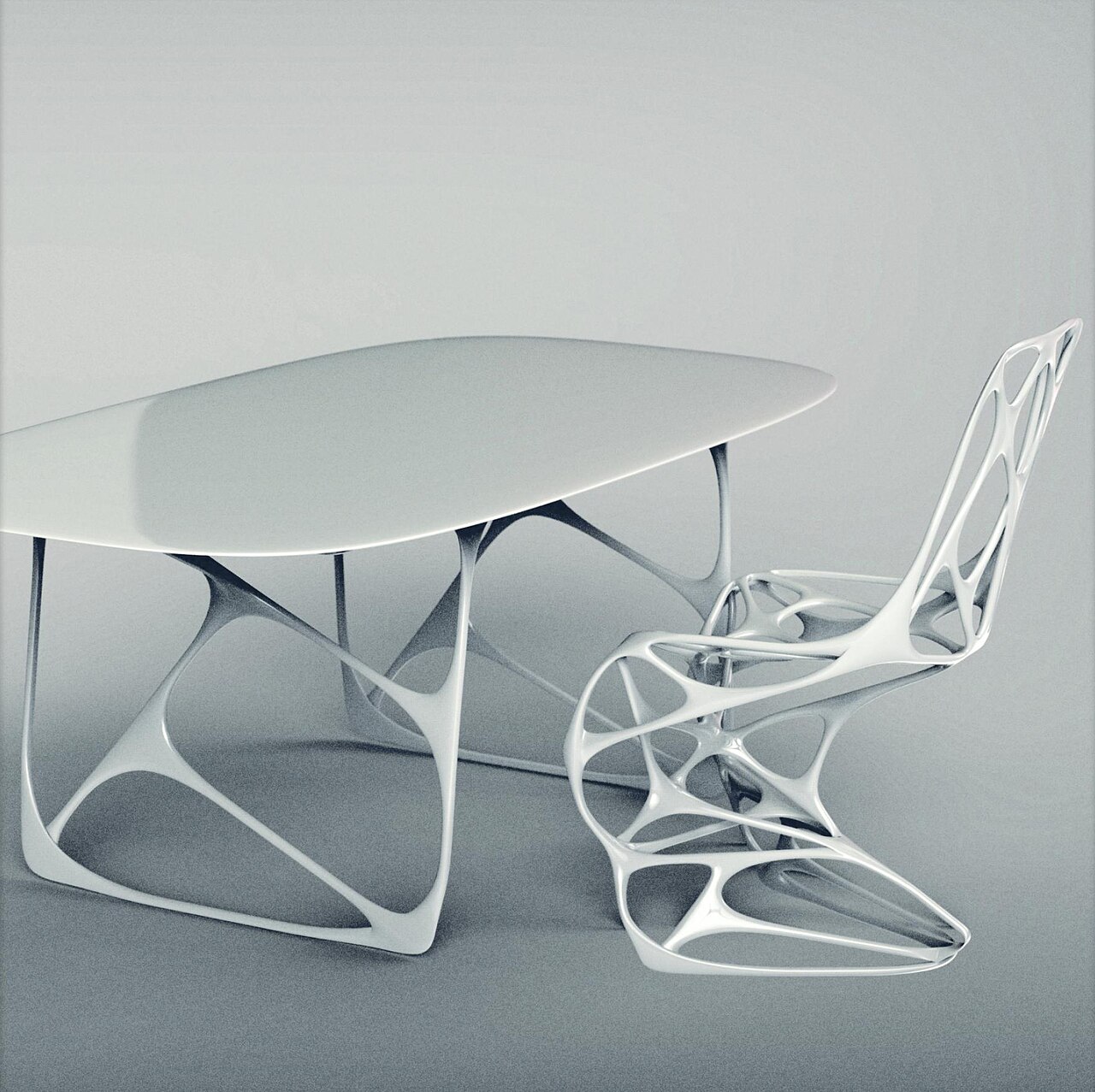
When most people hear the word "echo," they think of sound bouncing back at them from a hard surface, arriving late and slightly degraded. The design studio Nagami and Zaha Hadid Architects (ZHA) have taken the word somewhere else entirely. Their new ECHO Chair, 3D printed in recycled PETG and sold made-to-order through Nagami's shop, treats an echo not as acoustic repetition but as a geometric transformation — a form that returns to you altered rather than merely repeated. It is a small conceptual pivot with large physical consequences, and it is also one of the clearer signs yet that additive manufacturing is settling comfortably into the world of consumer furniture.
The chair is the latest product of a collaboration that goes back several years. As VoxelMatters reported, ZHA and Nagami previously produced the BOW and RISE chairs together in 2018. ECHO continues that lineage, but the framing has shifted from pure sculptural statement toward something the studios describe as a balance of geometry, ergonomics and sustainability — three constraints that do not always pull in the same direction.
One Continuous Surface, No Assembly
The defining engineering decision behind ECHO is that it is printed as a single continuous piece. There is no bolting a seat onto a base, no welding a backrest to a frame. Nagami's large-format extrusion 3D printing lays the entire chair down as two continuous surfaces that grow from a shared structural edge, so the seat and base effectively mirror the backrest and supporting structure. That shared edge is where the "echo" idea stops being a marketing line and becomes a load path: the same geometry that reads as poetic symmetry is also what carries weight through the object.
Printing furniture-scale objects in one go is not trivial. Large-format extrusion systems deposit far more material per pass than a desktop FDM machine, and doing it across a chair-sized envelope without warping, delamination, or a collapsed overhang requires careful control of geometry, cooling and toolpath. By committing to a single continuous piece, Nagami sidesteps the failure modes that plague joined assemblies — glue lines, fastener stress concentrations, mismatched thermal behavior between parts — at the cost of demanding a great deal from the print itself. When it works, the result is a monolithic object with no seams to hide.
Layer Lines as the Point, Not the Problem
Here is where ECHO diverges most sharply from the instincts most makers have drilled into themselves. Anyone who has spent time with an FDM printer has fought visible layer lines: sanding them, coating them, chasing finer heights to make them disappear. ECHO does the opposite. Its vertical layer lines are left plainly visible and used as a deliberate aesthetic, running with the form to emphasize motion. The manufacturing signature becomes the surface design.
This is not laziness dressed up as intent. Choosing to expose layer lines means every parameter that governs them — layer height, extrusion width, flow consistency, the smoothness of the toolpath around curves — becomes a visible finish quality rather than a hidden internal detail. A wobble that a painted part would forgive is, on ECHO, a permanent cosmetic flaw. Orienting the lines vertically to reinforce the sense of upward motion is a design choice that also happens to be a print-orientation choice, tying aesthetics directly to how the part sits on the bed. It is a reminder that in additive manufacturing, "how you print it" and "how it looks" are frequently the same decision.
The Material Story: From Waste to Beauty
ECHO is printed in recycled PETG, and Nagami wraps the material in a brand narrative it calls "from waste to beauty" — a process it frames as rescuing, purifying, transforming and transcending waste materials. Stripped of the poetry, the practical claim is straightforward: post-use plastic that would otherwise be discarded is reprocessed into feedstock for a high-value object.
PETG is a sensible choice for this. It is tougher and more temperature-tolerant than PLA, less prone to the brittle failures that would be unacceptable in a chair, and it extrudes cleanly at large scale. Recycled PETG carries the usual caveats — inconsistent source streams, moisture sensitivity, and property drift with each reprocessing cycle — which makes the decision to display rather than hide the layers all the more notable. There is nowhere for a bad batch to disappear to.
Pricing runs from EUR669 to EUR1,231 (roughly $760 to $1,400), with the variation driven by color choice rather than size or configuration. That the color of a recycled-plastic chair can swing its price by nearly a factor of two is itself a window into recycled-material economics: certain colors are harder to achieve consistently from reclaimed feedstock, and consistency is exactly what a made-to-order product has to guarantee.
What It Means for Makers
ECHO matters beyond the design-gallery crowd because it demonstrates several things the hobbyist and small-shop additive world has been circling for years. First, that "print it as one piece" can be a viable manufacturing strategy at furniture scale, not just a party trick — the elimination of assembly is a genuine structural and aesthetic advantage when the machine can handle the envelope. Second, that layer lines are a design language, not just a defect to be sanded away; deciding when to hide them and when to celebrate them is a legitimate creative axis. Third, that recycled PETG is being trusted in a load-bearing, premium-priced consumer product with its surface fully exposed — a meaningful vote of confidence in reclaimed feedstock.
None of this requires a warehouse-sized robot to learn from. The core lessons — orient the part so its layers reinforce the form, treat material choice and finish as a single problem, and design geometry so that structure and appearance share the same lines — scale down to a desktop machine intact. ECHO is a high-end object, but the thinking behind it is portable.
Bottom Line
The ECHO Chair is a made-to-order, single-piece seat printed in recycled PETG via large-format extrusion, priced by color from EUR669 to EUR1,231, and built on an idea — the echo as transformation rather than repetition — that shows up in its geometry as much as its name. For a maker audience, it is worth watching less as a purchase and more as a case study in what happens when additive manufacturing stops apologizing for how it looks and starts designing around it.
