
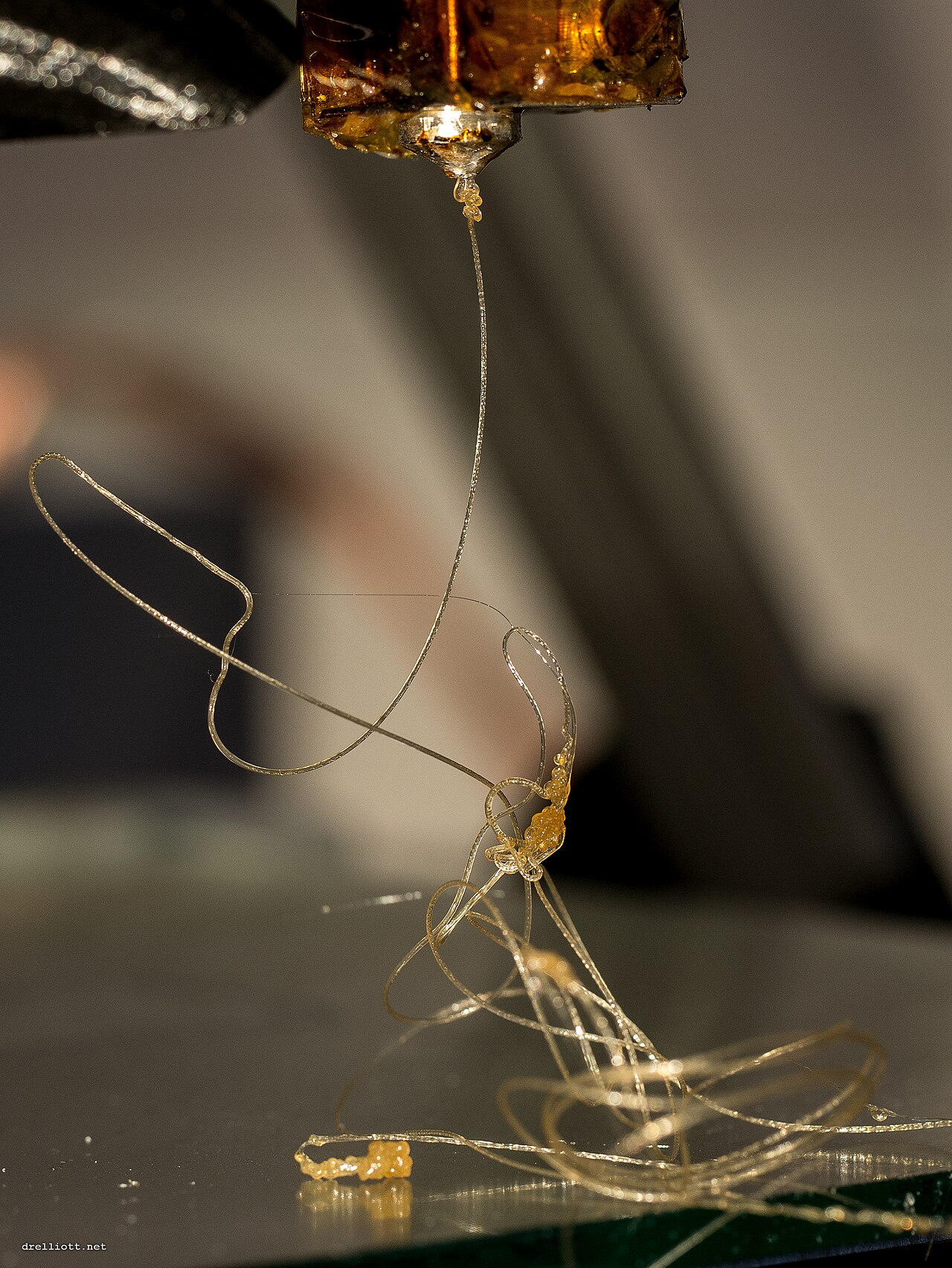
Every micro-extrusion printer eventually runs into the same wall: the nozzle. You can tune pressure, tweak rheology and slow the gantry to a crawl, but the line you lay down can never be much finer than the orifice it came out of, and machining a clean, straight bore below a few tens of microns is somewhere between expensive and impossible. A team at McGill University and Drexel University decided to stop machining and start harvesting. On September 3, 2026, at the 36th First Annual Ig Nobel Prize ceremony in Zurich, the 2026 Ig Nobel Technology Prize went to Justin Puma, Changhong Cao, Jianyu Li and their collaborators for "3D Necroprinting" — using the proboscis of a dead female mosquito as a 3D-printing nozzle.
The Ig Nobels exist to make people laugh and then think, and the thinking half is the interesting part here. The work was published in Science Advances (vol. 11, no. 47, November 19, 2025, doi.org/10.1126/sciadv.adw9953), and the numbers in it are not a gag: 20-micron printed lines from a nozzle nobody had to machine, one that degrades when you are done with it and, with proper handling and cleaning, can be reused many times as long as you stay inside its pressure envelope.
Why the nozzle is the bottleneck
Bioprinting and micro-extrusion live and die by feature size. Cell scaffolds, cell-laden hydrogels and tissue-engineering constructs need channels and struts on the scale of the cells themselves. As Li put it in McGill's announcement, high-resolution 3D printing and microdispensing rely on ultrafine nozzles, typically made from specialized metal or glass, and "these nozzles are expensive, difficult to manufacture and generate environmental waste and health concerns." According to McGill, the mosquito proboscis produced line widths as fine as 20 microns — a little smaller than a white blood cell — roughly twice as fine as commercially available nozzles; VoxelMatters puts the same result as a 250 percent improvement over conventional printing tips. The proboscis itself is about half the width of a human hair.
The trick is that the mosquito already solved the manufacturing problem. Evolution has spent a very long time optimizing a tube that has to pierce skin and move fluid through a lumen far narrower than anything a tool shop wants to bore, and it does so in a structure roughly 2 mm long with minimal curvature.
Screening the animal kingdom
The mosquito was not the first candidate. Per VoxelMatters, the group screened fangs, stingers, plant xylem vessels, and the proboscises of bed bugs and tsetse flies before settling on the female mosquito. Each is a natural hollow structure, but the mosquito proboscis won on the combination of length, bore and geometry that a dispense system can actually make use of.
Integration was deliberately unglamorous. As The Scientist reports, the proboscis was attached to a standard dispense tip on a 3D printer, and the researchers then characterized its pressure tolerance and the extrusion speeds it could sustain with bioinks. In other words, no exotic printhead.
"Mosquito proboscides let us print extremely small, precise structures," Cao, an assistant professor and Canada Research Chair in Small-Scale Materials and Manufacturing, told VoxelMatters. Cao attended the Zurich ceremony to collect the prize.
What they actually printed
The demonstrations in the paper cover the range you would want from a proof of concept. On the geometry side, the team printed honeycomb and maple-leaf patterns. On the biology side, they built bioscaffolds fine enough to hold individual cancer cells and red blood cells, which is the kind of single-cell placement that matters for tissue models and diagnostics. And because a mosquito proboscis is, functionally, a needle, they also ran it in reverse: injecting model drug carriers into pig skin at picomolar concentrations.
McGill's newsroom lists the intended applications as cell scaffolds, tissue engineering, cell-laden gels and the transfer of microscopic objects — including, notably, semiconductor chips. That last one is a reminder that the ultrafine-nozzle problem is not confined to biology.
Biodegradable, reusable, free
The sustainability pitch is real, if secondary. "Since biological nozzles are biodegradable, we can repurpose materials that would otherwise be discarded," Cao said, per VoxelMatters. Li, an associate professor and Canada Research Chair in Tissue Repair and Regeneration, framed it more broadly: introducing biotic materials as viable substitutes for complex engineered components "paves the way for sustainable and innovative solutions in advanced manufacturing."
Reusability is bounded. McGill says the nozzles can be cleaned and reused many times, but "as long as the pressures stay within safe limits," in Cao's words — push a biological capillary past what it evolved to handle and you have a very small failure with no catalog replacement.
The project was funded through NFRF Exploration, NSERC Discovery, FRQNT New Academics, the CFI John Evans Leaders Fund, the Canada Research Chairs program and NSERC-FRQNT Nova. The full author list on the prize citation runs to twelve names across China, Canada, the USA and Egypt, including Drexel's Megan Creighton and Ali Afify.
What It Means for Makers
Nobody reading this is going to glue a mosquito to a Volcano nozzle, and the paper does not suggest they should. Thermoplastic extrusion is a different regime entirely, with melt pressures and temperatures that would obliterate a biotic capillary. Necroprinting is a room-temperature, low-pressure, hydrogel-and-bioink technique, and its market is labs, not print farms.
The transferable lesson is about where resolution actually comes from. Desktop FDM has spent a decade chasing smaller steps, stiffer frames and better motion control, but in any extrusion process the orifice sets the floor, and manufacturing that orifice gets exponentially harder as it shrinks. The McGill team's answer — find a structure that already exists at the size you need and adapt your tooling to it — is worth remembering the next time a nozzle spec sheet stalls out at 0.1 mm.
It also says something about the ceiling for desktop bioprinting. If a 20-micron nozzle can be bolted onto a standard dispense tip with no proprietary head, the barrier to sub-cell-scale extrusion is lower than the price of commercial micro-tips implies.
The Ig Nobels are, by design, a mixed bag. This year's other honorees include research on cockroach milk protein and a soil-health study that involved burying a thousand pairs of underwear. Necroprinting belongs on that list for its premise. It belongs in the literature for its results.
Sources
- Ig Nobel Prize Winners — 2026 Technology Prize (Improbable Research)
- Mosquitoes' feeding tubes make ultrafine 3D-printing nozzles (McGill Newsroom)
- McGill researchers win Ig Nobel for mosquito mouthpart 3D printing nozzle (VoxelMatters)
- Mosquito Blood-Sucking Organ Turned 3D-Printing Nozzle Wins Ig Nobel (The Scientist)
