
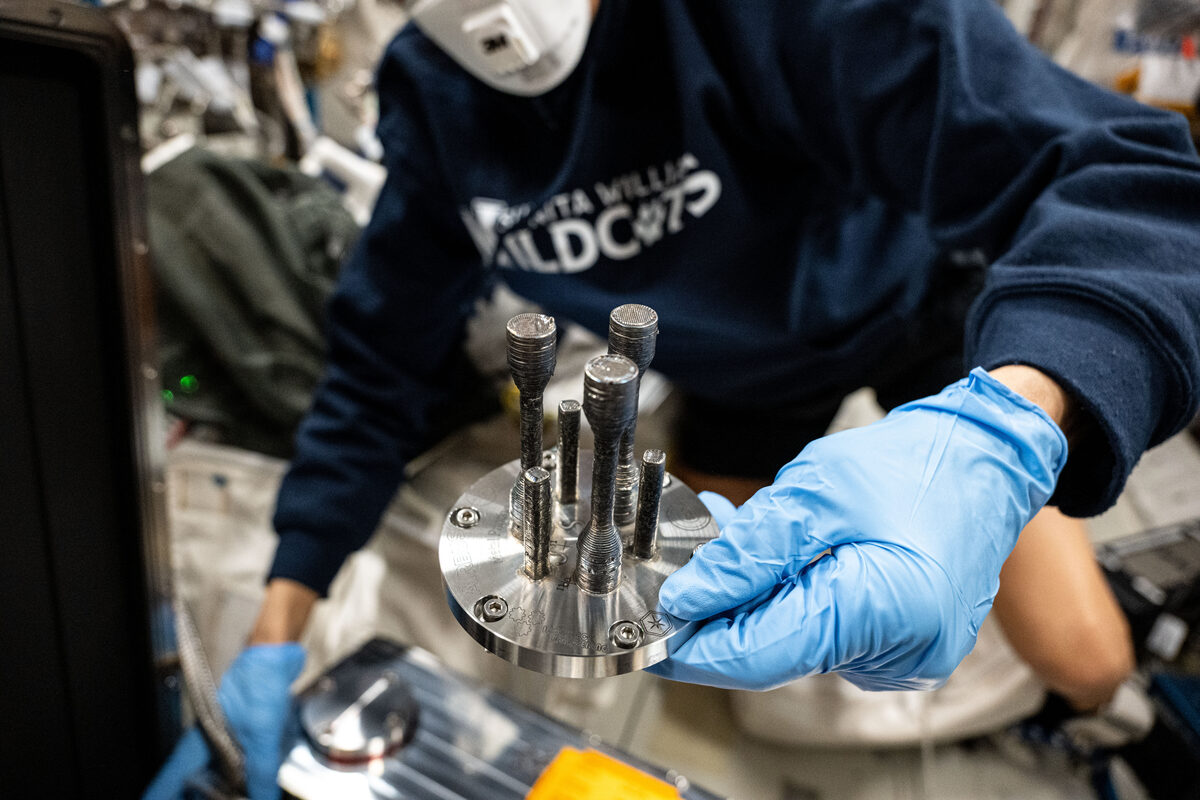
Nikon's metal additive manufacturing division wants to build the machines that keep future space stations running without a resupply rocket every time a bracket cracks. The company's space industry applications page lays out a case that in-orbit 3D printing isn't a novelty experiment anymore — it's infrastructure, and Nikon SLM Solutions already has hardware and materials qualified for the job.
The pitch got a public airing this week when 3DPrint.com reported on Nikon Advanced Manufacturing's broader industrialization strategy, which treats space as one of several high-value verticals — alongside defense, aviation, and energy — where metal laser powder bed fusion earns its keep. In the August 21 piece by Vanesa Listek, Nikon Advanced Manufacturing CEO Hamid Zarringhalam is quoted making the case plainly: "Space is one of the most compelling examples where additive manufacturing delivers clear and measurable value."
It's a claim that's easy to nod along with and harder to actually justify with hardware, materials data, and paying customers. Nikon is trying to show its work on all three fronts.
Why Space Is the Argument, Not Just an Application
The logic Nikon is pushing isn't new to anyone who has priced out a satellite launch, but it's worth spelling out because it's the whole justification for the bet. Every kilogram that leaves Earth costs real money, every part has to survive launch vibration and vacuum before it does anything useful, and once something breaks in orbit there's no hardware store. A commercial space station or a long-duration mission can't carry a warehouse of spares for every possible failure, and some of the structures a future station will need — trusses, radiators, antenna reflectors — are either too fragile to survive a rocket ride assembled, or too large to fit inside a fairing at all. Additive manufacturing addresses that in two overlapping ways. On the ground, it lets Nikon's aerospace customers consolidate parts, cut weight, and shorten lead times on components that still launch from Earth. In orbit, the argument goes further: a metal or polymer printer aboard a station could produce replacement brackets, tools, and mounting hardware on demand, and eventually print oversized structures in modules that get assembled after they're made, sidestepping the launch-volume constraint entirely. Nikon's framing treats that second piece — genuinely in-space production — as the frontier, with today's ground-based aerospace work as the qualification path that gets the materials and processes proven before anyone trusts them off-planet.
The Hardware and Materials Already in Service
Nikon isn't starting this pitch from zero. According to the company's space industry page, its selective laser melting (SLM) systems are already running at space-sector customers, printing in a materials list built for the environment: titanium, aluminum, cobalt, copper, nickel, steel, and niobium alloys, each chosen for the combination of strength-to-weight ratio, thermal performance, or radiation and erosion resistance that different spacecraft components demand. The hardware spans Nikon's SLM lineup — the SLM 500 and SLM 280 PS/2.0 on the smaller end, and the multi-laser NXG XII 600 and NXG 600E systems for higher-throughput production. That range matters for a space customer: a prototype antenna bracket and a production run of structural nodes have very different build-volume and speed requirements, and Nikon is positioning its catalog to cover both without forcing a customer to switch vendors as a program matures. Two named customer relationships give the pitch some substance. Optisys, which builds antennas for space missions, uses Nikon's systems to print components that have to resist atomic oxygen erosion — a real degradation mechanism in low Earth orbit, where atomic oxygen in the residual atmosphere slowly eats away at exposed surfaces over a mission's lifetime. That's a materials and surface-finish problem as much as a design one, and it's the kind of qualification data that's hard to fake. On the broader aerospace side, Nikon also counts Safran and Rolls-Royce as customers running aerospace components on its multi-laser systems, which speaks to the industrial-scale end of the business even where the parts aren't destined for orbit themselves.
What It Means for Makers
None of this touches a desktop FDM printer or even most hobbyist-accessible metal systems — SLM 500-class machines and multi-laser NXG platforms are industrial equipment running in the hundreds of thousands to millions of dollars, sold to companies with aerospace-grade quality systems, not garage workshops. So the direct relevance to most FilamentFeed readers is limited. What's worth tracking is the trickle-down. Every material system Nikon qualifies for space — a titanium alloy tuned for erosion resistance, a copper alloy proven for thermal parts, a process window validated for niobium, a metal notoriously difficult to print — becomes documented, de-risked knowledge that eventually filters into the broader metal AM ecosystem, the same way aerospace-driven titanium and Inconel work over the past decade shaped what's available on mid-range industrial and even prosumer metal systems today. Space is also a useful stress test for the argument makers already understand instinctively: additive manufacturing wins when a part is complex, low-volume, or logistically painful to source any other way. A space station is the most extreme version of that logic — no supply chain, no do-overs, no room for excess mass — and if Nikon's approach holds up there, it's a strong signal for what serious metal AM adoption looks like anywhere resupply is expensive or slow, from remote industrial sites to defense applications closer to home. There's also a longer-horizon story here for anyone interested in where manufacturing itself is headed. If commercial space stations do become a real market in the next decade, the companies that get their materials and machines qualified early — as Nikon is explicitly trying to do now — stand to define the baseline everyone else builds against. That's a bet worth watching even from the ground.
