
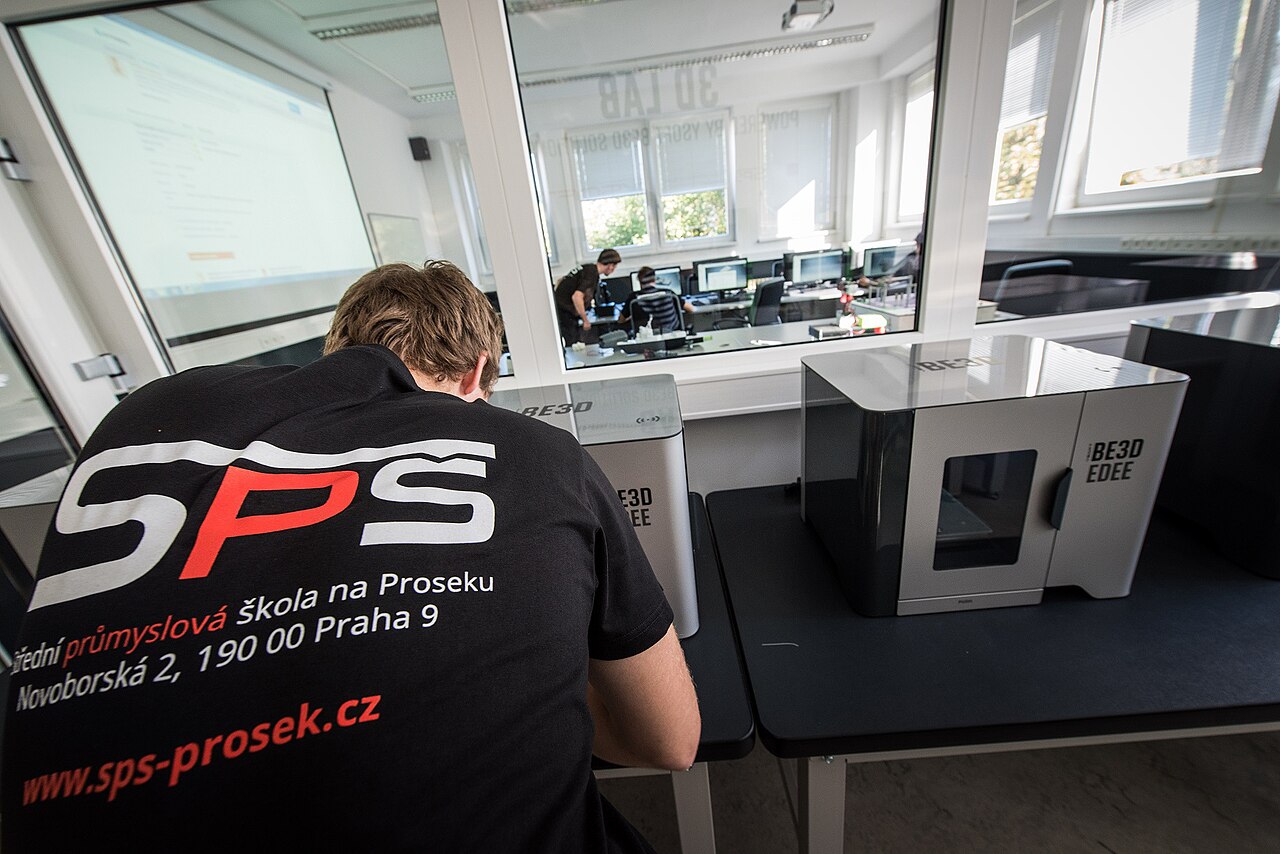
Every maker who has taught someone else to print knows the moment: the printer is not the hard part. The slicer is. That is precisely what a cohort of southern New Mexico schoolteachers discovered this summer at the DREAM Research Center at New Mexico State University, where the center held its third annual Additive Manufacturing Personal Development (AMPD) workshop. Over a multi-day, hybrid program run out of NMSU's Aggie Innovation Space, K-12 educators from the region learned to design 3D objects, slice them and drive the machines that turn a model into a physical part — the same pipeline any shop or makerspace runs, taught to people who will carry it back into classrooms.
The framing from the center is deliberately unglamorous. Demystifying manufacturing is how program manager Mat Martins describes the goal; the program, he says, "demystifies manufacturing through empowering students and educators to interact with advanced instruments." The aim is not producing a room full of CAD experts in a week, but stripping away the sense that additive manufacturing is a specialist black box. For teachers, that demystification has to happen before it can be passed on to students, which is why AMPD puts educators through the whole workflow rather than handing them a finished lesson plan.
The software is the wall, not the printer
If there is a single takeaway from the workshop for anyone who runs a printer farm or a classroom lab, it is this: the toolpath, not the toolhead, is where new users get stuck. Tajkirah Wallace, a special-education teacher at Chaparral High School, put it plainly: "Programming all that, the software, that's the harder part." That is not a beginner's complaint so much as an accurate map of the learning curve. Loading filament and leveling a bed are mechanical, teachable-in-an-afternoon tasks. Understanding why a model needs supports, how orientation changes strength and surface finish, what infill density actually buys you, and how to read a slicer's preview — that is the conceptual work, and it is genuinely closer to computer programming than to shop class.
The AMPD organizers evidently agree, because the workshop treats computer programming as a core principle rather than incidental. That is a meaningful pedagogical choice. A lot of "3D printing in schools" enthusiasm stops at the novelty of watching a part grow on the bed. AMPD instead anchors the experience in the design-and-slice decisions that separate a print that works from a spaghetti failure — the exact skills that make the difference in a production environment. Math teacher Vishal Kapoor of Desert Pride Academy was among the educators working through that pipeline, a reminder that additive manufacturing sits naturally alongside geometry and algebra, not just in a dedicated tech elective.
What DREAM actually is
The teacher workshop is the visible, community-facing edge of a much larger research program. DREAM stands for Distributed Resilient and Emergent intelligence-based Additive Manufacturing, and it is backed by a $7 million National Science Foundation EPSCoR RII E-RISE grant (award #OIA-2417062) running from 2024 through 2028. The center was established in 2024 with that NSF funding, and its scope is far broader than a single university lab.
DREAM is a statewide consortium. Alongside NMSU, it unites the University of New Mexico, New Mexico Tech and Navajo Technical University, drawing on eleven research leads spread across artificial intelligence, cybersecurity, networking, manufacturing and education. The mission statement reads like a thesis on where additive manufacturing is headed: secure and reliable distributed additive manufacturing across New Mexico, built on locally sourced materials, protected designs and community workforce development. In other words, the research is not just about printing parts — it is about printing them across a network of sites, resiliently and securely, using inputs that a region can actually supply, and doing so without exposing proprietary design files.
That combination — distributed production, cybersecurity for the toolchain, locally sourced feedstock — is a coherent answer to problems the AM industry keeps running into. Digital designs are trivial to copy and tamper with; supply chains for polymers and metals are fragile; and a printer sitting idle in one facility cannot help a job queued at another. DREAM is treating all of those as one connected research problem, with the K-12 pipeline as the long-term supply of people who will eventually work inside it. The center also supports small and medium-sized enterprises, tying the academic work to the shops that will use it.
What It Means for Makers
For working makers, educators and shop owners, the DREAM workshop is worth watching for a few concrete reasons. First, it validates something the community already knows but rarely funds properly: onboarding is a software problem. If you run a makerspace or a classroom lab, the lesson is to spend your teaching time on slicer literacy and design-for-additive thinking, not on the mechanical steps that a good printer largely automates now.
Second, this is a picture of the workforce pipeline that underpins the entire industry. The shops hiring the next generation of operators and technicians are downstream of exactly this kind of program. A teacher trained at AMPD seeds dozens of students a year with the basic mental model of how a part goes from CAD to printed object — and does it in southern New Mexico, not only in coastal tech hubs. That geographic point matters for anyone thinking about where AM talent will come from over the next decade.
Third, DREAM's research agenda — distributed, secure, locally sourced manufacturing — reads as a preview of where professional additive is going. Protected designs and networked print sites are not classroom abstractions; they are live concerns for anyone printing anything with commercial or IP value. A federally funded center working those problems in the open, while simultaneously training the teachers who train the workforce, is a rare case of the research and the pipeline being built together rather than in separate silos.
The bottom line: a $7 million NSF investment is quietly doing something the maker community has advocated for years — treating 3D printing education as a serious, software-forward discipline, and building the people side of the industry with the same rigor as the machines.
