
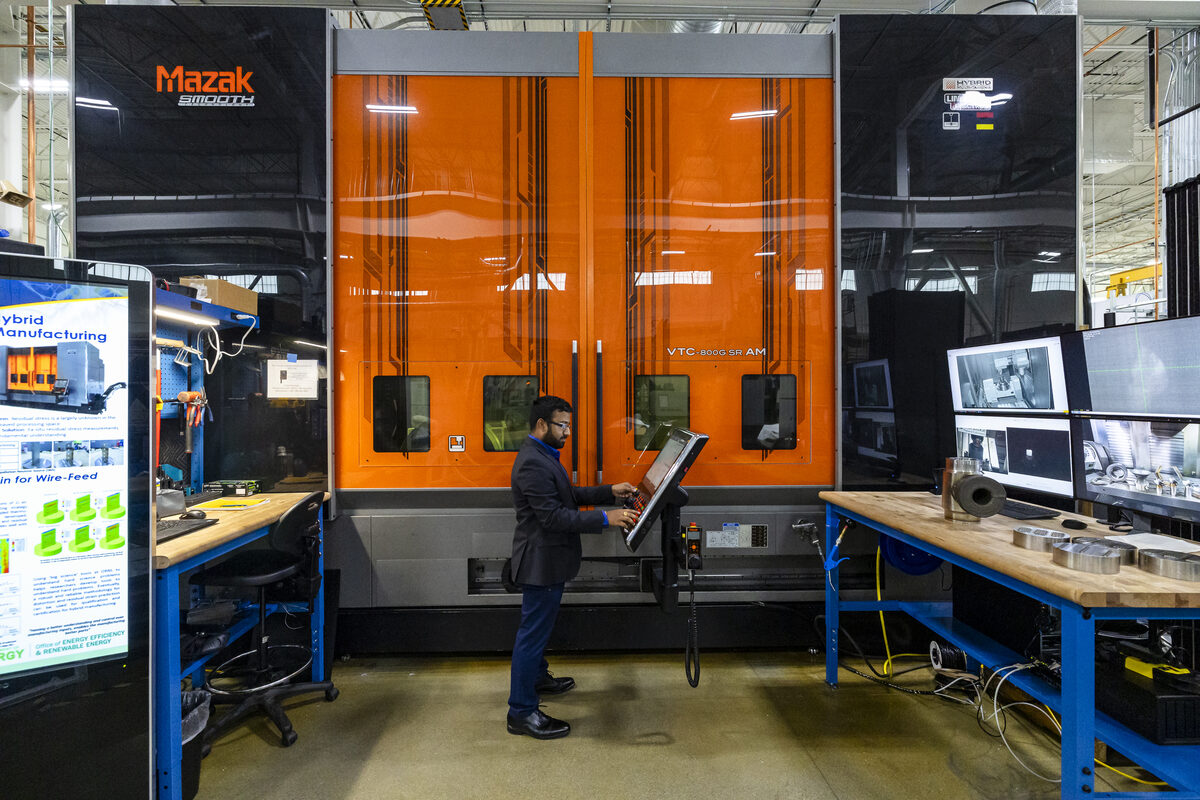
Oak Ridge National Laboratory and machine-tool builder Mazak have pulled the wraps off the VC-Ez WAAM platform, a hybrid manufacturing cell that welds metal parts up with a wire-arc printer and then machines them to final tolerance without ever leaving the same footprint. The system, developed jointly with Austrian welding-equipment maker Fronius, made its public debut this week at IMTS 2026 in Chicago — and it's one of the more concrete signs yet that additive and subtractive manufacturing are converging into a single production step rather than two separate ones.
For makers who've only ever printed polymer, wire-arc additive manufacturing (WAAM) is a different animal entirely. Instead of a nozzle laying down molten plastic filament, a robotic or gantry-mounted welding torch draws an electric arc to melt metal wire feedstock, depositing bead after bead to build up a near-net-shape part layer by layer. It's fast and cheap per kilogram of metal compared to powder-bed laser systems, but the tradeoff has always been surface finish — WAAM parts come off the machine looking like what they are: stacked weld beads, dimensionally rough and in need of substantial post-processing before they're usable.
What's Actually New Here
That post-processing step is exactly what ORNL and Mazak have folded into the same machine. The platform pairs Fronius's WAAM wire-arc deposition system with Mazak's VC Ez-20X, a five-axis vertical machining center, plus an automated palletized transfer system that shuttles parts between the additive and subtractive stages — so a part can be printed and then milled to spec in one automated cell instead of being craned between a welding bay and a separate CNC machine. According to VoxelMatters' reporting on the collaboration, the combined line is built to flex between high-mix, low-volume work and higher-volume production runs, with target applications spanning structural repairs, rapid tool production, and near-net-shape parts — the kind of large, dense metal components where WAAM's deposition speed pays off and integrated machining removes the traditional bottleneck of a second setup.
The VC Ez-20X itself is a fairly serious piece of hardware to be hosting a welding torch. Mazak lists 31.49 inches of X travel, 20.07 inches each on Y and Z, and a rapid traverse rate of 1,260 inches per minute — brisk enough to keep cycle times reasonable even with a deposition process bolted on. Workpiece capacity tops out at 27.55 inches in diameter by 23 inches tall, up to 880 pounds, which puts the platform in range of mid-size structural brackets, tooling inserts, and repair blanks rather than small precision components. Mazak also says the machine's footprint runs 26.5 percent smaller than comparable models in its class, a detail that matters more than it might seem for shops trying to fit a hybrid cell into existing floor space rather than building a new bay around it. Control runs through Mazak's MAZATROL SmoothEz5 interface, which should lower the learning curve for shops that already run other Mazak equipment but have never touched additive.
The platform is being shown live at IMTS 2026, running September 14 through 19 at McCormick Place in Chicago, where it's featured in AMT's Emerging Technology Center. Mazak President Dan Janka tied the debut to the companies' history together, saying the system "represents Mazak's longstanding relationship with Oak Ridge National Laboratory in terms of machining research and the advancement of hybrid additive manufacturing technology." That framing is telling: hybrid WAAM-plus-machining cells exist elsewhere in the industry, but a national lab partnering directly with an established five-axis machine builder to productize one, rather than keep it as a research rig, is a different kind of milestone.
What It Means for Makers
None of this is going into a hobbyist's garage, and it shouldn't be mistaken for that. The VC-Ez WAAM platform is aimed squarely at industrial and defense-adjacent manufacturing — repair depots that need to rebuild a worn turbine housing or landing-gear component without recasting it from scratch, tooling shops that want to print a die blank and finish it in the same cell, and production lines chasing near-net-shape parts to cut machining time and material waste on large metal components. If you're running an FDM or resin printer at your bench, this hardware isn't on your buy list.
But the trend it represents is worth tracking regardless of what's on your bench. WAAM has spent years as a niche process mostly confined to aerospace research labs and a handful of specialty shops, partly because pairing it with the CNC finishing every real part needs meant shuffling components between two separate, unintegrated machines — with all the fixturing, alignment, and handling risk that implies. A commercially available machine tool that treats deposition and machining as one continuous workflow, built by a company that already sells thousands of VMCs into ordinary job shops, is what actually starts pulling that capability down out of the research tier. The same logic that took desktop FDM from a hobbyist curiosity to a garage staple didn't happen because the underlying physics changed — it happened because someone packaged it into a machine an ordinary shop could buy, run, and trust. Watching whether Mazak's dealer network starts placing these systems with mid-size job shops over the next year or two is a better signal of real hybrid-manufacturing adoption than any lab demo.
Bottom Line
The VC-Ez WAAM platform doesn't change what's physically possible with wire-arc printing — the process itself isn't new, and neither is the idea of combining additive and subtractive steps. What changed at IMTS 2026 is packaging: a national lab and an established machine-tool manufacturer put a specific, spec'd, commercially framed product in front of the industry's largest manufacturing trade show, rather than a research paper or a one-off demo cell. For an industry that has talked about hybrid additive-subtractive manufacturing as the inevitable future for the better part of a decade, having an actual machine with actual travel specs on a show floor in Chicago is the difference between a roadmap slide and a purchase order.
