
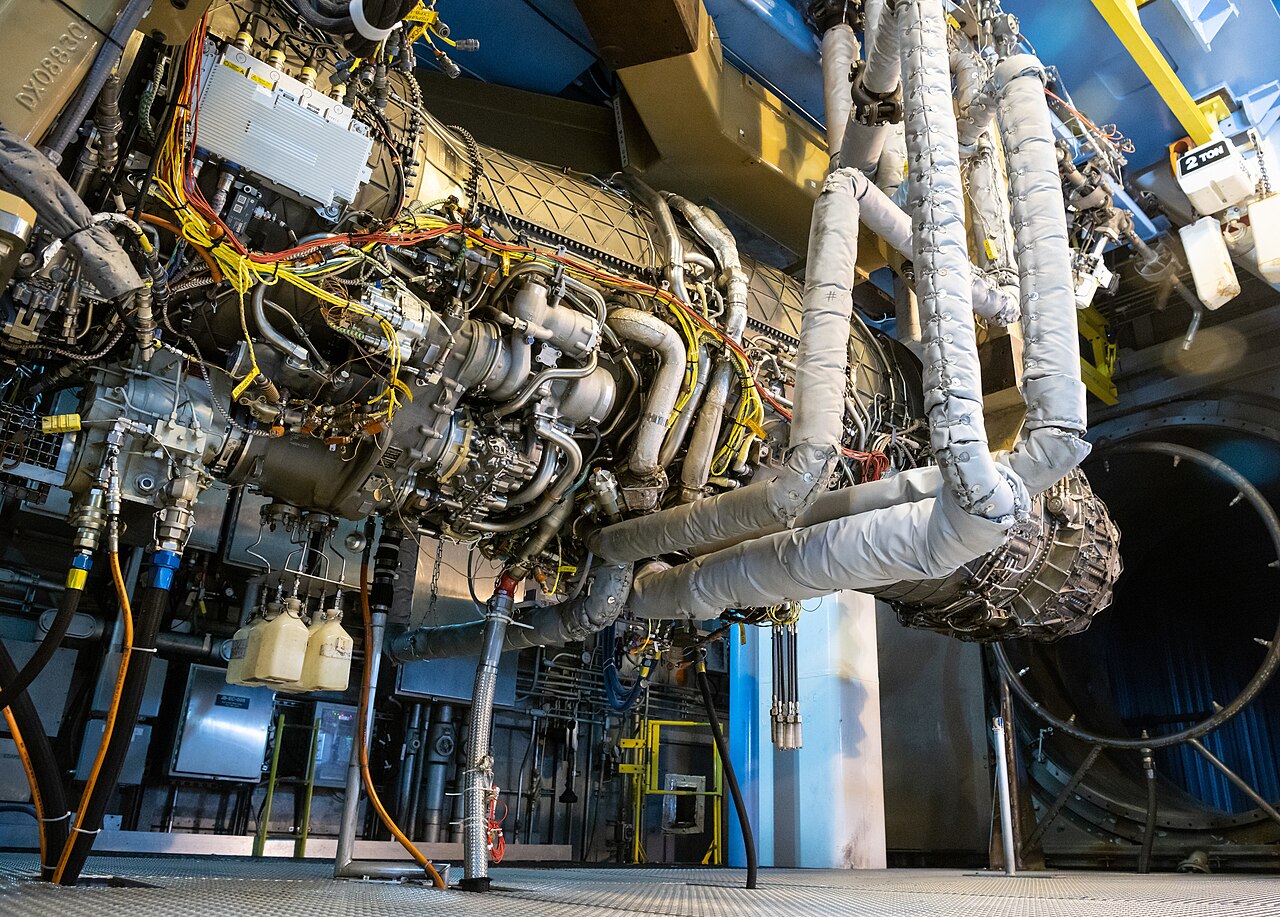
Farnborough is usually where aerospace primes announce orders. This year it was also where Pratt & Whitney announced two separate bets that the fastest way to get large titanium engine hardware is to stop forging it and start printing it. On July 22, Safran Aero Boosters and BMT Aerospace announced a joint development agreement with Pratt & Whitney to additively manufacture large-scale, complex components for the F135 — the engine that powers the F-35. Earlier in the same week, in the same halls, GKN Aerospace had signed a Technology Development Agreement with the same customer to print a full-scale F135 engine case. Same engine, same show, two different additive supply chains, both aimed squarely at parts the program cannot get fast enough.
Two deals, two countries, one bottleneck
The GKN agreement is the one that will make process nerds sit up. Development is being led from GKN Aerospace's facility in Kongsberg, Norway, using laser-directed energy deposition with wire — L-DED-w in the acronym-dense language of the trade. The stated goal is a full-scale component that maintains compatibility and interchangeability with the current engine design, meaning it has to drop into an existing engine rather than force a redesign around the manufacturing method. The first demonstrator component is expected in 2027, with the product certified by the end of 2028. The Norwegian Defence Materiel Agency is backing the work, and TCT Magazine notes it is thought to be among the first printed structures at this scale in a military engine application.
"This initiative reflects our ambition to further develop and industrialize additive technologies for demanding aerospace applications," said Sébastien Aknouche, Senior Vice President at GKN Aerospace — boilerplate until you notice the word "industrialize." The pitch, as VoxelMatters summarizes it, is supply chain resilience, reduced lead times, lower material usage, and higher efficiency. Note the ordering. Weight is not in the list. Pratt & Whitney's F135 program vice president, Chris Johnson, framed it as continued focus on "advancing technologies that support the long-term needs of the F135 program."
The Belgian deal comes at the same problem from a different direction. Safran Aero Boosters, based in Wallonia, and BMT Aerospace, based in Flanders, signed on with Pratt & Whitney to additively manufacture physically large, highly complex F135 components using titanium-focused additive technologies, explicitly targeting the supply chain constraints affecting the program's highest-priority components. The signing drew Belgian Minister of Defence Theo Francken and Wallonia Minister-President Adrien Dolimont, which tells you the framing on the European side: this is Belgium positioning itself as a supplier of advanced manufacturing to US aerospace primes under the F-35 program, not merely a workshop taking a subcontract.
François Lepot, CEO of Safran Aero Boosters, put it more bluntly than the press release around it: "First large scale proof of concept is ready!" That is a hardware statement rather than a roadmap statement — the sort of thing that separates a development agreement from a memorandum of understanding.
Why wire, and why now
Directed energy deposition sits at the opposite end of the metal-AM spectrum from powder bed fusion. Instead of spreading a thin layer of powder across a build plate and melting it with a laser, DED feeds material — powder or wire — into a melt pool at the point of deposition, usually on a multi-axis motion system. Powder bed fusion wins on resolution and internal complexity; DED wins on build volume, deposition rate, and the ability to add material to an existing part.
For an engine case, that tradeoff is not close. A powder bed machine large enough to swallow a meter-class casing is exotic, slow, and expensive to feed. A wire-fed DED cell is essentially a laser and a wire feeder on a robot or gantry, and it scales with the reach of the motion system rather than a sealed powder chamber. Wire also sidesteps the handling and contamination problems of reactive titanium powder, and converts far more of the purchased material into deposited part — the "lower material usage" line in GKN's benefits list, and for titanium a real number rather than a marketing one.
The catch is that DED deposits a lot of energy into a growing part, and near-net-shape means near, not net. Distortion management, interpass thermal control, post-deposition heat treatment, machining of every critical surface, and a qualification campaign that proves consistent microstructure across a meter-scale weldment are all still required. That is why the GKN timeline runs demonstrator in 2027 and certification at the end of 2028, rather than demonstrator and shipping in the same year.
What It Means for Makers
If you have watched or run a wire-arc additive setup — a MIG torch on a printer gantry, any of the garage WAAM experiments — you are looking at the same process family being pushed to certification on a military engine structure. The energy source differs; GKN is using a laser rather than an arc, which buys tighter heat input control and better process stability. The fundamentals do not. Melt pool, wire feed, bead geometry, layer-to-layer thermal history, and the fact that the part fights you as it grows are the same problems at both scales.
The failure modes you have already met at bench scale are the ones the primes are spending 2026 through 2028 engineering out: warp, inconsistent bead width, lack of fusion between passes, anisotropic properties along the build direction. Nothing about a defense budget makes those go away; it funds the instrumentation, closed-loop control, and destructive testing needed to bound them. Process knowledge from the hobbyist end of wire-fed deposition is not a dead end; the industrial version is more of the same discipline.
The other lesson is why additive is being adopted here at all. The consumer-facing story about metal AM has long been geometry: lattices, topology-optimized brackets, internal channels no mill could reach. Neither of these agreements is about geometry. GKN's case has to stay compatible and interchangeable with the existing design, which forecloses clever shapes almost by definition. The Belgian agreement names supply-chain-constrained, highest-priority parts as the target. Both are lead-time plays: when a forging has a long queue and a single qualified supplier, a process that turns wire and a robot into a near-net part is valuable even if the finished part is heavier, rougher, and costlier per unit.
That is a useful correction for your own projects. The question that justifies additive is rarely "can I make this lighter." More often it is "how long would I wait, and from whom, if I did not print it." Pratt & Whitney just answered that question twice in one week at the same air show, through two different European supply chains, for the same engine.
Sources
- Safran Aero Boosters and BMT Aerospace signed up to additively manufacture large scale critical components for Pratt & Whitney's F135 engine — Safran
- Pratt & Whitney and GKN Aerospace to 3D print large-scale F135 engine case — TCT Magazine
- GKN Aerospace and Pratt & Whitney expand additive manufacturing work to F135 engine — VoxelMatters
