
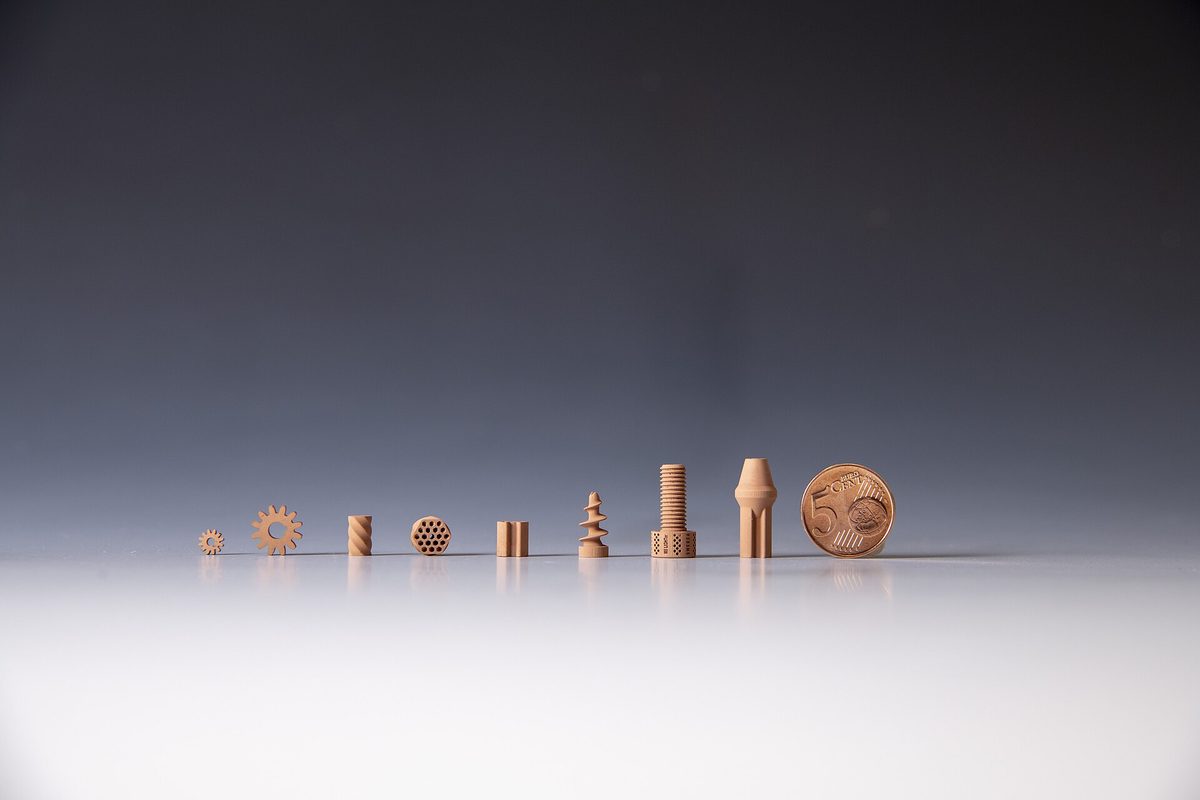
Prodways Printers is launching the CERAM PRO 365 Max at Formnext. The machine is a higher-power version of the company's existing ceramic printer, and on paper the change is a single number: light intensity. According to the product announcement on Prodways' own site, the Max delivers "up to 200 mW/cm²" at 365 nm on top of the company's proprietary MOVINGLight DLP technology. Prodways describes it as a new high-power configuration aimed at advanced ceramic material research, process development and demanding formulations, including darker, highly absorbing and higher-viscosity materials.
Most ceramic printer launches lead with a bigger build volume, a faster throughput claim or a new material. This one is about how much light reaches the vat, which says a lot about who Prodways expects to buy it.
The Numbers, Side by Side
VoxelMatters' launch report fills in the comparison Prodways' announcement leaves out. The standard CERAM PRO 365 delivers 130 mW/cm². The Max delivers up to 200 mW/cm² across its 264 x 328 mm build area, an increase of roughly 54%. Both machines work at 365 nm, in the UV-A band, which is shorter than the 385 and 405 nm sources common in desktop resin printers.
Apart from irradiance, the platform appears unchanged from what the standard machine is known for:
- Light source: MOVINGLight DLP projector, 365 nm UV
- Peak irradiance: up to 200 mW/cm² (vs. 130 mW/cm² on the standard CERAM PRO 365)
- Native pixel resolution: 31 µm
- Build platform: modular, up to 264 x 328 mm
- Maximum build height: 350 mm
- R&D kits: run on less than 1 L of ceramic slurry
VoxelMatters says the 200 mW/cm² figure applies across the 264 x 328 mm area, and that detail matters. Getting high intensity onto a small spot is easy. Getting it uniformly onto a platform that size is much harder, and that is where MOVINGLight comes in.
Why a Moving Projector
A conventional DLP printer has a fixed trade-off. One projector lights the whole build area at once, so if you spread the image over a larger platform, each pixel gets bigger and each square centimeter gets less light. A small field gives you fine detail, and a large field gives you capacity at the cost of resolution.
MOVINGLight, as VoxelMatters describes it, gets around this by moving the DLP projector across the build area instead of holding it still. Fine resolution then does not depend on a small platform, which VoxelMatters calls a common limit of fixed-projector systems. The Max is Prodways applying the same approach to the other variable in that equation, which is how much optical power reaches the slurry.
Why Ceramics Want More Light
Photopolymer ceramic printing doesn't cure a clear resin. It cures a slurry: ceramic powder suspended in a photosensitive binder. Every exposure has to push enough UV energy through that loaded mixture to solidify a layer, and the powder works against it. Prodways' own wording, darker, "highly absorbing" and higher-viscosity formulations, names the problem directly. The more of the incoming light a formulation absorbs, the harder it is to deliver enough curing energy in a reasonable exposure time.
More irradiance gives process engineers more room to work with. VoxelMatters says the extra power widens the processing window for slurries that need higher exposure energy. A slurry that is marginal at 130 mW/cm² may become workable at 200. That could open formulations a research group couldn't run on the standard machine, whether those are different ceramic chemistries, different powder loadings or binder systems tuned for something other than easy curing. Prodways stops short of specific performance claims, such as which materials the Max can print that the standard model cannot, or how exposure times change in practice. Those are the numbers a prospective buyer would want to see from Formnext demos and early users.
A Research Instrument, Not a Production Line
The positioning is consistent across both sources. Prodways' site uses the language of material research and process development, and VoxelMatters adds material qualification. VoxelMatters also notes that the R&D kits need less than a liter of ceramic slurry, and in a lab that is a meaningful spec.
Experimental ceramic slurries are expensive and often mixed in small batches. A machine that needs a large vat filled before it can print one test coupon makes every formulation trial costly. A sub-liter kit lets a materials lab test a new mix without committing a large batch to it. That fits the Max's purpose: it is a tool for figuring out whether a material can be printed and how, before anyone scales that process up. VoxelMatters says the same machine can then move to larger builds once a formulation is qualified, though it also says the standard version remains the choice for established formulations and production work.
Prodways has an installed base to draw on. VoxelMatters reports that the company's ceramic printer business has installed more than 200 machines worldwide, and that the parent Prodways Group is listed on Euronext Paris. A high-power variant sold into that base is a logical extension. Labs already working on the CERAM PRO 365 platform get a way to push further without moving to a different architecture.
What It Means for Makers
Let's be clear: nobody reading FilamentFeed is putting a CERAM PRO 365 Max on a garage bench. Prodways hasn't published pricing in either source, and the machine is built for industrial and institutional R&D. Even so, there are a few reasons it's worth paying attention to.
It shows where vat photopolymerization is heading. Hobbyist resin printers compete on screen resolution and build volume. At the industrial ceramic end, the competition is increasingly about how much light reaches the material and how evenly. Specs like irradiance tend to show up in industrial machines before they become selling points further down the market.
It explains a familiar problem. Anyone who has struggled with heavily pigmented, filled or opaque resins on a consumer printer has run into the same physics on a smaller scale: material that absorbs or blocks light is hard to cure through. Prodways is addressing that problem with optical power and a moving projector, not by reformulating the resin.
Materials work is where printed ceramics improve. If high-irradiance R&D machines help labs qualify ceramic formulations that couldn't be printed before, those materials could eventually reach service bureaus and the parts that makers order from them.
Formnext is the first chance to see how the Max performs in practice. The key thing to look for from Prodways is real slurry data: which formulations the extra 70 mW/cm² actually makes printable, and how much it shortens exposure on the ones that already work.
