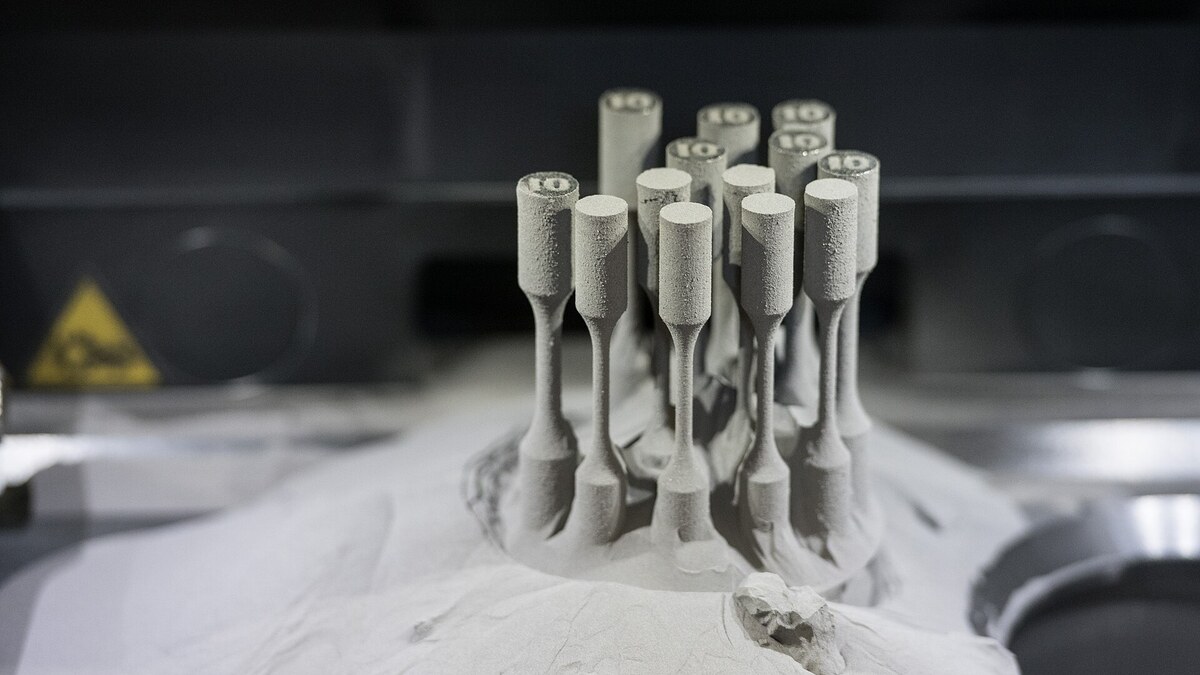
Support structures are the tax every laser powder bed fusion user pays. They anchor overhangs, pull heat away from fragile geometry and keep parts from curling off the plate, and then they have to be cut, ground and blasted away, often by hand. Renishaw's answer, according to 3D Printing Industry's report on the new support reduction package, does not involve a new machine at all. It is a software license. Built on the company's LIBERTAS technology and delivered inside its QuantAM build preparation software, the package targets the RenAM 500 series and works by changing laser energy dynamically according to the geometry being printed, allowing more extreme downskin angles than conventional parameter sets tolerate.
Renishaw will show the package at Formnext in Frankfurt, November 17 to 19, in Hall 11 at Stand C11. LIBERTAS itself is not brand new: 3D Printing Industry notes it was first introduced in August 2026 as an upgrade to QuantAM, and Renishaw publicized it in a press release timed to IMTS 2026. What is new is a package aimed squarely at one of the most expensive parts of the metal AM workflow.
The Problem LIBERTAS Is Aimed At
Renishaw's press release frames the issue plainly: poor downskin finish and the need for supports. Downskin surfaces are the ones that face down toward the build plate, the undersides of overhangs and shallow angles where freshly melted metal sits on loose powder rather than on solid material below. Anyone who has looked closely at a metal part's underside knows the result: rougher texture, dross and a surface that looks nothing like the upskin side of the same part.
The usual fix is supports, and supports bring their own costs. As 3D Printing Industry explains, they manage thermal conditions and keep the part stable while it prints, but they also consume extra material and lengthen build times. Once printing is complete, the marks they leave, known as support witnesses, need further finishing. On intricate parts, the support strategy can dictate how a part is oriented on the plate, how many parts fit in a build and how much finishing work lands on a technician afterward.
Renishaw's press release sets LIBERTAS against conventional workflows, saying that, unlike them, it dynamically adjusts scan parameters across the part geometries. The aim is to let engineers print complex components with smoother downskin surfaces.
How It Works, at the Level Renishaw Has Described
According to the Renishaw press release, LIBERTAS dynamically adjusts scan parameters across part geometries and gives users greater control of laser parameters and scan paths. 3D Printing Industry describes the support reduction package as changing laser energy based on geometry, and says Renishaw credits the resulting improved thermal management with maintaining stability and limiting distortion even with fewer supports in place. Put together, the idea is that the software reads the part and modulates how much energy goes into each area, rather than applying one recipe to a whole category of surface.
The practical payoff, as described in both sources, is twofold. First, by tailoring energy to the local geometry, the system allows more extreme downskin angles to be printed, which reduces the number of supports a part needs and, per the press release, can greatly reduce or eliminate them. Second, Renishaw says the approach improves the finish of unsupported downskin surfaces, the problem the press release identifies at the outset.
Renishaw has not, in the material available here, published a detailed breakdown of exact angle limits, alloys or quantified surface roughness figures, so claims about specific numbers should wait for the company's own data or independent testing. The Formnext showing should be the first chance for many engineers to see sample parts up close.
One example application appears in the coverage: removable partial dentures, shown in an image of parts made on a Renishaw AM machine with LIBERTAS technology. The sources do not give support-reduction figures for dental work, but it is easy to see why a part type with a lot of support removal labor makes a natural showcase.
A License, Not a Machine
The commercial model may matter as much as the technology. The package is integrated into QuantAM and licensed per QuantAM seat, according to 3D Printing Industry, and build files prepared with it can be used across multiple machines. No new hardware is required, and owners can add the capability to RenAM 500 machines they already run.
That structure has a few consequences. Shops that already operate RenAM 500 series systems can adopt the capability without a hardware purchase. Because the license is tied to the build preparation seat rather than to individual printers, a single engineer preparing jobs can feed several machines with the same files. And it places the improvement where Renishaw evidently believes the leverage is: in the toolpath and parameter strategy rather than in new equipment.
3D Printing Industry's report also quotes Benjamin Diaz, Renishaw's Principal Software Product Manager, who calls LIBERTAS "an enabler, bringing metal AM's benefits to a greater range of volume production applications." The broader message from Renishaw's press release is economic rather than purely technical: by reducing the need for traditional supports, the software helps manufacturers increase output while reducing cost per part. Fewer supports mean less material spent on structures that are thrown away, shorter post-processing and, potentially, more freedom in how parts are laid out on a plate.
What It Means for Makers
Very few readers have a RenAM 500 in the garage, and this is not a product most hobbyists will touch directly. But the direction it represents is worth watching closely, because it is the same direction the desktop world has been moving for years: getting better parts from existing hardware through smarter slicing.
Filament printer users already know the pattern. Features like variable layer heights, per-feature speed and cooling control and overhang-aware flow adjustments have steadily expanded what a given printer can do without changes to the machine. LIBERTAS applies similar logic to a metal laser system: treat the process parameters as something that should change with geometry, rather than a handful of fixed presets.
For makers who send designs out to metal service bureaus, the near-term implications are more speculative. If support reduction of this kind becomes widely deployed, design rules around minimum self-supporting angles may loosen, finishing costs on quotes may fall and geometries that were once marginal for metal powder bed fusion may become practical. Those benefits depend on adoption and on results holding up across real production parts, which is exactly what buyers will be examining at Formnext.
Bottom Line
Renishaw is betting that the cheapest support structure is the one software lets you skip. The LIBERTAS-based package for the RenAM 500 series adjusts laser energy by geometry to push downskin angles further and improve downskin finish, it ships as a per-seat QuantAM license rather than new hardware, and its build files travel across machines. The open questions are quantitative: how far the angles go, on which materials, and with what surface quality. Expect those answers to start emerging when the parts go on display in Frankfurt next week.