
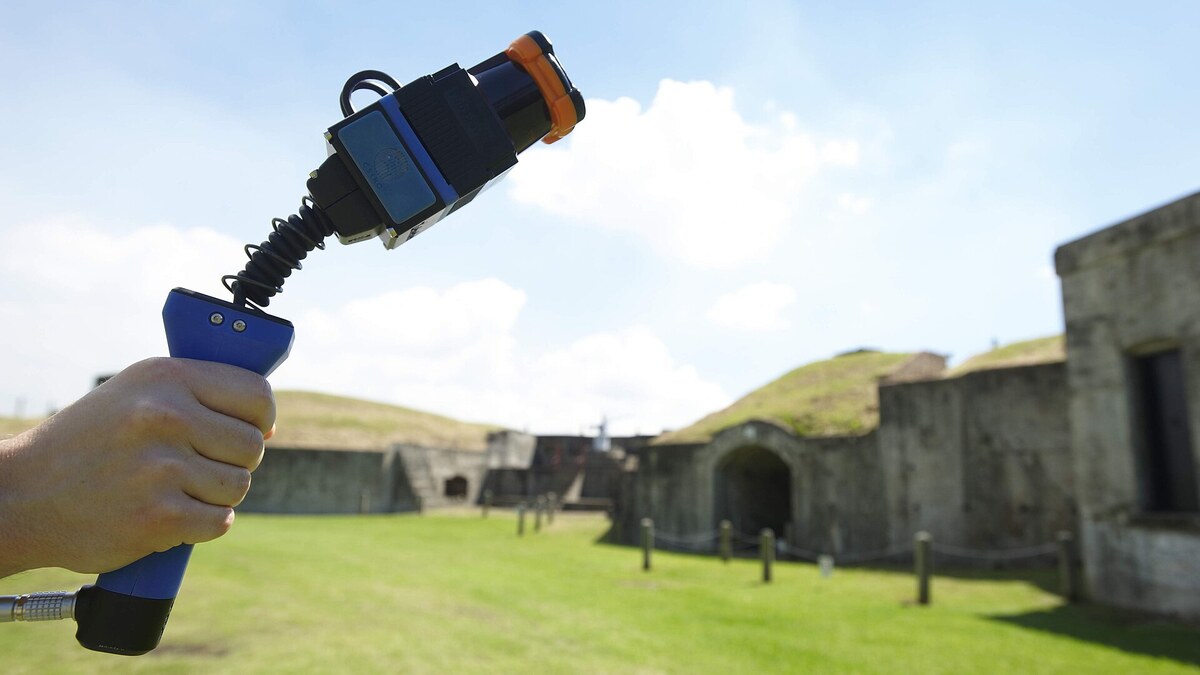
Revopoint has put its second-generation all-in-one scanner up for crowdfunding. The company announced the MIRACO 2 on Kickstarter with Super Early Bird pricing from $1,425. The handheld unit weighs 960 g and carries its own processor, screen and battery, so it can capture a part without a laptop attached. The headline feature isn't in the optics, though. Revopoint is shipping a software layer called Revo Agents that takes natural-language instructions and runs scan-to-CAD and tolerance-inspection jobs. For makers who scan worn or discontinued parts so they can model and reprint them, that last step is where most of the hours go.
This explainer covers what the hardware does, how the modes split across different jobs, and what the agent layer actually claims to handle.
The Hardware: A Scanner That Is Also the Computer
The MIRACO line's pitch has always been self-containment, and the second generation keeps it. Revopoint lists an 8-core CPU and a 6-core NPU inside the body, driving a 6-inch 2K AMOLED touchscreen. Storage and memory come in two tiers, 16 GB/256 GB or 32 GB/512 GB, according to 3D Printing Industry. A 10,000 mAh battery is rated for about three hours of use and supports 65W fast charging.
The scanner works in three ways: fully standalone, over Wi-Fi 6, or tethered over USB-C 3.0. The difference is more than convenience. Several of the scanner's most demanding capabilities depend on a PC. Revopoint says the multi-line laser modes reach up to 120 frames per second only when the scanner is connected to a GPU-powered computer, and markerless tracking of textured objects in the laser-line modes also belongs to PC mode. Standalone operation is the grab-and-go option. The tethered mode is where you get the full throughput.
For color, the MIRACO 2 carries two RGB cameras: a 2 MP unit for near work and a 50 MP unit for far work. In PC mode it can also export 1:1-scale 3D Gaussian Splatting files in .splat format. That isn't something you'd send to a slicer, but it's a useful photoreal capture format for documentation and visualization.
Six Modes, Sorted by Job
Revopoint has packed six distinct scanning modes into the unit. They're easiest to understand grouped by what you would point each one at.
Precision mechanical parts
The 34-line blue cross laser and the 15-line parallel laser are the metrology-oriented modes. Revopoint quotes single-frame accuracy up to 0.02 mm in multi-line laser mode. That figure matters most for brackets, housings and mating parts you plan to reverse engineer and reprint to fit. Note that it is a single-frame number. Accuracy across a whole stitched scan of a large part is a separate question, and the published figures don't answer it.
Holes and recesses
A single-line deep-hole laser mode targets deep-hole capture, a job that broad-pattern scanners handle poorly. Anyone who has tried to capture the inside of a fastener boss knows the problem: the geometry you most need for a functional reprint is often what the scanner sees worst.
Surfaces, speed and big objects
Full-field HD, VCSEL rapid and hybrid HD cover the rest. Hybrid HD is rated at up to 10 million points per second. The VCSEL mode has a working distance of 300 to 1,000 mm, which is a longer reach than the close-range laser modes. Revopoint quotes a minimum scan volume of 10 x 10 x 10 mm. With an optional photogrammetric metrology kit, the maximum extends to 5 x 5 x 5 m. The company also rates the unit for ambient light up to 100,000 lux, so outdoor or brightly lit shop scanning is within spec.
Revo Agents: What the AI Layer Claims to Do
Any maker who has done scan-to-CAD knows a raw mesh is not a model. You clean the scan, align it to a coordinate system, segment it into planes, cylinders and freeform regions, and then rebuild those features as editable geometry. Inspection is similar: you compare the scan against a reference and report deviations against tolerances. Both jobs take time and skill, and they usually happen in specialist software.
Revo Agents is Revopoint's attempt to put a natural-language front end on those steps. According to 3D Printing Industry, you describe the job in plain language and the agents carry out scan-to-CAD conversion or tolerance inspection. The published material doesn't detail which CAD features it reconstructs, how editable the output is, or how it handles ambiguous geometry. Those are the questions that decide whether this saves an afternoon or just moves the cleanup somewhere else.
Revopoint has been specific about privacy. The agents run in a local sandbox with access limited to an authorized software directory, scan data is not uploaded, and any action requires explicit user authorization. One caveat: with user consent, conversational instructions are sent to regional cloud servers, though an offline mode is available. For makers who scan customer parts, prototypes or anything under an NDA, keeping scan data local is a real advantage over a cloud-first design.
What It Means for Makers
The MIRACO 2 is aimed at a specific maker profile: someone who scans parts so they can redesign and reprint them, and who would rather not keep a laptop tethered while doing it. If that's you, three things are worth weighing.
First, separate the two use modes. Standalone operation is the reason to buy an all-in-one, but the fastest laser frame rates and markerless tracking of textured objects need a GPU-equipped PC. If you will mostly scan at the bench next to a workstation anyway, part of what you're paying for in the onboard compute goes unused.
Second, match the modes to your parts. The deep-hole laser and the 0.02 mm single-frame multi-line accuracy are the features that matter for functional mechanical reprints. The VCSEL and hybrid modes, the 50 MP camera and Gaussian Splatting export look better suited to larger objects and visual capture. Few makers will use all six modes heavily, so price the unit against the two or three you actually need.
Third, treat Revo Agents as promising but unproven. Natural-language scan-to-CAD goes straight at the most tedious stage of the reverse-engineering workflow, and the local-sandbox, authorize-every-action design is the right default. But the value depends on output quality, and the launch material doesn't show it. Until independent users publish results on real parts, budget your time as though you will still be doing some CAD reconstruction by hand.
The usual crowdfunding caveat applies. A Kickstarter Super Early Bird price is a pledge, not a retail purchase. Delivery timing and final software capability are not guaranteed by the campaign announcement.
Bottom Line
On paper, the MIRACO 2 is a capable standalone scanner with a mode for nearly every kind of part, from small mechanical components to room-scale objects with the metrology kit. What sets it apart from a crowded field is the claim that you can ask it, in plain language, to turn a scan into CAD or check it against tolerances, and that scan data stays local. If Revo Agents delivers clean, editable geometry, the $1,425 entry price buys back real hours for reverse-engineering makers. If it doesn't, you're left with a well-specified scanner and the familiar job of rebuilding the model yourself.
