
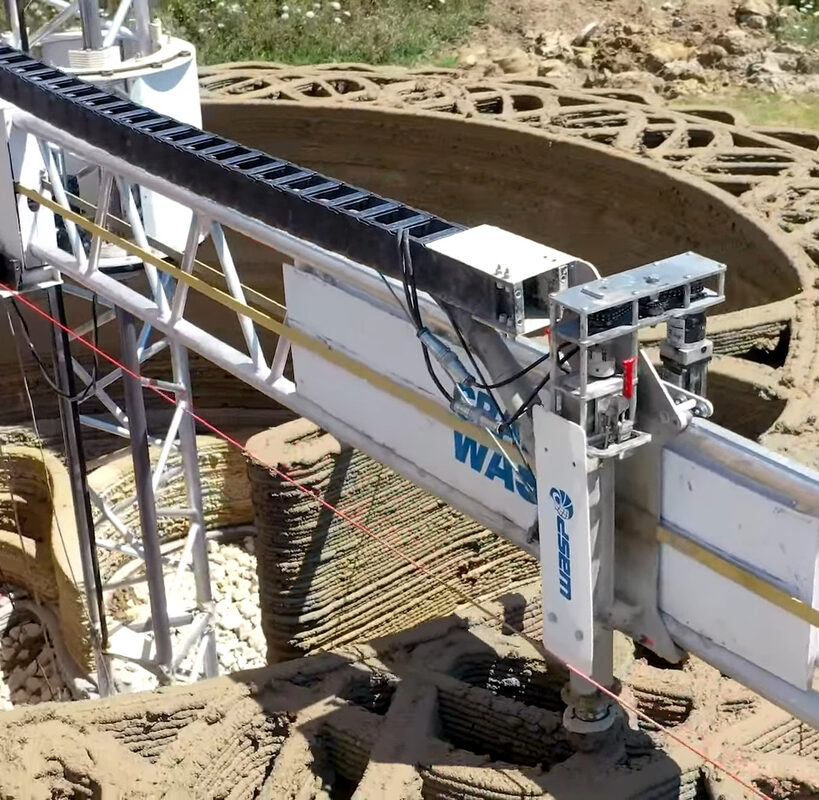
A concrete-printing robot has just done something that matters more than another glossy demo reel: it helped build a house that a real family plans to live in, on a permitted lot, in a real American city. According to 3DPrint.com, Denver-based RIC Robotics and Sacramento builder K4k Construction have completed Sacramento's first permitted 3D-printed building — a 1,200-square-foot accessory dwelling unit (ADU) whose entire wall system was printed in 12 days. For a field that has spent the better part of a decade producing photogenic prototypes and one-off show homes, a permitted, occupiable structure is a meaningfully harder bar to clear.
The distinction between "printed a building" and "printed a permitted building" is the whole story here. Anyone with a gantry, a pump, and a printable mortar can extrude walls in a field for a press release. Getting a local building department to sign off — to accept the wall system as code-compliant, inspectable, and safe for human occupancy — is where most additive-construction projects quietly stall. That is the threshold Sacramento's ADU crossed.
What Actually Got Printed
The 12-day figure refers specifically to the wall system, not the finished home. That is an important piece of literacy for makers who follow this space: concrete printing handles the vertical envelope — the load-bearing and partition walls extruded layer by layer — but the roof, floor, windows, doors, plumbing, electrical, and interior finish still come from conventional trades. The printer replaces the framing-and-masonry portion of the schedule, not the entire build. Twelve days of printing produces a structure that human crews then finish out.
Even bounded that way, the number is striking. Wall assembly is one of the slower, more labor-intensive phases of small residential construction, and compressing it to under two weeks of largely autonomous work is exactly the kind of schedule compression the technology has long promised. An ADU is also a smart proving ground: small enough to keep risk contained, but a genuine permitted dwelling subject to the same inspections as any other habitable structure.
A Builder Who Bet on His Own Family
What separates this project from a vendor pilot is who commissioned it. K4k co-founder and CEO David Gonzalez didn't build the ADU as a demonstrator — his firm built it for family, as a home for the parents of Estelle Gonzalez, David's wife and a K4k engineer. "When we decided to build this home, it wasn't simply about trying a new construction method," Gonzalez said, "it was about proving that innovative technology can deliver high-quality, code-compliant housing while helping address some of the biggest challenges facing our industry."
That detail carries more weight than a typical customer testimonial. A builder putting his own family's roof — literally — on a printed wall system is making a bet with real stakes on durability, inspection, and livability. It is the difference between believing a technology works and being willing to have relatives sleep inside the result.
RIC Robotics founder Ziyou Xu made the broader claim explicit: "This project demonstrates that autonomous construction has moved beyond experimentation into real-world residential development." Founders say things like that about their own products, so treat it as positioning — but in this case the permitted status and the owner-occupants give the claim more grounding than usual.
The Fleet Behind the Headline
The Sacramento ADU isn't RIC's first jobsite, and understanding the company's footprint helps calibrate how far along this actually is. Per its own materials, RIC Robotics builds large-scale 3D concrete-printing robots designed for commercial jobsites, and reports 30 machines deployed across four continents — 12 of them in the United States — with more than 200 completed projects to date. The company headquarters are in Denver, Colorado.
RIC's performance claims are the standard efficiency pitch for the category: 50 to 80 percent labor savings, 33 percent faster delivery, and the ability to complete a 5,000-square-foot structure in roughly seven days. Those are vendor figures, not independently audited benchmarks, and the usual caveats apply — labor savings depend heavily on local wage structures, and "complete" in printing terms means the printed envelope, not a turnkey building. Still, a fleet of 30 machines and 200-plus completed projects is a materially different posture than a startup with a single prototype and a rendering. Whatever discount you apply to the marketing math, the deployment numbers suggest a company running production work, not a lab.
What It Means for Makers
For the maker and small-fabrication crowd, the Sacramento ADU is worth watching for a few concrete reasons — no pun intended.
First, permitting is the real frontier, and it just moved. The hard part of construction-scale additive manufacturing was never the extrusion; it was convincing a jurisdiction to treat a printed wall as a legal structural assembly. Every permitted project makes the next one easier, because building departments build precedent and inspectors accumulate familiarity. Sacramento is now on that list.
Second, ADUs are the wedge. Accessory dwelling units are small, increasingly encouraged by California housing policy, and forgiving enough to absorb a new construction method without betting a full subdivision on it. Expect the near-term growth of printed housing to concentrate in exactly this footprint — backyard units, granny flats, infill — rather than in large tract developments.
Third, keep your units of measurement honest. When a company advertises a house printed in days, the number almost always describes the wall system, as it does here. That is not a knock on the technology; it is the correct way to read the claim. The printer is compressing one phase of the schedule dramatically, and the rest of the build still runs on conventional trade timelines.
Bottom Line
Sacramento's first permitted 3D-printed building is a modest structure — a 1,200-square-foot backyard dwelling — but it clears the bar that actually counts. A local jurisdiction permitted it, a builder trusted it enough to house his own family in it, and the wall system went up in 12 days of largely autonomous printing. Against a fleet of 30 machines and 200-plus prior projects, it reads less like a stunt and more like the point where autonomous concrete printing starts showing up as a normal option on a real jobsite. The demos are over; the inspections have begun.
