
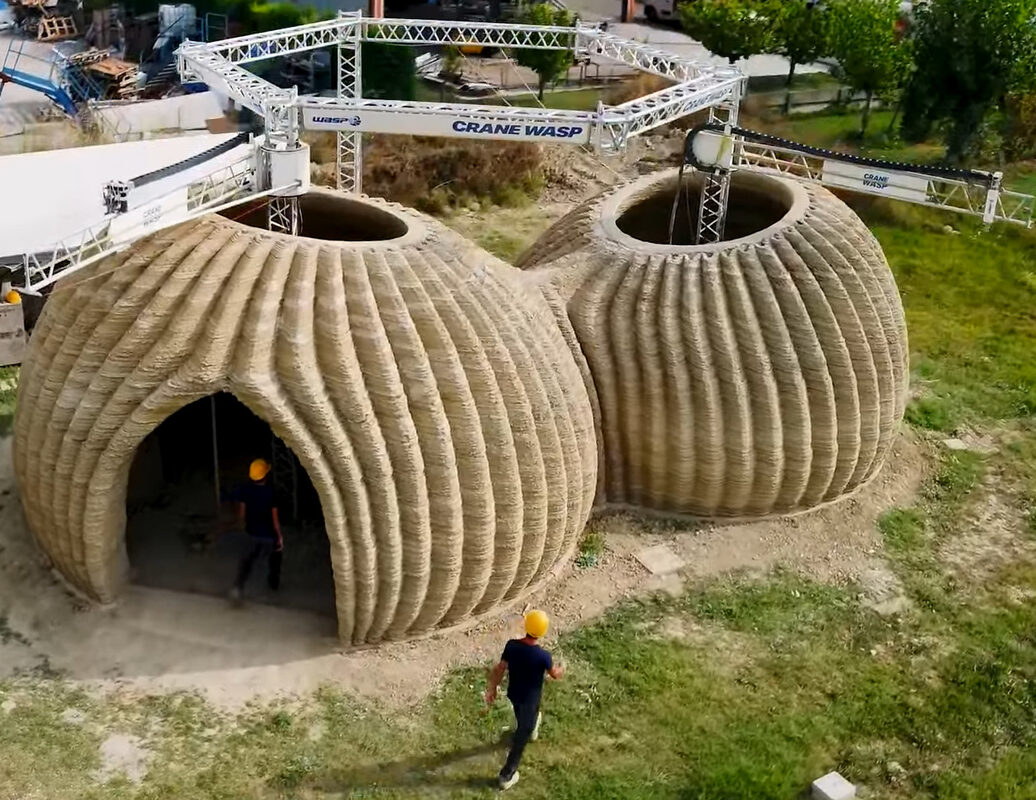
Students in Holstebro, Denmark, have started moving into concrete apartments that, six months ago, didn't exist as walls at all — just a nozzle path in a slicer. According to a press release from COBOD International, the Skovsporet development ("The Forest Trail") is now Europe's largest completed 3D-printed housing project, and its 36 student apartments have their first tenants in place.
The scale here is the headline. Skovsporet isn't a demo house or a single show unit for a trade fair — it's six separate buildings, six apartments each, totaling 1,654 square meters (about 17,800 square feet) of printed floor area. Each unit runs 40-50 square meters (3DPrint.com's on-the-ground reporting puts the range slightly wider, at 39-50 m²), which is modest but livable studio territory. The client is NordVestBO, a Danish nonprofit housing association, and the buildings sit near VIA University College — student housing built for students, not a speculative showcase aimed at press photographers. COBOD's release dates project completion to October 2025, with the first tenants moving in this year.
The Print: One Machine, One Crew, Six Buildings
Every wall in the project came off a single COBOD BOD3 gantry printer, operated by a three-person crew, extruding D.fab concrete formulated around Aalborg Portland's FUTURECEM — a lower-carbon cement blend that's been steadily displacing ordinary Portland cement in COBOD's Danish work. A second low-carbon mix, MEVOcem, went into a bicycle shed on the site and is credited with an 84 percent reduction in embodied CO2 compared to regular concrete, per 3DPrint.com's coverage of the project. The number worth sitting with is the learning curve. The first of the six buildings took the print crew several weeks to complete. The last one took five days — more than one finished apartment per day of printing, by COBOD's own accounting. That's not a marginal improvement; it's the kind of throughput curve that turns a novelty construction method into a repeatable production line. 3DCP Group CEO Mikkel Brich, quoted in the 3DPrint.com report, framed the six-cluster layout as intentional: "the technical breakthrough was not printing one successful structure — it was repeating the process across six clusters while improving speed, maintaining accuracy, and integrating the printed elements with conventional building systems."
COBOD founder Henrik Lund-Nielsen made a similar point in the company's own release, saying "the results at Skovsporet show how 3D construction printing can deliver large-scale projects faster and more efficiently than ever before" — a claim about the BOD3 platform, and by extension the gantry-printer approach COBOD builds its business on, moving past single custom homes into genuine multi-unit residential work. COBOD's own materials describe its printers as having gone up on "all six inhabited continents" doing 1- to 3-story residential, commercial and public buildings; Skovsporet is the first project at this scale the company has been able to point to as proof that the approach holds up across a repeated, multi-building build-out rather than just a one-off.
Design Constraints That Print Doesn't Erase
SAGA Space Architects, working alongside co-designer MS+, layered in requirements that had nothing to do with the printer and everything to do with the site: the development preserved 95 percent of the trees already standing on the plot, threading six buildings around a forest rather than clearing it. SAGA co-founder and lead architect Sebastian Aristotelis, quoted by 3DPrint.com, said the project "proves that 3D printing is no longer just an experiment" — a pointed remark, given how much of the industry's residential printing to date has consisted of exactly that: one-off demonstration houses that never scale into a second phase, let alone a sixth building.
Cost discipline mattered as much as the tree count. Denmark's subsidized-housing program comes with strict construction requirements, and both sources frame meeting them as the real test of the project. Mikkel Brich, quoted in COBOD's release, said Skovsporet "proved that 3D construction printing can meet the strict requirements of subsidized housing while delivering high precision and productivity," and 3DPrint.com reports the finished buildings meet local Danish construction guidelines and the targets set for subsidized local housing. That detail matters more to a construction-tech story than any print-speed number, because it's the one thing that determines whether a housing association ever commissions a second printed project. A fast, telegenic print that can't meet the program's requirements doesn't get a sequel. One that does, does.
What It Means for Makers
None of the equipment here belongs to the desktop or even prosumer FDM world most FilamentFeed readers work in, but the process arc should look familiar to anyone who's dialed in a large-format print. The five-day final building versus several-weeks first building is the exact shape of a calibration curve any maker recognizes: first-part failures and overcautious settings giving way to a tuned, repeatable process once the machine, material, and operators have run enough cycles together. COBOD's BOD3 is a gantry system, printing walls in place rather than depositing a part that gets moved — but the underlying lesson, that repetition across near-identical builds is what turns additive manufacturing from stunt to production, scales down to a print farm just as it scales up to a housing block.
The material story is also worth watching if you follow concrete or composite printing at any scale: FUTURECEM and MEVOcem are both attempts to cut the carbon cost of the binder itself rather than just optimizing print paths to use less material, and an 84 percent CO2 reduction on a real, occupied building is a stronger data point than any lab claim. It's a reminder that the binder chemistry underneath a print, not just the toolpath, is doing real sustainability work — a variable a maker optimizing filament formulations would recognize immediately.
For a construction-printing sector that has struggled to move past hero-project single houses, six buildings meeting a government housing program's requirements, with tenants already moving in, is the more useful benchmark than another architectural showpiece would have been. Whether Skovsporet opens the door to more projects at this scale will show up in whether NordVestBO, or another Danish housing association, commissions a second cluster somewhere else — a second order from a client who has already lived with the first one, rather than another single showcase print.
