
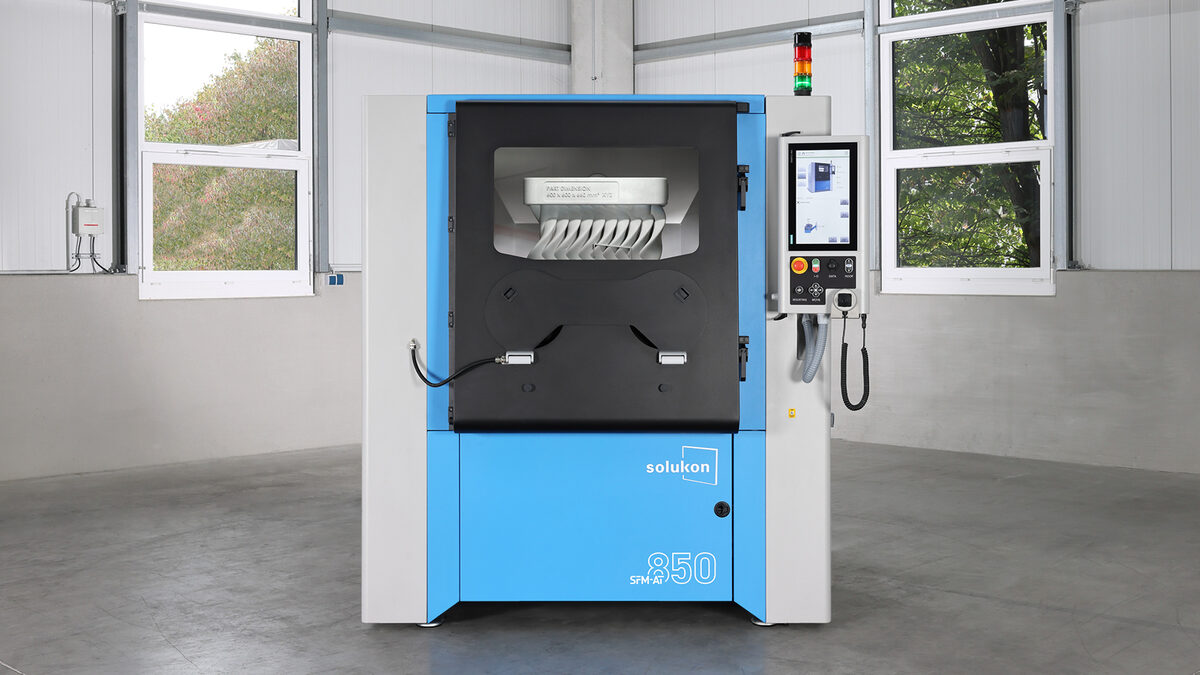
Printing a large metal part is only half the job. Once a laser powder bed fusion (LPBF) build finishes, the part is still full of loose powder, and that powder has to come out before anything else can happen. On October 15, post-processing specialist Solukon announced the SFM-AT850, a depowdering system rated for metal parts weighing up to 1,000 kg. It will replace two machines in the company's current lineup, the SFM-AT800-S and the SFM-AT1000-S, and will make its world premiere at Formnext 2026.
Alongside the base machine, Solukon is offering the SFM-AT850-E, which adds ultrasonic excitation. Orders open at the show, and Solukon expects deliveries by the end of the third quarter of 2027.
Bigger Load, Smaller Box
The SFM-AT850 has a build chamber of 650 x 650 x 800 mm. Solukon says the machine's overall footprint is smaller than that of the SFM-AT800-S it replaces, even though it handles heavier parts. That combination matters in a production cell, where floor space around large-format printers is limited and a post-processing station that is bigger than it needs to be is a real cost.
Solukon's release says load capacity has increased by 700 kg and 200 kg compared with the predecessor models. Trade coverage has not fully agreed on that point: VoxelMatters reported the increases as 700 kg and 100 kg. The manufacturer's own figures are the ones to rely on, and the 1,000 kg ceiling for the new machine is not in dispute.
Solukon is pitching the machine as a companion to the current generation of large-format metal printers. It names the EOS M 4 ONYX and the Nikon SLM Solutions NXG XII 600 as examples. For taller parts, an optional long swivel arm handles components up to 1,050 mm tall, such as those produced on the AMCM M 4K. Once the current batches are delivered, the SFM-AT800-S and SFM-AT1000-S will be phased out, so the AT850 takes over this size class in Solukon's lineup.
How the Powder Comes Out
The machine uses Solukon's SPR system (Smart Powder Recuperation). SPR combines programmable rotation on two axes with vibration, so a part can be tilted and shaken through a planned sequence that makes the powder flowable and lets it run out of even complex channels. On big parts with internal channels, this is not a simple shake-and-dump process.
Planning that sequence is the job of SPR-Pathfinder, Solukon's software that calculates a motion sequence from the part's CAD data. Solukon says users can run it as early as the design phase to check whether a geometry can be depowdered and to get an estimate of the depowdering time. VoxelMatters confirms that the AT850 is compatible with SPR-Pathfinder.
The system can be inertized with protective gas, which Solukon points to for reactive materials such as aluminum and titanium.
The ultrasonic variant
The SFM-AT850-E adds ultrasonic excitation. Solukon already uses it in the smaller SFM-AT350-E, and it is now available in the large-part class. According to the company, ultrasound is suited to highly intricate lattice structures such as those in medical parts, and to very long internal channels, the geometries where powder is hardest to shift. Solukon CEO and CTO Andreas Hartmann said in the release, also quoted by VoxelMatters, that ultrasonic depowdering has proven itself in recent years as a genuine alternative to pneumatic excitation, and that this gentle and noiseless method is now available for larger parts.
The Smaller Changes
Many of the updates focus on daily operation rather than headline specifications:
- More connections on the rotation plate. There are two extra compressed-air connections and two extra protective-gas connections. Solukon suggests one use is an additional blow-off system on the plate.
- Larger glove ports. They are positioned ergonomically at an ideal height and have been enlarged, which should make manual work inside the chamber easier.
- Stainless-clad door interior. According to Solukon, the cladding keeps powder from adhering to the inside of the door.
- User access levels and managed cleaning programs. Different user levels carry different access rights, and cleaning programs, both SPR-Pathfinder and custom-programmed ones, can be managed and assigned on the machine.
- Remote maintenance. This will be available on the SFM-AT850 for the first time, according to both the company and VoxelMatters.
None of these features is groundbreaking alone. Together, they suggest Solukon is designing for production environments where access control and repeatable cleaning routines matter as much as raw capacity.
What It Means for Makers
Few people reading this will buy a depowdering station that holds a 1,000 kg part. But the AT850 reveals where industrial metal additive manufacturing is putting its effort. Printers with large build volumes are only useful if the parts they produce can be cleaned reliably. A finished build that can't be depowdered isn't truly finished; it is just a heavy object full of loose powder. Solukon's launch, pitched alongside the latest large-format LPBF systems, shows that the post-processing stage now has to keep pace with the printers.
Two ideas here also apply on a smaller scale. First, the CAD-driven motion planning in SPR-Pathfinder treats powder removal as a design problem. Solukon itself describes Design for Depowdering as becoming a firmly established step in the process chain. Anyone designing parts for powder-bed processes, whether metal LPBF or polymer SLS sent to a service bureau, benefits from thinking about how loose powder will exit through internal channels. A geometry that cannot be cleaned is a geometry that cannot be fully printed. Second, Solukon's emphasis on ultrasonic excitation for lattices and long channels suggests that intricate lightweight designs are among the hardest to clean, so cleaning should be considered before you commit to a design.
Bottom Line
The SFM-AT850 combines two predecessors into one machine with a smaller footprint than the SFM-AT800-S, a 1,000 kg capacity, an optional ultrasonic variant, and a set of production-focused upgrades, including remote maintenance, a first for the AT850 in Solukon's range. Visitors to Formnext 2026 can see it at booth D58 in Hall 12.0, where orders will open. Buyers should expect a wait, though, since deliveries are planned by the end of Q3 2027.
