
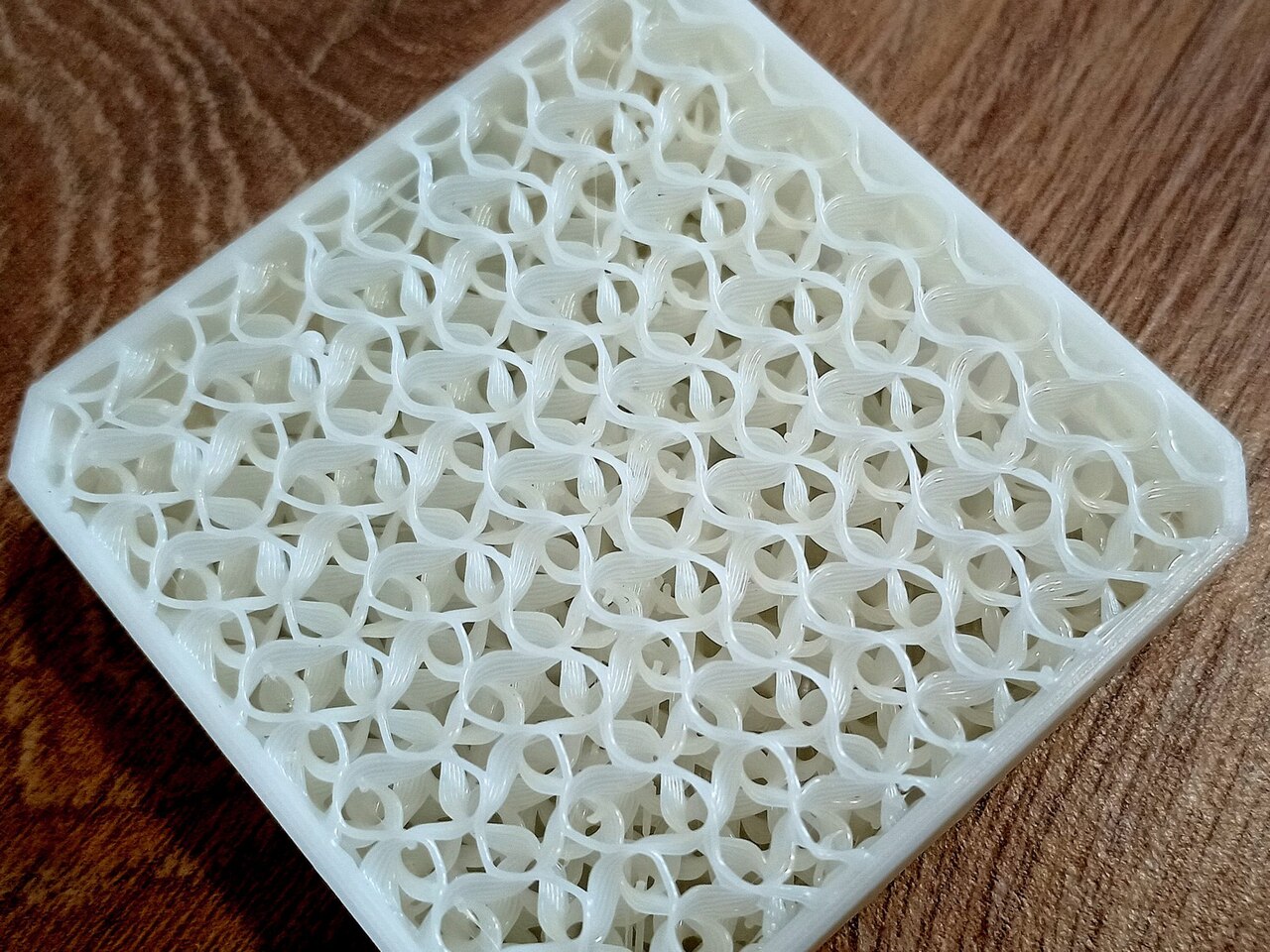
Anyone who has designed a gyroid-filled bracket knows the awkward part. The lattice looks right in the design tool, but checking whether it carries the load means exporting it to a separate finite-element package, meshing it again, and hoping nothing broke on the way. Swiss software company Spherene says it has removed that step. As 3D Printing Industry reported on October 8, 2026, sphereneNXT v2.0.0 adds linear static structural simulation directly to the company's platform for designing internal architectures, so engineers can test infill in the same environment where they generate it.
The release is a narrow one in scope, and that is mostly a good thing. It does not try to be a general-purpose FEA suite. It puts a structural check inside the loop where lattice and minimal-surface infill is designed, which is where that check is most useful.
What sphereneNXT Is
For readers who have not come across it, sphereneNXT is a browser-based engineering platform for what Spherene calls internal architectures: the structures that fill the inside of a part, as opposed to its outer shape. The company says the platform can also be reached from within a CAD workflow, so it does not have to be run as a standalone tool.
Its central technology is ADMS, short for Adaptive Density Minimal Surfaces, which Spherene describes as patented. The platform combines ADMS with more familiar structure types: triply periodic minimal surfaces (TPMS, the family that includes the gyroid most slicer users already know), beams, lattices, and conformal structures that follow a part's geometry. According to the company, designs can be optimized for strength, weight, thermal management, manufacturability and cost.
The difference between ADMS and a standard TPMS is in the first word. A conventional TPMS infill repeats one unit cell at one density across the whole volume. An adaptive-density approach changes the structure through the part, so material can be concentrated where it is needed and thinned out elsewhere. That flexibility is exactly why simulation matters: once density varies locally, intuition about how a part will behave becomes much less reliable.
What v2.0.0 Adds
The new feature is linear static analysis, the most common form of structural simulation. It assumes small deformations and materials that stay in their elastic range, and it answers the core questions: given these loads and supports, how far does the part move and where is the stress highest? According to 3D Printing Industry, sphereneNXT can now run that analysis both before and after infill is generated.
That before-and-after option is the most useful part of the release. Simulating the solid part first shows where the load paths and stress concentrations are, which is the information you need to decide where an adaptive infill should be dense. Simulating again after generation tests the structure that will actually be printed, not an idealized solid.
The analysis covers all three of the structure families the report names: ADMS, TPMS and beam structures. The setup details are what you would expect from a serious tool, not a demonstration:
- Load cases: one or more load cases are supported, and loads can be assigned to nodes, facets, surfaces, planes and edges. Real parts rarely see a single load, so being able to define several cases matters.
- Meshing: users can pick linear or quadratic tetrahedral elements, apply local mesh refinement, and run a mesh-quality check. Quadratic elements usually handle curved geometry and bending more accurately at a higher computational cost, which is a relevant trade-off for thin, curved minimal-surface walls.
- Solvers: both iterative and direct solvers are available. In general, direct solvers are robust but memory-hungry, while iterative solvers scale better on large models, so the choice lets users match the solver to the size of the mesh.
- Results: the software reports displacement and stress results, with point maps for inspecting values at specific locations.
The announcement also includes comments from Spherene CEO Claudio Nessi on the release.
Why Integration Matters
Infill structures are hard on traditional simulation workflows. A dense TPMS or lattice can contain huge numbers of thin walls or struts, and exporting that geometry as a mesh to a separate solver is slow, prone to errors, and painful to repeat. Each design change starts the export-mesh-solve cycle over again, which discourages the kind of iteration that adaptive structures are supposed to make possible.
Keeping simulation inside the design platform shortens that loop. Change the density distribution, rerun the analysis, compare the results. The mesh-quality check and local refinement controls also suggest that Spherene expects users to work on difficult geometry and wants the setup visible to them, not hidden.
The limits of the feature should be stated plainly. Linear static analysis does not model large deformations, buckling of slender struts, plasticity, fatigue, or the anisotropy and layer-adhesion weaknesses typical of FDM parts. The announcement, as reported, describes linear static capability and nothing beyond that. For a first check of stiffness and stress hotspots, that is often enough. For safety-critical parts, it is a starting point, not a sign-off.
What It Means for Makers
sphereneNXT is clearly aimed at engineering teams, not at people tuning infill percentages in a desktop slicer. Even so, the release points to a direction that will matter to advanced makers. Infill has long been treated as a print setting, chosen by eye and by habit. Tools like this treat it as structure: something designed against loads and checked with numbers.
If you are already designing functional parts with gyroid or lattice interiors, perhaps for drones, jigs, or lightweight brackets, the workflow here is the one worth adopting, whatever software you use. Simulate the solid to find the load paths, put material where the stress is, then check the result. The meshing and solver choices Spherene exposes are also a useful reminder that a simulation result is only as good as its setup: coarse meshes on thin walls can understate peak stresses.
There are open questions the report does not answer, including how the simulation accounts for the properties of a specific printing process and how large a model the browser-based solver can handle in practice. Those details will decide how far the feature reaches beyond early checks.
Bottom Line
sphereneNXT v2.0.0 brings linear static simulation into the same browser-based environment where Spherene's ADMS, TPMS and beam structures are designed, with configurable load cases, configurable tetrahedral meshing, a choice of solvers, and displacement and stress output. It does not replace a full FEA package for demanding validation work. It does remove the export step that has made testing complex infill tedious, and that makes iterating on internal structure realistic.
