
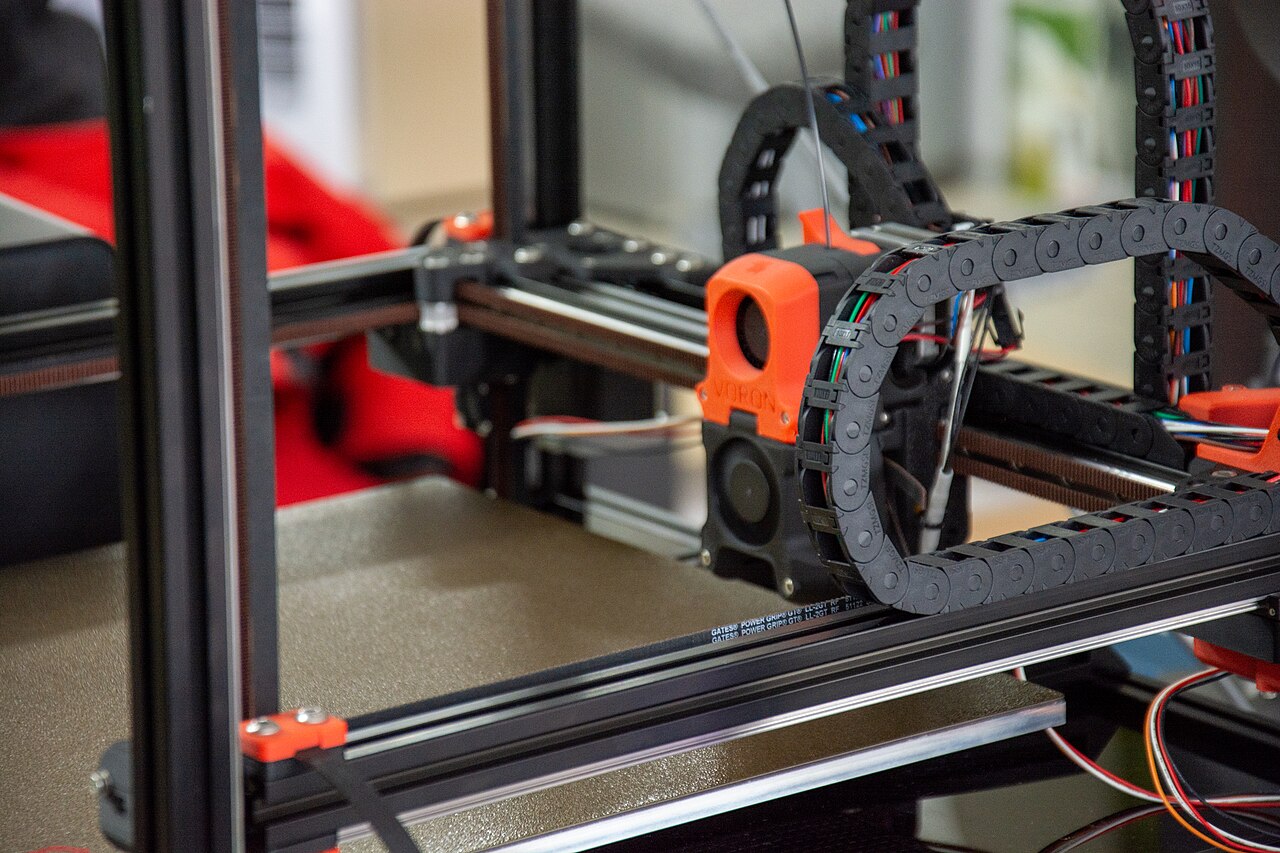
Belts and pulleys have moved the toolheads of hobby 3D printers for so long that most makers treat them as a fixed feature of the medium. Tesseract Technologies, a startup based in Breda in the Netherlands, is betting that the next step up in motion control skips the belt entirely. The company sells ironless, closed-loop linear motors intended as a direct-drive replacement for belt-and-pulley axes, and it has a pilot running on a large-format machine from FELIXprinters. Commercial launch is planned for Q1 2027.
None of this is on a shelf yet, and the performance figures come from the company. But the specifications are detailed enough to be worth reading closely.
What Tesseract Is Actually Selling
A linear motor unrolls a rotary motor into a straight track. Instead of a spinning rotor turning a pulley that drags a belt, a moving carriage rides along a stator and is pushed directly by electromagnetic force. There is no transmission between the motor and the load. Tesseract lists this as direct drive with zero backlash and no wear parts, since nothing in the drivetrain is meshing, stretching or rubbing. In the 3Dnatives interview, the company says a belt stretches and vibrates during movement, and a linear motor removes that elastic link.
The design is also ironless. Motors with iron in the magnetic circuit tend to exhibit cogging, a ripple in force as the moving part passes discrete magnetic poles. Tesseract says its ironless construction gives zero cogging, which is the property a toolhead moving slowly and steadily would want.
The company offers three motor series, distinguished by continuous force:
- ROVIN: 20 N continuous force
- BAMBI: 35 N continuous force
- ZAROS: 70 N continuous force
Shared across the range, according to the manufacturer, are a peak velocity of 2 m/s (120 m/min), an encoder resolution of 0.5 µm, repeatability of ±5 µm, a 5,000 Hz control loop, a 1 mm air gap and a 24 to 48 V DC bus. Maximum stator length depends on the series: 1,200 mm for ROVIN and 1,700 mm for BAMBI and ZAROS. The 5,000 Hz loop works out to a position update every 200 microseconds, and the encoder resolution is ten times finer than the stated repeatability.
The Package, Not Just the Motor
What distinguishes the offer from a bare component is the scope of supply. Tesseract's motor bundle lists the linear motors, an optical encoder, a Lotus control board that supports up to four axes, motor and encoder cabling, and access to the Tesseract Dashboard and motor control. That is a complete motion axis, not a bare magnet track.
According to 3Dnatives, which profiled the company on September 17, 2026, founder Timothy Kramer says Tesseract developed every element of its linear motor from scratch: the motor hardware, control electronics, sensor technology and firmware. He also says that, compared with existing products of similar performance, the company is currently two to five times more cost-effective. That comparison is against existing products of similar performance, described as premium industrial linear motors, not against belts, and no absolute price has been published in the sources we reviewed. How a Tesseract axis compares with a belt drive on cost is therefore unknown.
The company also says it maintains a database of more than 15 million viable motor models.
Closed Loop and Multiple Carriages
Two capabilities stand out against a typical belt drive. The first is closed-loop position correction. An open-loop controller counts steps and assumes the toolhead went where it was told; a belt that stretches or a motor that skips is invisible to it. With a linear encoder reading position directly at the carriage, the controller can see the error and correct it.
The second is multiple independent carriages on a single axis. Tesseract says its system supports IDEX gantry, dual gantry and multi-carrier shuttle configurations. That maps directly onto independent dual extrusion, where two toolheads must each move on their own.
The FELIX Pilot
The pilot machine is the FELIX Pro XXL from FELIXprinters, another Netherlands-based company. It is an IDEX printer with a build area of around 1 x 1.5 m and two independent toolheads. According to 3Dnatives, the axis on this machine measures approximately 1.5 x 1.7 m. Tesseract lists a maximum stator length of 1,700 mm for the BAMBI and ZAROS series, so an axis of that size sits at the top of that range.
Large format is the obvious stress test for any motion system, since a long belt run has more length to stretch.
Timeline and Credibility
According to 3Dnatives, Kramer discovered the linear motor in 2017, and by 2020 the company had a prototype that outperformed the motion systems in 3D printers. The company was a finalist for the Formnext 2025 Rookie Award, and the FELIX Pro XXL was shown there. Kramer says Tesseract is preparing to enter a strategic partnership with an experienced machine-building and manufacturing company, and that together they expect to bring the technology to market in the first quarter of 2027. The partner has not been named.
Those are markers, not independent validation. We have not seen third-party test data, print samples, a published price list, or a statement on what continuous force a given printer needs. The manufacturer's site and the 3Dnatives profile are the sources for everything here, and the 3Dnatives piece relays the company's own claims.
What It Means for Makers
For anyone building or buying a printer in the next year, the practical impact is limited. Tesseract sells a motor bundle that runs on a 24 to 48 V supply with a dedicated control board, and its pilot is on a large industrial-style machine. That looks closer to an OEM design win than a bolt-on upgrade for a desktop printer, though that is our inference.
The longer-term relevance is in what it suggests about where motion systems are heading. Belts are cheap, quiet and good enough for many machines, but the company's argument is that stretch and vibration are the limits. A ready-to-integrate linear axis with closed-loop feedback and no wear parts addresses those problems directly. The open question is price. A claimed two-to-five-times saving over comparable existing products could still leave the system well above a belt, a pulley and a stepper.
Watch for three things: published pricing, a look at real prints from the FELIX Pro XXL, and the details of the manufacturing partnership. Any one of those would tell us whether this stays an industrial curiosity or becomes a component makers can build around by 2027.
