
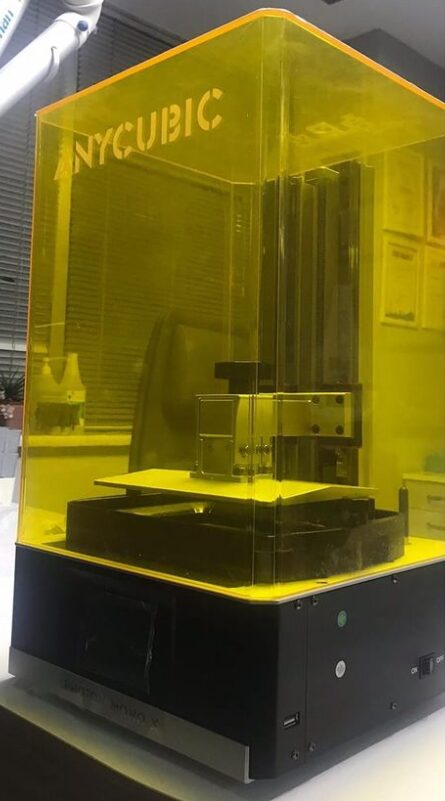
A team of UCLA chemists has built a hybrid zinc-ion battery whose core electrode began life as a lattice printed on an Elegoo Mars 3 Pro resin printer, the kind of desktop machine plenty of hobbyists already have on a shelf. According to a California NanoSystems Institute release, the resulting device stores more than seven times the charge of comparable batteries and retains 82% of its capacity after 1,500 charge-discharge cycles — numbers that would be notable coming out of any lab, let alone one that leaned on desktop-printer hardware to get there.
The work, led by co-corresponding authors Maher El-Kady and Ric Kaner along with first author Sophia Uemura, was published June 29, 2026 in the journal Small under the title "High Mass-Loading Vanadium Oxide on 3D Printed Carbon Lattices for Zinc-Ion Supercapacitors," a collaboration between UCLA and Taiwan's National Tsing Hua University. El-Kady is an assistant researcher in UCLA's chemistry and biochemistry department and also Chief Science and Technology Officer of Nanotech Energy; Kaner is a UCLA Distinguished Professor of Chemistry, Biochemistry and Materials Science and Engineering and holder of the university's Dr. Myung Ki Hong Endowed Chair in Materials Innovation. Their target wasn't a faster phone charger — it's grid-scale storage, the unglamorous but increasingly urgent problem of banking solar and wind power for when the sun isn't out and the wind isn't blowing.
Why Print the Electrode at All?
Battery electrodes are usually built by coating a flat current collector with active material in a slurry, then pressing and drying it — a process optimized for manufacturing speed, not for surface area. The UCLA team instead used the Mars 3 Pro to build a 3D lattice structure, then heat-treated it to convert the printed resin into a conductive carbon framework. That framework was subsequently coated with vanadium oxide, the layer that actually does the work of storing and releasing charge in the finished zinc-ion cell. According to the CNSI release, a single gram of the resulting electrode material unfolds to roughly the surface area of ten tennis courts — a concrete illustration of just how much charge-storing surface a lattice can pack into a small footprint.
The lattice geometry is the whole point. A flat electrode only offers charge-storage material at its surface; a lattice threads that surface area through the entire volume of the electrode, letting the team load far more active vanadium oxide into the same footprint without choking off the ion pathways that make a battery actually charge and discharge quickly. It's the same intuition that drives lattice infill in a mechanical print — trade solid mass for a load-bearing (here, charge-bearing) structure with dramatically more surface per gram — just applied to electrochemistry instead of stiffness-to-weight ratios.
Zinc Instead of Lithium
The chemistry choice matters as much as the printing. Lithium-ion batteries dominate consumer electronics and EVs, but lithium is geographically concentrated, water- and energy-intensive to extract, and increasingly expensive to recycle at scale. Zinc, by contrast, is roughly 100 times more abundant than lithium, according to 3DPrint.com's coverage of the paper, and is described by that outlet as cheaper, easier to find, and generally considered safer than lithium for this kind of chemistry. Zinc-ion batteries aren't new — they've been a research target for years precisely because of that abundance and safety profile — but they've historically lagged lithium-ion on energy density and cycle life. A 3D-printed lattice electrode that pushes both metrics up simultaneously is the kind of result that could make zinc-ion chemistry viable for applications where lithium is currently the only practical option, starting with stationary storage where weight and size are secondary to cost and cycle life.
The Housing Was Printed Too — On an FDM Machine
The resin-printed electrode is the headline, but it wasn't the only 3D-printed part in this project. Per 3DPrint.com's report, the team also designed and printed a transparent, sealed test-cell housing — modeled in Onshape and printed in transparent filament — on a Bambu Lab X1 Carbon, an FDM printer far more familiar to the average maker than a resin machine. The housing let researchers visually inspect the battery's internals during testing, and it also standardized how the cell was tested: the CNSI release notes that the sealed, 3D-printed test cell retained 98% of its capacity in testing, versus failure within fewer than 100 cycles for an open-beaker setup — a reminder that even the test fixture, not just the electrode, mattered to the result. It combined a resin printer for fine lattice geometry with an FDM printer for a transparent structural enclosure, using each machine for what it's actually good at.
That's worth sitting with. Custom battery-test housings are normally machined, injection-molded, or bought as generic lab glassware that doesn't match the geometry of a novel cell design. Being able to CAD a bespoke, see-through enclosure and print it overnight on consumer-grade FDM hardware is exactly the kind of workflow acceleration that desktop 3D printing has been promising researchers for a decade — and here it's being used in service of energy-storage chemistry rather than just prototyping brackets.
What It Means for Makers
None of this means you'll be printing your own battery cells anytime soon — the heat-treatment and vanadium oxide coating steps require lab equipment well beyond a typical print farm, and the paper is a materials-science proof of concept, not a build guide. But there are two takeaways worth internalizing.
First, the printers doing the enabling work here are the same ones on maker workbenches: an Elegoo Mars 3 Pro for the electrode lattice, a Bambu Lab X1 Carbon for the test housing. Consumer-grade resin and FDM printers are increasingly capable of producing geometry precise enough for serious materials research, not just cosplay props and mechanical parts. That's a signal about where the accessible edge of "advanced manufacturing" now sits.
Second, if you're a maker interested in energy storage, battery-adjacent, or electrochemistry side projects, this is a concrete example of lattice-structure printing applied to a domain outside the usual mechanical-engineering context — a reminder that infill strategy, surface-area-to-volume tricks, and print-then-post-process workflows generalize well past brackets and enclosures. The UCLA team's approach — print a scaffold, then transform its material properties entirely through heat treatment and coating — is a pattern any maker experimenting with functional (rather than purely structural) prints should note.
