
The University of Maine's Advanced Structures and Composites Center (ASCC) has launched the 3Dirigo X, a 30-foot, large-format 3D-printed boat that has hit nearly 40 knots in open-water testing. It's a headline-grabbing top speed for any vessel, let alone one that came off a print bed rather than a mold — but the more consequential number in the announcement isn't the boat's speed. It's the print rate behind it.
The vessel was launched at ASCC's facility in Hampden, Maine, the same lab that put large-format additive manufacturing on the map back in 2019, when the original 3Dirigo earned three Guinness World Records. That first boat was as much a proof-of-concept as a working craft. The X is something closer to a production article: a hull that ASCC executive director Habib Dagher says was designed with technologies that let it "withstand extreme ocean environments," printed at a rate that has climbed roughly 25-fold since the program began.
From 20 Pounds an Hour to 500 — and Aiming for 1,000
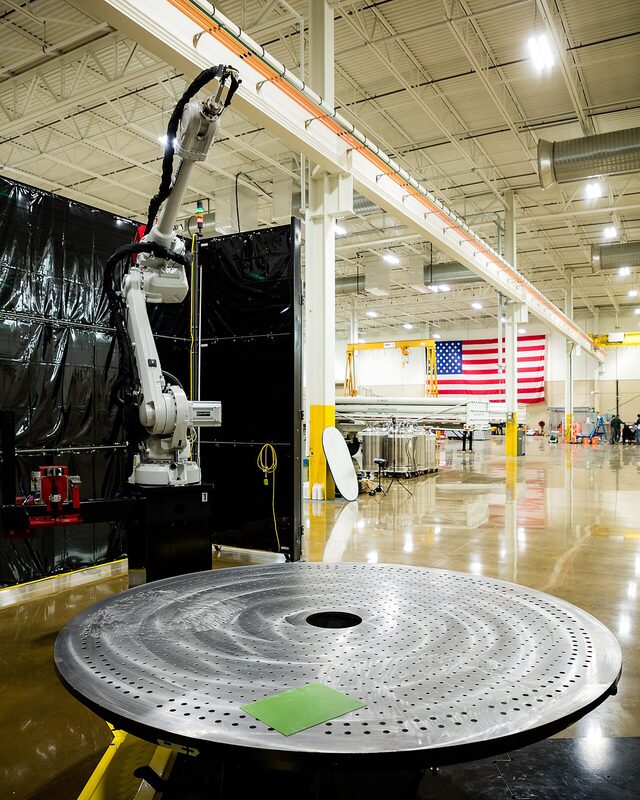
According to Dagher, the center's large-format printers were laying down material at around 20 lbs/hour when the research began. That rate now sits at about 500 lbs/hour — a jump that turns what would have been a multi-week build into something measured in days. Twenty to 500 lbs/hour is a roughly 25x increase in throughput, achieved on the same extrusion-based process rather than through a wholesale technology swap.
The stated target is 1,000 lbs/hour — another doubling from today's rate — and ASCC plans to chase it inside a new, 55,000-square-foot building the university calls the GEM facility, which will house what ASCC is calling its "Factory of the Future." The framing matters: this isn't a one-off boat program, it's infrastructure being built specifically to keep pushing print rate higher.
For context, hobbyist and prosumer FDM printers typically operate in grams-per-hour territory. Even fast desktop machines optimized for high-flow printing rarely clear a kilogram an hour of throughput. ASCC's printers work at a completely different scale — extruding thermoplastic composite in large beads to build structures the size of boat hulls, bridge components, and military infrastructure — but the rate increase still tracks a pattern familiar to anyone who has chased faster prints on a desktop machine: incremental gains in extrusion hardware, motion control, and material feed compound into large leaps in throughput over a few years.
Funding for the push comes in part from the federally funded Accelerated Rapid Prototyping initiative, which backed development of the 3Dirigo X specifically. Paired with the GEM facility build-out, the funding signals ASCC's ambition isn't a one-off boat — it's a repeatable, faster manufacturing pipeline for large-format printed structures generally, with boats as the current showcase.
Federal Officials Frame It as a National-Security Story
The launch event drew attendance and remarks that positioned the 3Dirigo X well beyond a university lab demo. Sen. Susan Collins called it "a great day ... for American manufacturing and for our national security," adding that the boat "represents Maine ingenuity at its best — practical, innovative, forward thinking." Keith DeVries, the Department of Defense's Manufacturing Technology Director in the Office of the Secretary of Defense, spoke to the value of digital-twin iteration, saying digital manufacturing "allows us to build the digital twin" and "enhances our design cycle" and "test modeling and iteration so that the next copy is that much stronger than what we had today." UMaine System Chancellor Dannel Malloy and UMaine President Joan Ferrini-Mundy were also present, according to coverage from VoxelMatters.
That framing isn't incidental. Large-format additive manufacturing has been drawing defense and infrastructure interest for years precisely because it collapses the design-iterate-build cycle DeVries described. A hull design that would traditionally require a new mold — an expensive, slow, single-purpose investment — can instead be adjusted in CAD and reprinted. For military logistics in particular, the pitch is straightforward: faster iteration on hull forms, and eventually the ability to print vessels or components closer to where they're needed rather than shipping them from a fixed production line. Neither source ties the 3Dirigo X to a specific military program or vessel class; the officials' remarks frame it as a manufacturing-capability story rather than an order for a named platform.
What It Means for Makers
None of this translates directly to desktop or even prosumer large-format printing — ASCC's machines operate at an industrial scale most makers will never touch directly. But the trajectory matters to anyone paying attention to where FDM technology is headed. A 25x increase in print rate on a single research program, achieved without abandoning the fundamental extrusion-based process, is a concrete data point that large-format thermoplastic printing hasn't hit a throughput ceiling — it's still climbing steeply enough to fund a purpose-built facility around the next milestone.
It's also a useful marker for the broader "boats and big infrastructure by additive manufacturing" thread that's been building since the original 3Dirigo's 2019 records. That vessel proved the process could produce something structurally sound at a huge scale. The X proves the process can now do that at a pace and a performance level (nearly 40 knots offshore) that starts to look like genuine production, not demonstration. Techniques and material learnings from a program operating at this scale — composite formulations, cooling behavior in large deposits, structural design for thick-walled printed parts — plausibly filter down into the broader large-format and eventually the prosumer space over time, the way earlier large-format additive manufacturing research has historically influenced later commercial systems, though neither source cited here traces a specific commercial spinoff from ASCC's work.
Bottom Line
The 3Dirigo X is a 30-foot, nearly-40-knot 3D-printed boat — an impressive craft on its own. But the story UMaine and federal officials are telling is really about the printer behind it: a roughly 25x throughput increase since the program began, a stated 1,000 lbs/hour target, and a purpose-built factory to chase it. Watch this program less for the boat itself and more for what its printing rate does next.
