
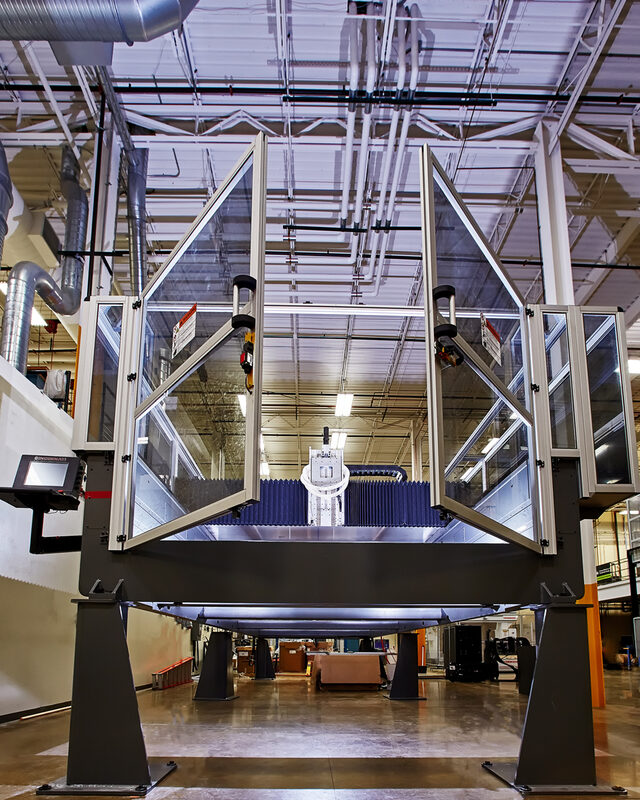
Velo3D announced on June 30 that it is tripling its metal additive manufacturing production capacity with a new campus in Livermore, California, which the company describes as one of the largest single metal additive manufacturing buildouts announced in North America to date. The move is a direct response to what the company describes as sustained, production-scale demand from aerospace, defense, and energy customers who have moved past prototyping and into recurring part orders — the kind of volume that a single, prototyping-era facility struggles to absorb.
The announcement, titled "Velo3D Triples Production Capacity to Meet Strong Defense and Aerospace Demand," lands at a moment when metal AM providers across the industry are being asked a similar question by their biggest customers: can you actually build at the rate we need, not just the rate you can demo? Velo3D's answer is a second campus that will sit alongside — not replace — its existing Fremont, California headquarters. Under the new arrangement, Fremont remains the hub for research and development, applications engineering, process development, customer collaboration, prototyping, and qualification activities, while Livermore becomes the company's primary production and manufacturing center.
The Numbers Behind the Buildout
The Livermore facility itself is substantial by any additive manufacturing standard. According to reporting from DailyCADCAM, the campus totals 288,747 square feet — roughly the size of five football fields — with approximately 270,000 square feet dedicated specifically to manufacturing space. That production floor is built with clear heights exceeding 36 feet — tall enough to accommodate large-format metal printers, their supporting gas and powder-handling infrastructure, and the overhead crane or hoist systems that heavy industrial AM lines typically require. Multiplied out, the facility represents nearly 10 million cubic feet of enclosed volume, a figure that underscores just how much of this expansion is about physical throughput rather than incremental upgrades to existing lines.
Velo3D plans to launch the Livermore site with more than 40 large-format metal printing systems already installed and running, then scale that installed base to more than 100 systems within a couple of years. Combined with the machines already operating at the Fremont headquarters, the two-campus footprint is expected to form a 125-machine production ecosystem — a scale that pushes Velo3D's operation well beyond what most metal AM providers, even well-funded ones, currently run. The company expects the Livermore campus to become operational later in 2026.
CEO Arun Jeldi framed the expansion as a response to a shift in how customers are using the technology rather than growth for its own sake: "This expansion is a reflection of the increasing demand we are seeing from customers who want to move beyond prototyping and qualification into production." That distinction matters in metal AM specifically, where the gap between "we can print a qualified part" and "we can print thousands of qualified parts on a predictable schedule" has historically been where a lot of promising programs stall. Chief Revenue Officer Michelle Sidwell echoed that framing, saying, "We believe additive manufacturing should be accessible, scalable, and production-ready." Livermore Mayor John Marchand was also quoted in the release, welcoming Velo3D as "an industry leader in advanced additive manufacturing and precision engineering" now calling the city home to its primary production facility — with the mayor's involvement signaling that the city itself is treating this as a notable economic development win, a large industrial tenant committing to sustained, skilled manufacturing employment in the East Bay.
Why Aerospace, Defense, and Energy — And Why Now
The three sectors named in Velo3D's announcement — aerospace, defense, and energy — share a common trait relevant to metal additive manufacturing: they are all currently under pressure to shorten supply chains for complex metal components that are traditionally cast, forged, or machined from billet with long lead times. Defense procurement in particular has leaned harder into domestic, qualified additive suppliers over the past several years, driven by both cost pressure and a desire to reduce dependence on single-source or overseas forgings for critical hardware. Energy customers — think turbine components, heat exchangers, and other complex internal-geometry parts — have similar incentives, since additive manufacturing can consolidate assemblies and cut the tooling lead time that conventional casting requires.
For a metal AM vendor, that translates into orders that look less like one-off engineering evaluations and more like standing production contracts, which is precisely the kind of demand that justifies building 270,000 square feet of new manufacturing floor rather than adding a handful of machines to an existing building. Facilities built specifically for scaled, repeat production also tend to differ in kind from prototyping shops: expect purpose-built material handling and powder logistics, inert-gas distribution sized for many simultaneous builds, and quality systems designed around statistical process control rather than one-off part inspection.
What It Means for Makers
None of this is desktop or even prosumer-relevant in the direct sense — Velo3D's large-format systems and six-figure-plus build volumes sit firmly in the industrial tier, serving customers who need qualified, repeatable metal parts at volume. But the Livermore expansion is still worth watching for anyone following the broader trajectory of the additive manufacturing industry, for a few reasons.
First, it's a data point on where real capital is flowing in metal AM right now: production-scale, sector-specific demand from defense and aerospace, not general-purpose or consumer applications. Second, expansions of this size tend to create downward pressure on qualification and lead-time bottlenecks industry-wide, since more installed capacity at a single qualified vendor means aerospace and defense primes have more options for dual-sourcing production runs — which, over time, can make additive-manufactured metal components more competitive on price against traditional casting and forging. Third, it's a signal to the broader supplier ecosystem — powder producers, post-processing shops, and software vendors serving metal AM — that the addressable market for production-volume metal printing is growing, which historically pulls more investment into the tooling and materials that support it. Makers running desktop metal or bound-metal systems won't see a direct effect from a single facility opening, but the maturation of metal AM as an industrial-production process, rather than a prototyping niche, is exactly the kind of macro trend that eventually filters down into more accessible tools and materials.
