
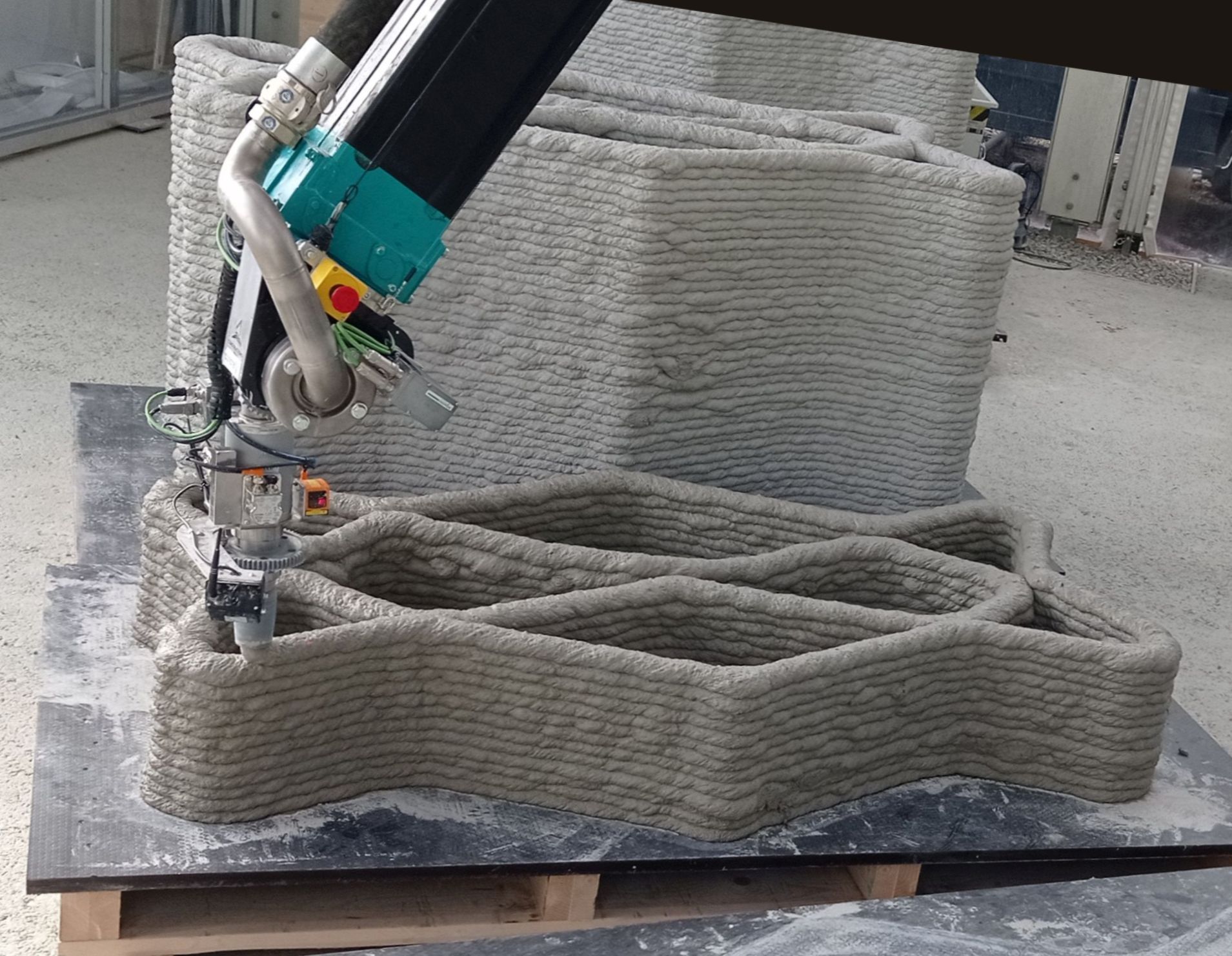
Dutch construction 3D printing company Vertico has installed the largest 3D concrete printing system it has ever built at ITeCons, a Portuguese institute for applied research, testing and development in construction, energy, environment and sustainability. The rig is a Robot on Track configuration — an industrial robotic arm that rides along a linear rail — spanning a 10-meter track with a robot reach of 3.1 meters, giving it a working envelope well beyond anything Vertico has shipped before. To christen the new system, the ITeCons team printed a concrete column 3 meters tall, which Vertico says is the tallest single print its technology has produced to date.
It's a fairly quiet announcement as construction-tech news goes — no ribbon-cutting footage, no press conference — but it's a useful marker for where large-format concrete printing is headed in 2026: out of vendor showrooms and into the hands of researchers who will spend the next several years figuring out what the process is actually good for.
What "Robot on Track" Actually Buys You
If you've only encountered concrete printing through gantry-style machines — essentially oversized Cartesian FDM printers scaled up to pour walls — the Robot on Track category can look like overkill. A gantry is simpler to reason about: X, Y, and Z axes, a print head riding a fixed frame, a build volume that's easy to visualize because it's a box. A six-axis robotic arm mounted on a linear rail is a different animal. The rail gives it travel along one long axis — in this case 10 meters — while the arm itself supplies six degrees of freedom at the end effector, plus a 3.1-meter reach in any direction from wherever it sits on the track. That combination matters for two reasons that don't show up on a spec sheet reduced to "10m x 3.1m." First, reach plus rotational freedom means the nozzle can approach a surface at variable angles rather than always printing straight down, which is what lets concrete printers build overhangs, curved walls, and non-planar geometry that a fixed-gantry machine would need extensive workarounds to attempt. Second, and more practically for a research institute, a track-mounted arm can be reconfigured or relocated more easily than a room-filling gantry frame — you're not committing an entire bay of floor space to one fixed build volume forever.
Vertico's news post frames the reach and track length as the headline numbers, and for good reason: in concrete printing, unlike polymer FDM, the printable envelope is usually the first constraint that shows up in a project brief. A structural column, a load-bearing wall segment, or a full building facade panel needs a machine that can physically get its nozzle everywhere the design calls for material — there's no equivalent of slicing a big part into printable sections and gluing them together after the fact, not for anything meant to bear load.
The 3-Meter Column
The inaugural print — a 3-meter-tall concrete column — is described by Vertico as the tallest single element its printing technology has produced. Height is the print axis that most exposes weaknesses in a concrete extrusion process: each layer has to support the wet weight of every layer printed on top of it before the mix has time to gain enough green strength to carry that load, and the taller the print, the longer that stack sits under stress before it fully cures. A column is also a relatively unforgiving test case, since it's typically expected to be structurally functional rather than purely decorative, meaning ITeCons was validating that the printed geometry could plausibly hold up under real loads, not just that the printer could physically lay down the shape.
Neither Vertico nor VoxelMatters' coverage of the install (which independently confirms the 10-meter/3.1-meter rig and the 3-meter column) details the concrete mix design, print speed, or curing regime used for the column, so there's no way to say from the available reporting how this compares technically to tall prints from other vendors in the space. What is confirmed is the intent: the column was printed specifically to mark the system going live, functioning as a proof-of-capability piece rather than a finished structural component destined for a building.
What It Means for Makers
Concrete printing lives in a different world from desktop FDM and resin printing, but the trajectory pattern will look familiar to anyone who watched polymer 3D printing mature: a vendor with an established product line places its most capable hardware at an institution whose job is to run it, break it, and publish what they learn. ITeCons' role here — as the release puts it — is to open large-scale concrete printing access to researchers, students, and industry partners. That framing points toward the install seeding broader research use rather than functioning as a showcase reserved for Vertico's existing customer base. That's the mechanism by which a still-niche fabrication method accumulates the mix formulations, print parameters, and structural validation data that eventually let it get specified into ordinary construction projects instead of showcase pavilions.
According to VoxelMatters' reporting, this installation sits within a broader Vertico product line that includes the two-component Accelerator printhead alongside On Track, Solo, Compact, LabCell, and EduCell robotic configurations, with installations reportedly at more than 40 locations worldwide. Vertico also offers services around the hardware — design, structural calculations, robot programming, production, transport, and HMI — plus slicing software compatible with Rhino and Grasshopper, the parametric-design tools already standard in architecture firms. For makers watching construction printing from the outside, that's arguably the more consequential detail than any single machine's dimensions: Vertico is positioning itself less as a printer manufacturer and more as a turnkey fabrication partner, which is the model that tends to determine whether a technology category scales past a handful of flagship installs.
Nothing about this release suggests concrete printing is arriving at consumer or even small-studio scale anytime soon — these are industrial robots on 10-meter rails, not desktop machines. But research-institute installs like this one are exactly the step that has to happen before large-format concrete printing shows up in more building codes, more architecture curricula, and eventually more construction sites.
