
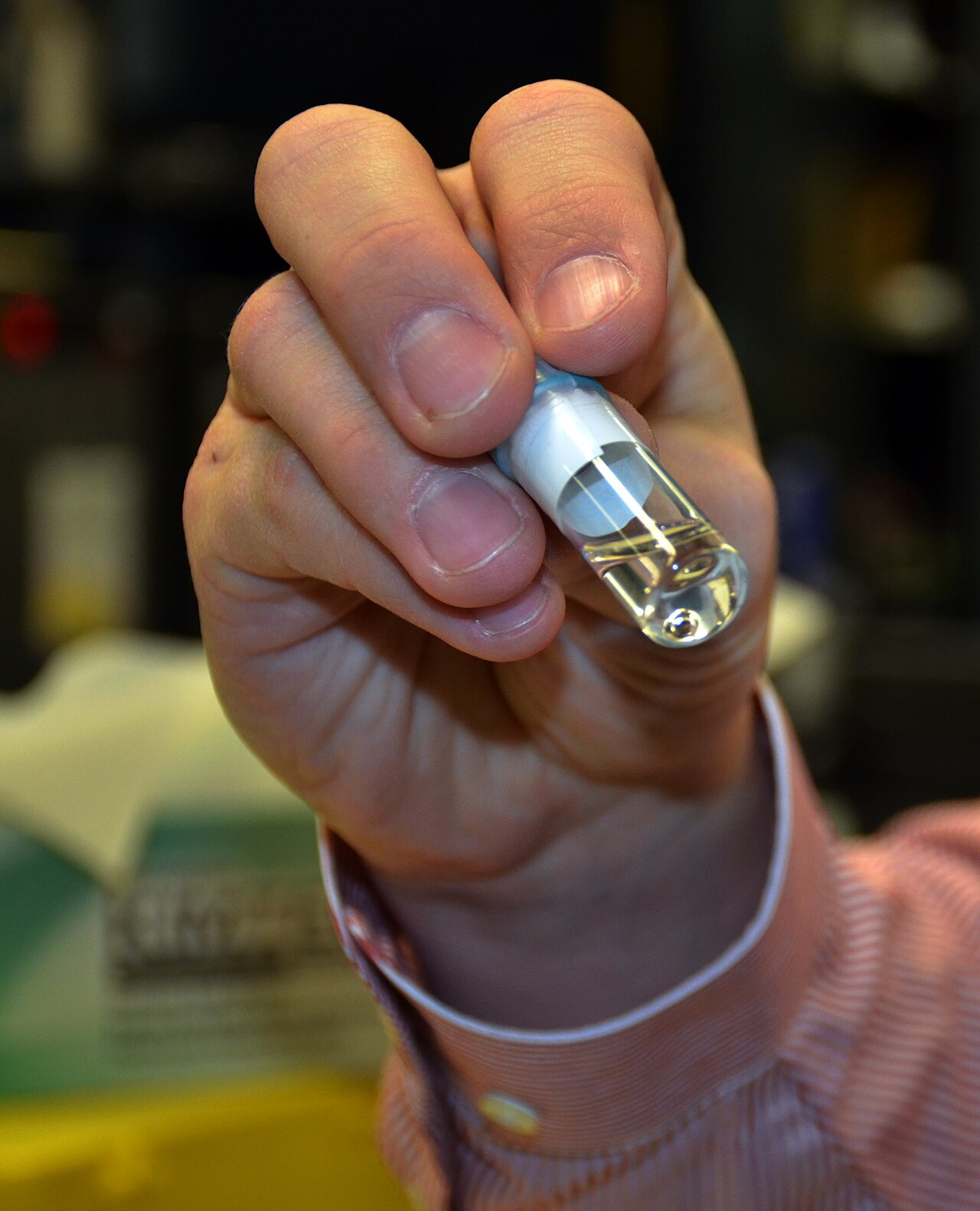
A team at Virginia Tech's VT MADE Lab has built a composite material that does something most conductors can't: it starts out as an electrical insulator, only "switches on" where it's damaged, and then quietly repairs the break itself. The work first surfaced in a video from the YouTube channel 3D Printing Nerd, published September 25, which documents the lab's process for casting and printing the stuff — and which has already pulled in nearly 46,000 views.
The material itself is deceptively simple in concept: tiny droplets of gallium-indium liquid-metal alloy, suspended throughout a matrix of PDMS — the same silicone polymer that shows up in soft robotics, microfluidics, and no small number of maker-shop mold projects. On its own, PDMS is a fine insulator, and in this composite it stays that way. The liquid-metal droplets sit embedded inside it like tiny, sealed pockets, electrically isolated from one another and from the outside world.
Puncture or cut into the material, though, and the physics change immediately. The force ruptures the liquid-metal "bubbles" along the damage path, and the gallium-indium alloy — which is liquid at room temperature — spills out and merges with its neighbors. That connects droplet to droplet, and suddenly you have a continuous conductive channel exactly where the cut happened. Because the alloy stays liquid rather than solidifying, when the material flexes or is pieced back together, the metal keeps flowing and re-bridging the gap, effectively self-healing the circuit path it just formed. It's a neat inversion of how engineers usually think about damage: instead of a break interrupting a circuit, the break *is* the circuit.
From Casting to Printing
According to the writeup on Hackaday, published September 26 by Ian Bos, the composite isn't locked into one fabrication method. It can be poured into a mold, cast by hand, or run through a 3D printer, and in all three cases it's finished with a short bake to cure the PDMS around the liquid-metal inclusions. That processing flexibility is the detail most likely to matter to makers: it means the material isn't a lab curiosity that requires specialized casting rigs, but something that could plausibly slot into existing printer-and-oven workflows already common in flexible-electronics tinkering.
The resulting composite is flexible and stretchy rather than rigid, which tracks with what you'd expect from a silicone-based matrix loaded with liquid inclusions instead of, say, rigid carbon fiber or metal powder. That stretchiness is part of the point — the material is being positioned for flexible circuitry, where a rigid PCB trace would crack under repeated bending but a soft, self-mending liquid-metal path just keeps working. The Hackaday piece also flags smart heat sinks as a target application, leaning on liquid metal's well-established thermal conductivity properties alongside its new party trick of on-demand electrical pathing.
What It Means for Makers
For the 3D printing community specifically, the interesting part isn't just that liquid metal conducts electricity — that's old news to anyone who has played with EGaIn in a syringe. It's that this composite behaves like a normal printable or castable resin right up until it's damaged, at which point it becomes its own circuit board. That's a genuinely different design primitive than the conductive filaments and pastes makers already have access to, most of which are conductive everywhere, all the time, by default.
Picture a flexible wearable sensor, a soft robotic skin, or a printed heat sink with embedded traces that can survive a puncture, a fold crease, or a stray screwdriver slip without an open circuit ending the project. Traditional conductive traces — whether etched copper, printed silver ink, or conductive PLA — don't recover from that kind of damage; you either route around it or start over. A material that stays insulating until it's asked to conduct, then heals the exact spot where it was asked to, could meaningfully change how makers think about durability in flexible electronics, especially for parts that flex, get handled, or live somewhere repairs aren't convenient.
It's also worth being realistic about what hasn't been demonstrated yet, at least based on what's public so far: neither the video nor the Hackaday writeup addresses conductivity numbers, cycle life for repeated self-healing events, or whether the cured composite is compatible with standard desktop resin or FDM printers versus requiring lab-grade dispensing equipment. VT MADE Lab's process, as described, still centers on pour/mold/print-then-bake — promising for accessibility, but the specifics of hobbyist-level reproducibility remain to be seen.
Still, the core idea — a printable, insulating-by-default composite that turns conductive and self-repairs exactly where it's stressed — is the kind of materials-science trick that tends to trickle down into maker-accessible products once someone packages it into a resin or filament SKU. Liquid-metal-in-elastomer composites have circulated in academic soft-robotics circles for a few years now; what makes VT MADE Lab's demonstration notable is the explicit framing around 3D printing and casting as production paths, rather than purely academic bench fabrication.
Nothing about gallium-indium alloys is exotic or new to the maker world — it's the same low-melting-point metal that shows up in stretchable strain sensors and soft antennas elsewhere in the literature. What's new here is packaging it inside a PDMS matrix specifically tuned to stay dormant until damage occurs, then act as its own repair mechanism. If that process scales down to something printable on a desktop machine, it's a genuinely useful addition to the flexible-electronics toolkit — not just a lab demo destined to stay in a lab.
