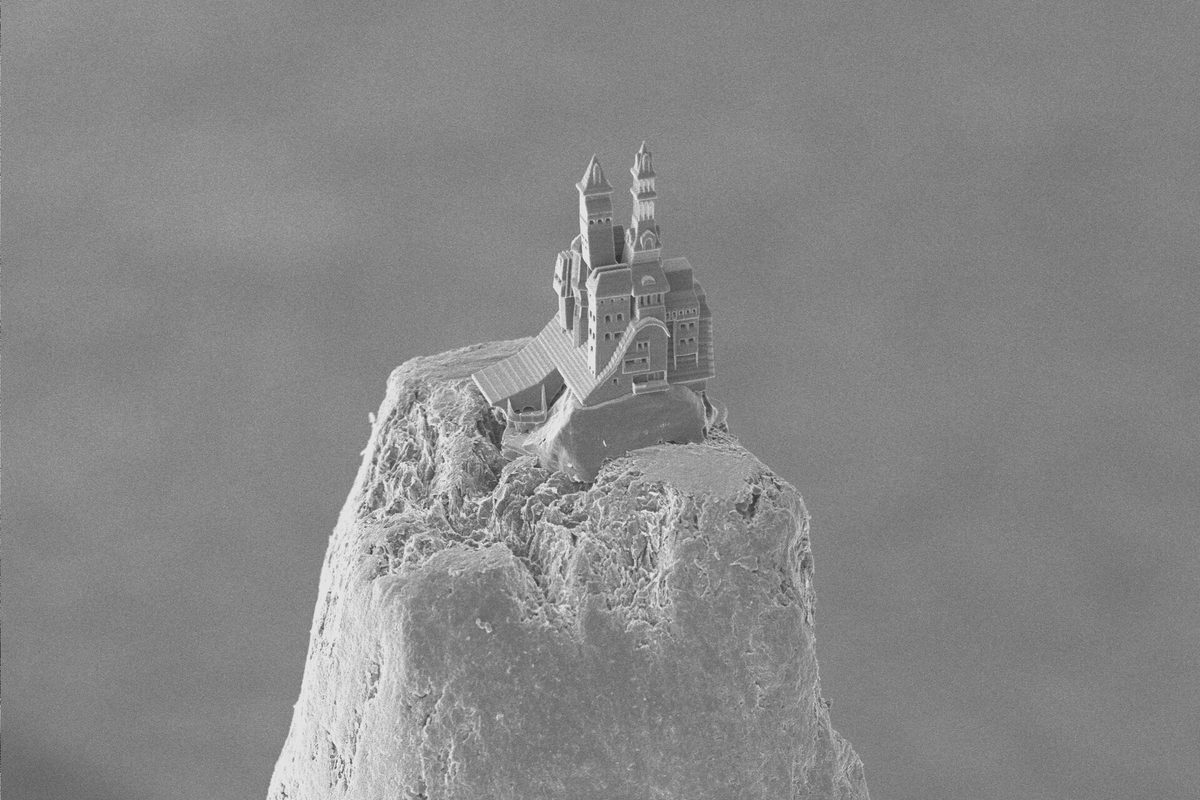
Researchers at the Karlsruhe Institute of Technology have spent a paper's worth of effort answering a question that most glass-printing work skips over: what actually happens to a 3D-printed polymer part between the moment it goes into the furnace and the moment it comes out as glass? Their answer, published October 30 in Communications Materials, traces a two-photon-polymerization print from a soft, rubber-like solid through a brittle brown intermediate to clear fused silica, and it ends with a strength number that is hard to ignore. Silica heated to 1000 C reached a tensile strength of 5.94 +/- 0.45 GPa, which the authors say exceeds the strongest commercial glass fibers.
The work comes from Jiajie Liang, Lisa Hoffmann, Paul Albrecht and Jens Bauer at KIT's Institute of Nanotechnology and Institute for Applied Materials. It was received by the journal on June 23 and accepted on October 9, and 3D Printing Industry covered it on November 10.
The Recipe: Print a Hybrid, Burn Out the Organics
The approach belongs to a family of methods that print a precursor rather than glass itself. The team formulated a resist built around POSS, polyhedral oligomeric silsesquioxane, a cage-shaped molecule with a silicon-oxygen core and organic groups hanging off its corners. The blend combined POSS from Hybrid Plastics with an acrylate from Sartomer and a photoinitiator, and it was printed on a Nanoscribe Photonic Professional GT2, a commercial two-photon lithography system that writes features with a tightly focused laser.
The printed part is an organic-inorganic hybrid. To get glass, you heat it in air until the organic fraction decomposes and leaves, and what remains condenses into a silica network. That much has been known. The KIT contribution is mapping the conversion step by step rather than treating the furnace as a black box.
Watching the Conversion Happen
The test specimens were small disks, 100 micrometers across and 25 micrometers high. The team heated them under a microscope while tracking size and color, and paired that in-situ thermolysis with thermogravimetric analysis and differential scanning calorimetry (TGA/DSC) to follow mass loss and heat flow. They also used optical photothermal infrared (O-PTIR) spectroscopy, which let them follow the chemistry of parts this small.
The sequence they report is easy to follow:
- Around 300 C: the disks yellow and begin to shrink.
- By 440 C: they turn brown and sit at roughly 70% of their starting size.
- Above about 575 C: optical clarity returns.
- Above about 600 C: mass and heat flow stop changing. Roughly 32% of the original mass remains, close to the 33% expected for pure silica.
The finished parts are fully transparent at about 60% of their original dimensions. The authors tie the brown phase to carbon-rich byproducts and the return to clarity to those residues burning off. They also report that the silica network condenses at temperatures more than 500 C below the melting point of SiO2. That matters, because it means the glass is assembled at temperatures where the printed geometry has no reason to slump.
From Rubber to Ceramic, in Numbers
The mechanical data is where the paper earns its headline. The team tested specimens treated at temperatures between 300 and 1000 C in compression and tension, and the material changes character completely along the way.
Untreated prints behave like rubber, with a tensile strength of 129 MPa and elongation above 60%. A 300 C treatment raises stiffness and strength by four to six times while keeping that rubbery behavior, which the authors attribute to heat-driven crosslinking outrunning early decomposition. At 440 C the material turns brittle and ceramic-like, with strength in the gigapascal range and elongation down to about 9%.
After 700 C, the silica measured 4.17 +/- 0.46 GPa in tension, the figure stated in the paper's abstract. At 1000 C it climbed to 5.94 +/- 0.45 GPa with a modulus of around 77 GPa. Beyond the comparison with commercial glass fibers, the authors say these values are roughly three times that of pyrolytic carbon.
A caveat that applies to all nanoscale mechanics: very small specimens tend to be far stronger than bulk material because they contain fewer flaws large enough to start a crack. These are strengths for 100-micrometer disks, not a promise about a printed bracket.
Where It Fits Among Earlier Glass-Printing Work
KIT isn't the first group to print glass at this scale. 3D Printing Industry points to a 2021 effort from Freiburg and Nanoscribe using Glassomer material, processed at 600 C with 6.1 nm surface roughness, and to 2018 work from Vilnius on the hybrid resist SZ2080, which was processed at up to 1500 C and shrank 40 to 50%.
The new paper does not try to beat those efforts on surface finish or processing temperature. Its value is the map: knowing which temperature produces a rubbery part, which gives a brittle ceramic and which yields clear, high-strength glass turns the furnace into a tuning knob instead of a single fixed step.
What It Means for Makers
Nobody is running a Nanoscribe GT2 on a workbench, and the parts in this study are measured in micrometers. Still, there are takeaways that carry over to anyone who works with printed precursors.
First, heat treatment is a design variable, not just a finishing step. The same print can be a compliant elastomer, a stiff composite or a glass depending on where you stop. Anyone who has annealed PLA, sintered metal-filled filament or debound a ceramic resin has dealt with a smaller version of this.
Second, shrinkage is large. Losing about 40% of every linear dimension sounds alarming, but a well-characterized shrink can in principle be compensated by scaling the model up before printing. Size-versus-temperature data like KIT's is the kind of information that makes that compensation possible.
Third, mass balance is a useful sanity check. Comparing residual mass to the theoretical silica content, as the team did, is a cheap way to tell whether burnout is finished, and the same idea applies to debinding filled filaments.
Whatever uses come out of this work will stay in labs and specialty fabs for now. The method behind it, characterizing every stage instead of trusting the recipe, belongs on any maker's bench.