
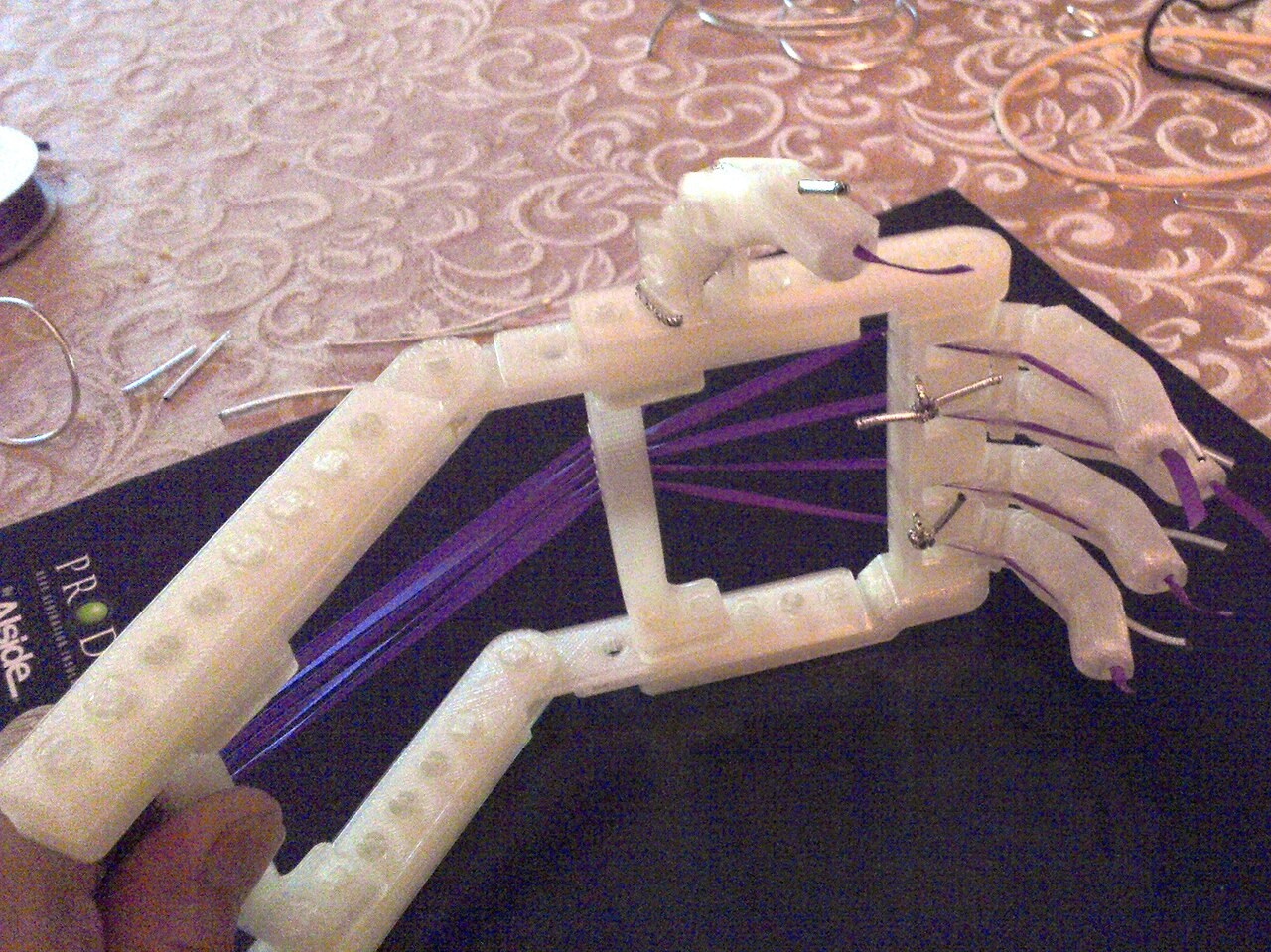
Most people who use a 3D printed prosthetic hand eventually hit the same small problem: the phone screen doesn't respond to it. A student team at the University of Guadalajara thinks the fix belongs in the material, not the hand. According to the university's own news outlet, Gaceta UDG, the students have made a filament from recycled plastic and nanomaterials. Prosthetic hands printed with it can work the touchscreens on phones and tablets. The project is called Filna, and it took first place in the Next Gen category at Enactus Mexico 2026 in August.
Gaceta UDG first reported the project on October 28. 3D Printing Industry picked it up this week and added a comparison with a recycled-PET student lab in Ukraine. Taken together, the two reports describe a smart idea at an early stage. It also comes with an obvious gap: nobody has published numbers yet.
From Printing Hands to Engineering the Feedstock
Filna didn't start out as a materials project. Gaceta UDG says team member Uriel Aranda Rodríguez, a biomedical technologies student at the university's CUGuadalajara campus, explained that the project first focused only on printing prostheses. Along the way the team found that the cost of a prosthesis was a real obstacle. So they shifted from the finished device to the plastic it's made from.
That change of direction is the most interesting part of the story. Hobbyists and nonprofits have printed open-source hand designs for years. Most of the effort has gone into geometry: finger linkages, tensioning, sizing, and fit. Filna takes the opposite approach. The idea is to build a function into the filament itself, so that any hand printed from it gets that function from the material.
The team draws on two University of Guadalajara campuses, CUGuadalajara and CUTonalá. Besides Aranda Rodríguez, the members are Rodolfo Yael Ibáñez Rodríguez, Brenda Lucía Muñoz Sánchez, and Eduardo Cornejo Magdaleno. Their mentors are Jacob Durán and Alejandro Campos.
What the Process Looks Like
The published process is short. The team collects plastic waste, shreds it, heats it, and adds nanomaterials. Aranda Rodríguez says the nanomaterials give the filament another function besides a structural one, and in this case that function is interaction with touchscreens. He links the additives to market demand for prostheses that work with mobile devices.
Anyone who has used a recycling setup will spot what the description leaves out. Neither report names the polymer or polymers in the waste stream. Neither identifies the nanomaterials, gives a loading percentage, or explains how they are dispersed. Neither mentions filament diameter tolerance, print temperatures, nozzle wear, or the kind of extrusion equipment used. Those details aren't trivia. They decide whether a recycled, filled filament prints reliably or jams halfway through a finger joint.
The touchscreen claim is also qualitative for now. Gaceta UDG says the material has the potential to interact with phone and tablet screens. Touchscreens react to conductive contact, so the filament has to carry enough charge to register a touch. No conductivity or resistivity figures have been released, and no mechanical data has been published either: no tensile strength, layer adhesion, or fatigue results. Fatigue matters a lot for a part that flexes thousands of times a day. Fillers often make plastic stiffer or more brittle, and recycled feedstock varies from batch to batch. A filament that does both jobs well would need proof that it does. That proof hasn't been made public yet.
None of this is a criticism of a student team that just won a competition. Enactus rewards projects for social and entrepreneurial value, not for peer-reviewed materials characterization. But it does mean makers should treat Filna as a promising concept for now, not a spec sheet.
What's Next: Fluorescence and Biodegradability
Both reports say the team is working with its mentors on two more properties. The first is fluorescence, which the students want for possible medical uses. The second is biodegradability. Neither report explains how either feature would be achieved or how it would interact with the touch function. Biodegradability is an odd pairing with a recycled feedstock, and it raises questions about service life that the team will need to answer.
A Parallel Effort in Ukraine
3D Printing Industry pairs the Guadalajara story with Alium, a lab run by medical students in Poltava, Ukraine. Alium prints laboratory and training equipment from recycled PET filament sourced from local waste, including bottles brought to a collection point in their dormitory. Its output includes centrifuge and lamp parts, microscope elements, anatomical bone models, and dental training blocks. The comparison fits. Both groups are students treating waste plastic as a cheap feedstock for medical and educational hardware, in places where commercial products are out of reach.
The two projects differ in what they produce, though. Alium prints educational tools, not prostheses, while Filna is trying to make a functional material for prosthetic hands with an extra capability built in. Neither report publishes test data for either effort, and for a material that is meant to do something more than hold its shape, that gap matters.
What It Means for Makers
For anyone printing assistive devices, the main takeaway is the design idea: put the function in the material instead of adding it to the part. If a filament can deliver touchscreen interaction directly, it could in principle simplify building a hand, though the reports give no evidence yet on cost or build time.
The recycling angle matters too, but it shouldn't be overstated. Cheap feedstock only stays cheap if it prints consistently. Recycled plastic loaded with nanomaterials is exactly the kind of material where batch variation, moisture, and filler clumping can make a print fail. Until the team releases its formulation, or at least performance numbers, there's nothing to buy, copy, or benchmark.
Here's what would make Filna worth watching closely:
- Disclosure of the base polymer and filler. Even general categories would let other makers judge printability and safety.
- Electrical data. Resistivity across a printed part, and whether touch response holds up across wall thicknesses and infill settings.
- Mechanical and fatigue testing. This matters most for flexing parts like finger joints.
- Consistency across batches from different waste sources.
Until then, Filna is a good example of student work aimed at a real, everyday problem. Being able to use a phone with a prosthetic hand isn't a minor convenience. The idea is sound and the motivation is clear. What's still missing is the evidence.
