
Two spools of PLA from different brands can look the same, print the same, and get used for the same jobs. A new paper from Curtin University in Western Australia finds they do not behave the same way when heated. In "Same polymer, different story: DSC analysis of commercial PLA 3D-printing filaments for forensic comparisons", published in Forensic Science International (vol. 390, article 113161), a team from the university's School of Molecular and Life Sciences reports that differential scanning calorimetry (DSC), combined with chemometric analysis, told apart 26 of 28 commercial PLA filaments sourced from the Australian market. That held even for filaments of the same colour sold by different brands. With one more processing step, the method also linked printed samples back to the filament they were made from.
The authors are Adamos, Chapman, Pitts, Lewis and Sauzier. Pitts also holds an affiliation with ChemCentre's Forensic Science Laboratory in Western Australia. The paper was published online on October 17, 2026, and its PubMed record was updated on October 22. The authors describe the work as the first research, to their knowledge, exploring the thermal properties of 3D-printing polymers used for privately made firearms in a forensic context. Tom's Hardware, which covered the study on October 31, credited the research to Dr. Georgina Sauzier and colleagues from Curtin and ChemCentre.
What DSC actually measures
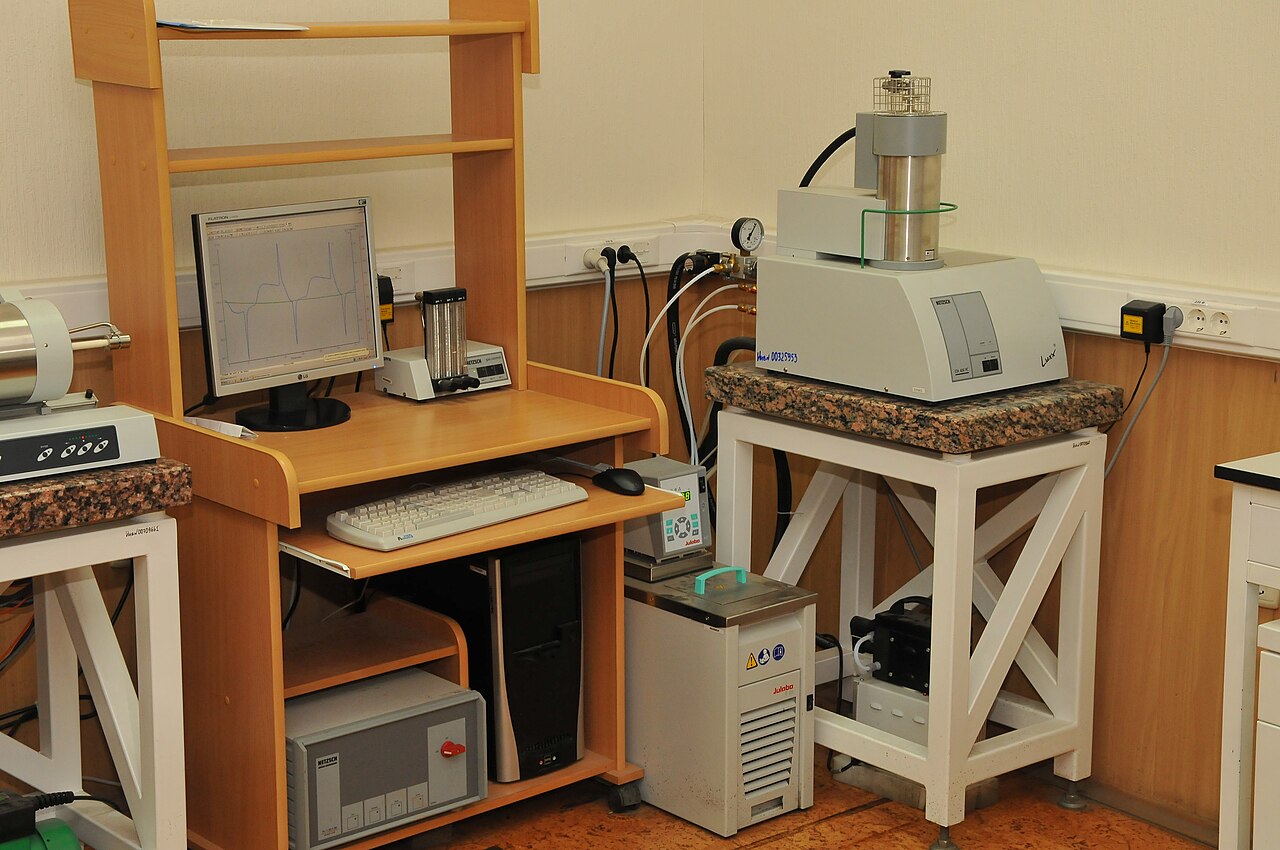
A DSC instrument takes a small sample through a range of temperatures and measures how heat flows through it, producing a graph of its thermal properties. Typical events on such a trace include the glass transition, where the amorphous regions soften; cold crystallisation, where chains frozen in a disordered state organise themselves; and melting, where the crystalline regions break down. Where these events fall, how large they are, and what shape they take depend on the base resin and on everything else in the filament.
That is why a generic material name tells you little. "PLA" covers a family of formulations, and the paper's title makes the point: the polymer is the same, but each product's thermal behaviour tells a different story. Chemometrics, meaning multivariate statistics applied to chemical data, is what turns small differences in the DSC curves into a classification that can tell one product from another. The abstract says the team used characteristic features in the thermograms to discern the filaments.
The thermal history problem
The difficult step was getting from a spool to a printed part. Printing changes the material. Tom's Hardware notes that the process alters the filament's physical properties and that cooling rates vary with what the printer is doing: faster cooling and slower print speeds on overhangs, slower cooling and faster print speeds on infill sections. A printed part and an unprinted sample of the same filament therefore do not start from the same thermal state, and DSC picks that up.
The abstract says this thermal history initially limited the team's ability to establish links between filament and printed samples. Their solution was heat treatment, used to control the thermal history of the PLA samples before measurement. With that step, printed samples were correctly associated with the corresponding filament material. Putting every sample through the same controlled thermal history means the comparison rests on the material rather than on how it happened to be printed. Per Tom's Hardware, the printed samples were small tiles printed on one machine and left for a year in monitored office conditions before testing.
Why PETG and ABS didn't work
The method only worked for PLA. The researchers also looked at ABS and PETG, and the abstract reports that DSC gave limited useful information for both because of their amorphous nature. Tom's Hardware reports that Sauzier blames that amorphous structure, which gives very similar results with no clear identifiers. PLA, by contrast, is semi-crystalline, and that gives clearer temperature transition points as the crystalline structures break down and rearrange.
Tom's Hardware reports that the team also tested ABS and PETG with attenuated total reflectance Fourier transform infrared spectroscopy (ATR-FTIR), which uses infrared light to identify chemical bonds and material composition. The spectra showed differences in additives, but not enough to link a sample back to its filament product. So for now, only PLA could be traced to its filament.
Where this sits, and its limits
The forensic motivation is clear. Tom's Hardware frames the work as a possible way to link seized 3D-printed firearms with seized filament, helping police build a clearer picture of how such weapons are made and distributed. Serial numbers and registration, the usual first lines of firearms investigation, do not apply to a printed gun. The abstract likewise says the findings could inform a material-specific approach to analysing semicrystalline 3D-printing polymers seized in criminal investigations.
The study is still early-stage, and Tom's Hardware notes the authors say as much. The work used a single printer and small sample tiles, and more rigorous testing is needed. Different printers may also affect the physical properties, adding another variable. A real-world method would likely have to cope with many printers, different slicer settings, filament ageing and moisture, batch-to-batch variation within one product, and a much larger reference library than 28 filaments from one national market. It would also need to show how often it produces false matches before anyone relies on it in court. Telling apart 26 of 28 products in a controlled study shows the idea works. It does not yet make DSC a validated forensic test.
What It Means for Makers
For most people with a printer and a shelf of spools, the practical takeaway is about materials, not policing. The study supports something experienced users already suspect: "PLA" on a label is not a specification. Filaments of the same colour from different brands are measurably different materials in their thermal behaviour, which is a good reason to treat print settings and annealing temperatures as product-specific rather than universal. The finding that thermal history affects PLA's thermal properties is a reminder that the printed part and the filament are not thermally identical either. That is worth remembering for anyone who anneals PLA parts or depends on their heat resistance.
Shops and print farms should take note that the materials themselves can carry identifying information that surface inspection misses. The capability is narrow so far: it covers PLA only, it needs a laboratory DSC and a reference library of known filaments, and it has not been tested beyond one printer. But the direction is clear. Forensic chemists are now studying hobby filaments the way they have long studied other trace materials, and future studies will need to deal with amorphous polymers such as ABS and PETG, where this one fell short.
