
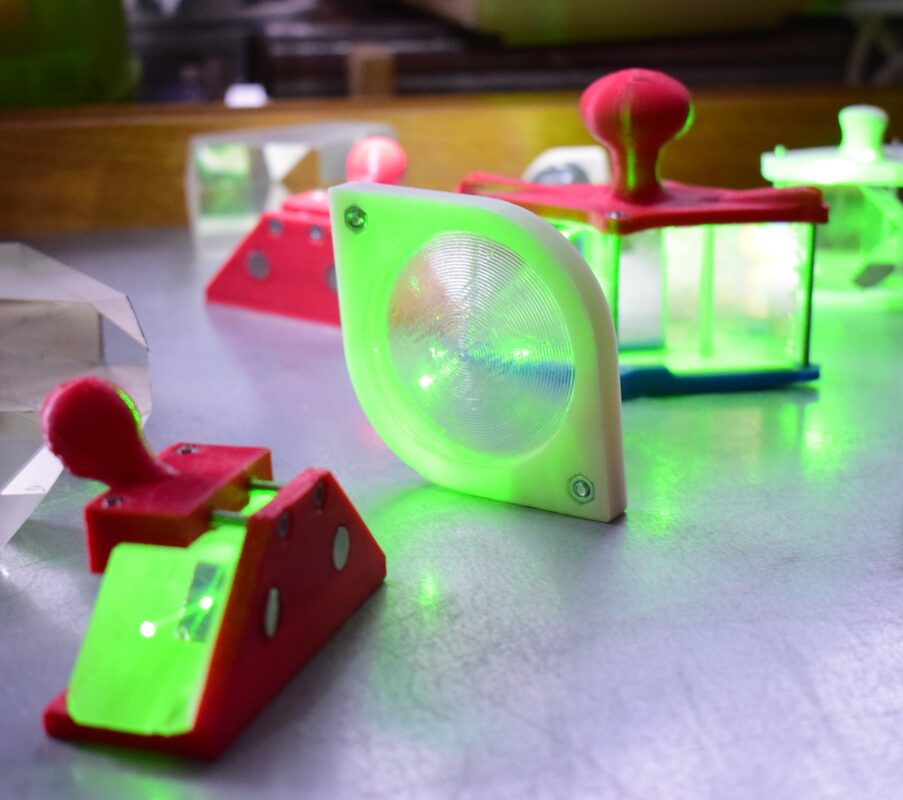
A team spanning Poland and Italy has demonstrated 3D printed optical parts that don't just sit still and bend light passively — they respond to it. In a paper published in Advanced Composites and Hybrid Materials, researchers from Wroclaw University of Science and Technology, the Italian National Research Council's Istituto Nanoscienze (CNR-NANO), Scuola Normale Superiore, and the University of Pisa describe vat-photopolymerized components that change their optical behavior on demand when hit with polarized visible light, dynamically modulating the intensity and polarization of a laser beam passing through them.
The work, led by researchers including Adam Szukalski, Francesca D'Elia, Lorenzo Lavista, Andrea Camposeo, and Dario Pisignano, sits at the intersection of two fields that rarely overlap on a maker's bench: resin-based additive manufacturing and photo-responsive molecular materials. The result behaves less like a static lens and more like a tunable optical switch — no motors, no liquid crystal cells, no external electronics required to change what the part does to light passing through it.
How a Printed Part Learns to React to Light
The trick lives in the resin chemistry, not the printer. The team doped standard photocurable SLA/DLP resins with an azobenzene dye called Disperse Red 1, or DR1 — a molecule already well known in photonics research for its ability to physically reshape itself when struck by light of the right polarization and wavelength. For SLA prints on a Sharebot Andromeda system, they doped a commercial E-Shell 600 resin with DR1; for DLP printing on a Micro Plus HD system, they built a separate formulation around a bisphenol-A-ethoxylate-dimethacrylate matrix with a DR1-acrylate derivative and a TPO photoinitiator. Azobenzene compounds like DR1 have two stable configurations: a straight, rod-like "trans" form and a bent "cis" form. Shine polarized light on the molecule and it flips between the two, over and over, in a cycle called trans-cis-trans photoisomerization.
Individually, one molecule flipping shape doesn't do much. But when billions of DR1 molecules are locked into a printed polymer network and hit with polarized light in unison, something more useful happens: the molecules that happen to be aligned with the light's polarization axis absorb it and reorient, while molecules aligned perpendicular to it are left alone. Repeated cycling drives a net statistical reorientation of the whole population — the molecules effectively "vote" with their long axes pointing away from the light's polarization direction. That collective realignment shows up as photoinduced birefringence: the printed material's refractive index becomes different along different axes, and the difference can be dialed up or down just by changing the incoming light.
In the printed components, the researchers measured photoinduced birefringence up to 2.5×10⁻⁴ — a modest number in absolute terms, but enough to meaningfully rotate the polarization state and intensity of a probe laser beam passing through the part, and enough to do it repeatably. In testing, the team drove the switching effect with pump light around 561 nm — near DR1's roughly 500 nm absorption peak — while reading out the response with probe beams at 637 nm and 785 nm. Printed disks 420 to 600 micrometers thick produced phase shifts of roughly 13.3° to 14.0° depending on the quadrant tested, with phase-control precision on the order of 10⁻² degrees per micrometer of thickness — evidence the effect scales predictably with how much DR1-doped resin the light passes through.
Durability Was the Real Test
Plenty of photo-responsive materials look great in a single demonstration and degrade fast under repeated cycling — azobenzene photoswitches are notorious for photobleaching or losing responsiveness after enough on-off cycles. This is where the vat photopolymerization angle matters: locking DR1 into a cross-linked 3D printed polymer network, rather than dispersing it in a soft film or liquid host, appears to give it mechanical and photochemical stability that loose-molecule systems don't have.
The printed parts sustained up to 60,000 on-off switching cycles while modulating the laser beam, with the modulation amplitude varying by only about 8% across that entire run — a sign the effect wasn't fading out or drifting cycle to cycle. Separately, the team characterized how fast the switch could respond, finding a peak modulation-frequency response of roughly 50 Hz. Together, those numbers matter for anyone thinking about real devices rather than lab curiosities: tens of thousands of cycles without the response collapsing is an endurance figure that starts to matter for anything meant to run repeatedly rather than be demonstrated once and photographed.
What It Means for Makers
Don't expect a DR1-doped resin bottle on the shelf next to your standard tough or flexible resins anytime soon — this is a research-grade result out of university photonics and materials labs, not a commercial formulation, and the paper doesn't describe a consumer-accessible process. The curing process itself is also more finicky than a standard resin print: resin conversion climbed to about 50% within the first couple of minutes of UV exposure before plateauing near 70% with prolonged curing, and keeping the DR1 chemistry intact meant staying within a fairly narrow exposure-dose window. That's process tuning that separates a lab recipe from a desktop printer's slicer profile — but the underlying idea is worth watching if you print optics, sensors, or anything adjacent to photonics hobbyist work.
What's notable here isn't the birefringence number itself — it's where the responsiveness lives. The optical functionality is built into the resin during formulation, then locked in geometrically by the printer during exposure. That means a standard vat-polymerization workflow — the same SLA/DLP process already used for resin printing on desktop machines — is, in principle, capable of producing functional, light-tunable optical elements directly from the printer, with no post-processing step to add the responsive behavior. The team also printed segmented disks, multi-material structures, and wedge-shaped components beyond simple disks, suggesting the approach generalizes beyond a single test geometry. If photo-responsive resin formulations like this one ever reach hobbyist-accessible pricing and open recipes, the payoff is optical components — beam attenuators, polarization modulators, adaptive filters — that print in one shot and can be reconfigured after the fact just by controlling the light hitting them, rather than needing mechanical parts to physically move.
For now, the realistic takeaway is narrower: this is evidence that vat photopolymerization is a viable manufacturing route for active photonic materials, not just passive lenses and light pipes. That's a meaningful data point for the slow convergence between desktop 3D printing and photonics research, even if the specific DR1 resin recipe stays in a university lab for a while yet.
