
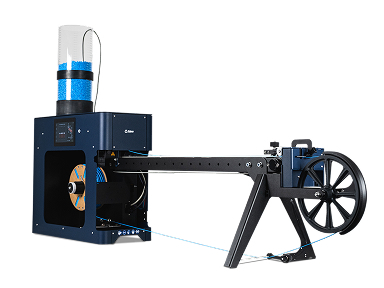
Dutch filament-extrusion specialist 3devo has released the Filament Maker X10, a high-volume extrusion system built for a very different customer than the desktop hobbyist who normally buys a spool at a time. The X10 is aimed at print farms, university labs, and material producers who need tighter diameter control and more flexibility with recycled or engineering-grade feedstock than off-the-shelf filament typically offers — and 3devo is backing that pitch with hard throughput and tolerance numbers rather than marketing adjectives alone.
According to the announcement, the X10 produces filament at 1.5kg per hour under high-tolerance settings, which works out to 36kg per day run around the clock. That is a meaningful jump from the lab-scale extruders that have defined 3devo's product line — the company says its Filament Maker Two will keep serving as the lab machine, with the X10 built for larger batches — and it signals a company betting that demand for in-house, on-demand filament production is growing beyond hobbyists and small labs into operations that consume filament by the kilogram-per-shift rather than the spool-per-week.
What's Actually New Under the Hood
The headline spec is diameter tolerance: 3devo says the X10 holds filament to ±30µm across an entire spool, verified in real time by a 3-axis optical sensor rather than a single-point laser gauge. A 3-axis sensor checks roundness as well as diameter, which matters for extrusion consistency — a filament that measures correctly on one axis but is slightly oval can still jam a hotend or produce uneven extrusion width, a failure mode single-axis sensors can miss entirely.
Cooling the filament after it leaves the die is a 2.8-meter air-cooled conveyor, a length that suggests 3devo is targeting faster line speeds than a shorter cooling path would allow — the material needs enough dwell time in moving air to solidify before it reaches the winder, and a longer conveyor is one of the more direct ways to buy that time without slowing throughput.
On the heating side, the X10 has four heating zones capable of reaching 450°C, held to ±0.1°C. That temperature ceiling is well above what's needed for commodity PLA or PETG, and the tight zone-by-zone control is the kind of spec that matters most for materials with narrow processing windows — high-performance polymers that degrade or become unworkable if the melt temperature drifts even a few degrees from target.
Material handling gets similar attention. The system feeds from a 7.25-liter SmartFlow Hopper designed to accept powder, regrind, or pellets — three physically different feedstock forms that don't always flow the same way through a single hopper geometry, so accommodating all three without jamming or inconsistent feed rate is itself a design problem. Where the feedstock meets the barrel, 3devo specifies a screw hardened to 58-62 HRC using DC53 tool steel, a hardness range chosen specifically to resist wear from abrasive or filled filaments — carbon-fiber and glass-fiber reinforced materials that will grind down a softer screw over repeated production runs.
The Materials List Signals the Target Customer
3devo says the X10 has been tested with PCL, PEEK, PEI, PA-CF, PA-GF, and recycled MJF PA12 powder. That's a materials list built for engineering and research applications, not general-purpose desktop printing. PEEK and PEI are high-temperature engineering thermoplastics used where parts need to survive heat or chemical exposure; PA-CF and PA-GF are fiber-reinforced nylons chosen for stiffness and dimensional stability; PCL is a low-melting-point polymer more common in biomedical and research contexts than in mainstream FDM.
The inclusion of recycled MJF PA12 powder is arguably the most telling entry on that list. Multi Jet Fusion printing leaves a lot of powder unused — 3devo puts the figure at 50-60% of what goes into a build never getting fused into a part — and with virgin MJF/SLS PA12 running €50–100/kg by 3devo's own numbers, that leftover powder isn't trivial to write off. Reclaiming it as filament feedstock for FDM extracts value from material that would otherwise sit unused or get downcycled at a discount; 3devo says it used 2,000kg of MJF PA12 powder waste to test the X10, converting it into printed parts. 3devo Chief Commercial Officer Timo van der Laak framed the X10's broader positioning in comments accompanying the launch, describing a gap between lab-scale extruders and full industrial lines: "If filament making isn't your core business, you cannot justify three-phase power, chilled water and somebody watching a machine all day. The Filament Maker X10 asks for none of that, and still produces filament at the tolerance you would expect from a supplier." That gap — infrastructure and supervision cost, not filament price — is what typically stops a lab from reclaiming MJF waste in-house.
What It Means for Makers
For the individual hobbyist working through a roll of PLA on a desktop FDM printer, the X10 changes nothing directly — it's priced and scaled for organizations, not garages. But its existence matters to that hobbyist indirectly in a couple of ways.
First, it's a signal of where the broader filament-production toolchain is heading: tighter optical-sensor-verified tolerances, wider heating ranges, and hardware built to survive abrasive fiber-filled materials are exactly the specs that, over time, tend to trickle down into smaller and cheaper extruders as the technology matures and manufacturing costs fall.
Second, for anyone running or supplying a print farm, a university makerspace, or a small business doing engineering-material printing, the X10 represents a real alternative to buying commercial spools at retail markup — especially for niche materials like PEEK or fiber-filled nylons that carry a steep per-kilogram premium when purchased pre-made. A ±30µm tolerance claim, if it holds up in independent testing, would put in-house production in the same tolerance range that many buyers associate with premium commercial filament brands, removing one of the traditional arguments against extruding your own. That said, the numbers here — throughput, tolerance, temperature range — come from 3devo's own announcement and are not yet independently verified by third-party testing. Buyers evaluating the X10 for a production environment will want to see those specs confirmed on their own material and their own printers before committing budget.
Bottom Line
The Filament Maker X10 is 3devo pushing further into the industrial end of filament extrusion, chasing the same print farms and material producers that have historically had to choose between buying commercial spools at premium prices or accepting looser tolerances from smaller in-house extruders. Whether the ±30µm and 36kg/day figures hold up under real production conditions with abrasive, fiber-filled, and recycled feedstocks will determine whether the X10 becomes a genuine alternative to commercial filament sourcing for the operations it's aimed at.
