
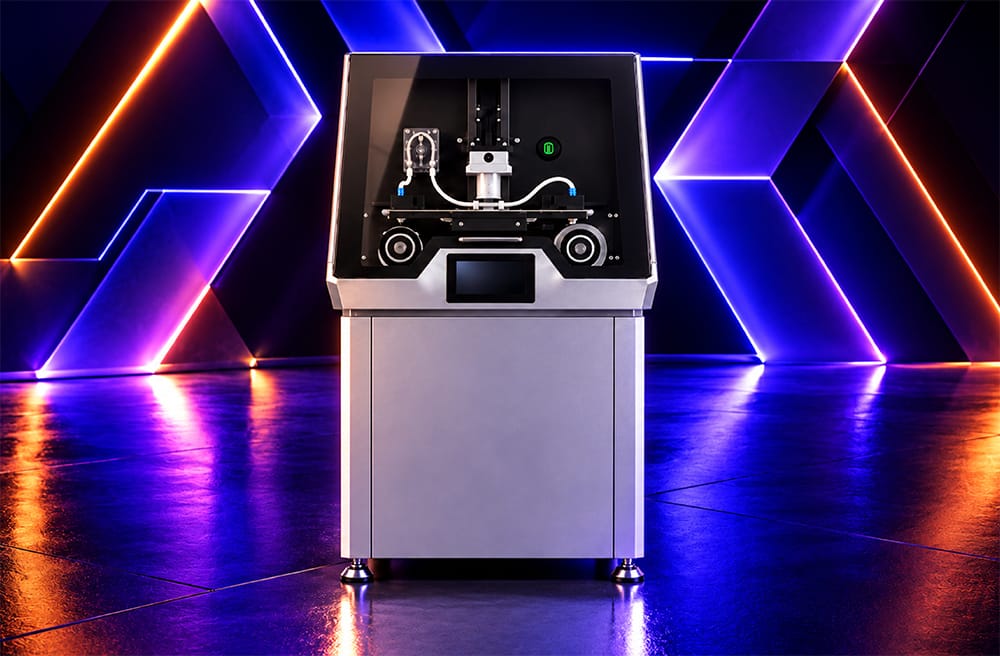
Technical-ceramics printing has mostly lived on factory floors, in machines priced and sized for production cells. Admatec Additive Solutions wants to change that with the Admaflex Discovery, a desktop vat-photopolymerization system for alumina, silica and user-formulated slurries. According to TCT Magazine, it costs $92,500 and is aimed mainly at universities and academic institutions, with industrial users as a second audience. The machine is due to be shown at Formnext.
$92,500 is not hobbyist money. But Admatec is open about the strategy: its product page talks about letting customers "start exploring at a low entry price and expand as their applications mature." Managing Director Michiel de Bruijcker told TCT that "ceramic 3D printing fits on lab and fab benches, and fits a first budget."
The Machine, by the Numbers
The Discovery is a DLP-based vat-photopolymerization (VPP) printer, which Admatec also places under the LCM label. A projected image cures a photosensitive slurry one layer at a time. Admatec's product page lists these specifications:
- Build volume: 96 x 54 x 110 mm
- Image resolution: 50 µm
- Layer thickness: 20–200 µm, depending on material
- Speed: up to 150 layers per hour
- Materials: alumina (Al2O3), silica, and base resin with or without photoinitiator
- File formats: SLC and STL
- Machine footprint: 700 x 560 x 525 mm
- Power: 110/230 V
- Environment: 22 ±5 °C working temperature, humidity below 40%
- Connectivity: Ethernet plus dual-band Wi-Fi 5, with a process webcam
The build envelope is small. A 96 x 54 mm platform is a machine for small parts, test coupons and short runs, not large components. That suits the target market. Early ceramic AM work in a research setting often means printing test geometries, characterizing material behavior, and repeating with slightly different settings, and a small vat and a short build height keep each of those experiments modest in scale.
The 50 µm image resolution and the minimum 20 µm layer are the numbers that matter most for fine features. Matching layer thickness to the material makes sense here. Ceramic slurries are loaded with solid particles, and how deep light can cure them changes from formulation to formulation, so one fixed layer height would suit some materials and fail others.
Industrial DNA in a Smaller Box
The Discovery is not a new design built down to a price. TCT reports, citing Admatec, that it shares "proven operation principles" with the company's ADMAFLEX 130 evolution system: a foil system, material recirculation, full layer-to-layer control, and the Z-axis Zero Clamping system. The product page lists a Zero-Point Clamping fixture for the build platform. Clamping systems of this kind generally let platforms be removed and refitted in a known, repeatable position, which helps any lab that moves parts between the printer and its cleaning or inspection stations.
The shared process matters for a reason beyond engineering. A lab that develops parameters on the Discovery is working with the same operating principles found in Admatec's 130 evolution. Whether those parameters carry over directly is something users will need to test, since neither source makes a claim on that. Still, the design suggests the company wants the Discovery to feed into its larger systems.
The machine uses a vat for low-viscosity polymer printing, and Admatec's page says the user interface runs on a laptop or PC. TCT adds that Admaflex software 3.0 supports the system, which has a built-in 7-inch touchscreen, and that any PC or laptop on the same network, including over Wi-Fi, can open the full interface in a browser. Together with the process webcam, that should let researchers watch long builds from another room, which helps when a print fills a whole afternoon.
Open Materials, Not a Walled Garden
For research users, the most important feature may be the materials policy. TCT reports that Admatec is taking an open approach: users can work with their own ceramic slurries or with Admatec premixes, and they have full control over system settings to develop and optimise materials and processes. The supported-materials list makes this concrete. Besides alumina and silica, it includes base resin with or without photoinitiator, which TCT describes as being for custom formulations and which gives labs a starting point for building their own ceramic-loaded mixtures.
This matters because a lot of academic ceramic AM research is materials research. A lab studying a new powder, a different solids loading, or a specific photoinitiator chemistry cannot use a printer that only accepts cartridges from the vendor. Support for base resin and user slurries makes the machine a research tool rather than a sealed appliance.
Users should not underestimate the work involved, though. Making printable ceramic slurries is its own field. Viscosity, settling, and how light scatters through the particles all affect whether a layer cures properly. The tight environmental window (22 ±5 °C and below 40% humidity) is a requirement Admatec lists, and a shared lab with no climate control could have trouble meeting it.
The Upgrade Path
The feature that stands out most is upgradeability. Admatec says the upgrade increases the build envelope, gives access to higher projection resolutions and more power, and adds the ability to work with two resolution settings. TCT describes the upgrade as a move to a larger, more powerful form factor. After the upgrade, the Discovery becomes a standalone model, no longer a desktop unit.
Neither source gives details such as upgrade pricing or the exact post-upgrade specs. But the idea addresses a common problem in lab purchasing. Grant-funded groups often can afford a capable entry machine at the start of a project but cannot justify a production system until the research proves itself. If the hardware can grow, the first purchase is less likely to sit unused once the work outgrows it. As de Bruijcker put it to TCT, "Because it is upgradeable, customers never outgrow their investment."
What It Means for Makers
For most people reading FilamentFeed, the Discovery will not be on their desk. The price, the strict environmental requirements, and the post-processing a printed ceramic green part normally needs before it becomes a finished component all keep it in institutional territory. The people most likely to use one are makers who work in university labs, makerspaces attached to engineering schools, or small R&D shops.
Still, the launch shows where technical ceramics are heading. TCT says Admatec sees opportunities in jewellery, dental and hospital settings, where accessible desktop ceramic printing can enable new workflows. A benchtop machine with an open slurry policy lowers the barrier for anyone developing materials or applications in those fields.
The bottom line: the Admaflex Discovery is not a consumer ceramic printer, and it does not pretend to be one. It puts Admatec's industrial operating principles into a smaller, lower-cost machine that research groups can grow into, with an open materials policy that lets them experiment. Anyone heading to Formnext who works with ceramics should go and look at it in person.
