
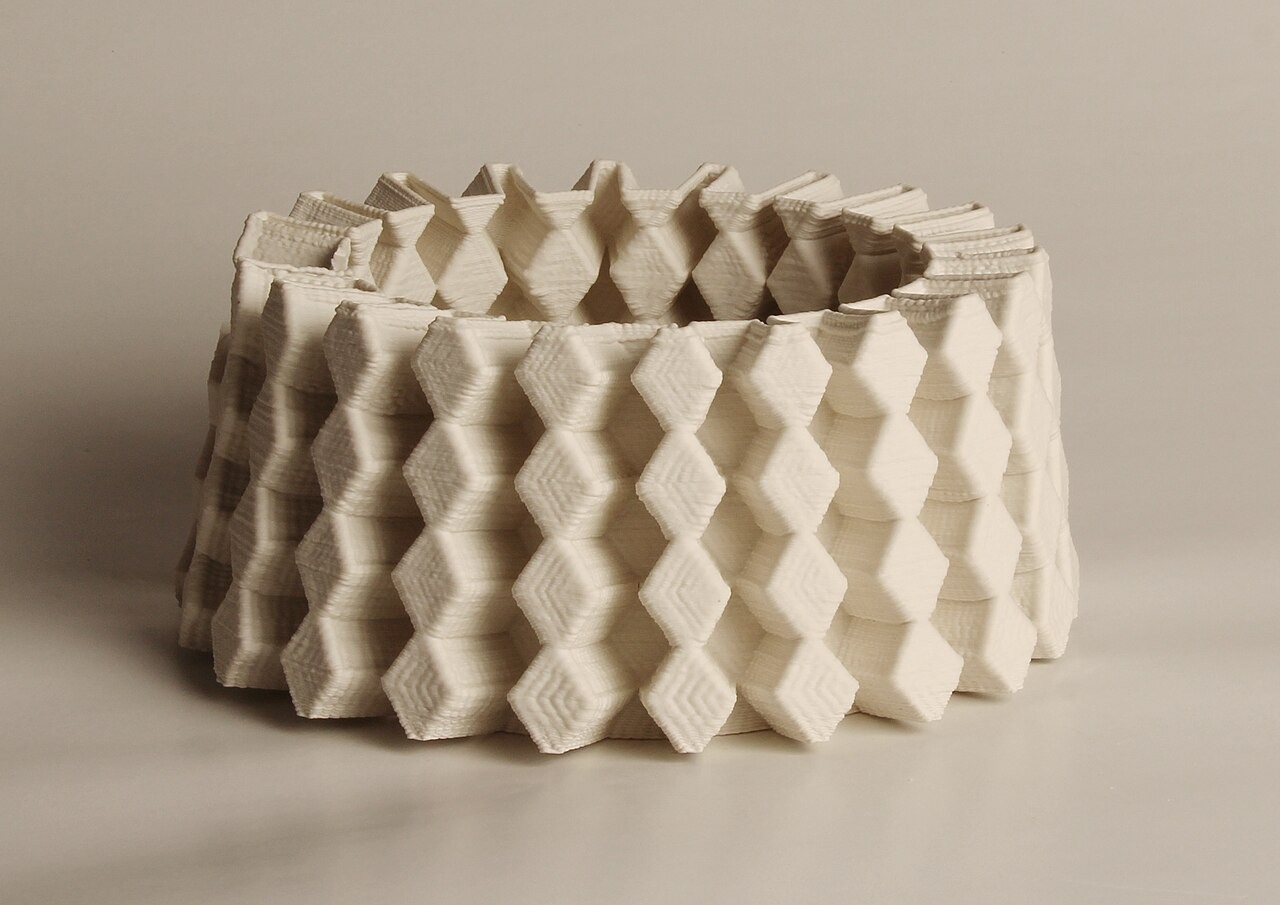
Italian printer maker WASP has spent more than a decade building machines that extrude two very different materials: wet earth paste and molten plastic pellets. Now it wants to put both in the same part. In a post published on its own site on October 12, the company described a dual extrusion process that alternates Liquid Deposition Modeling (LDM) of earth with Fused Granulate Fabrication (FGF) of plastic, layer by layer, in a single print. The plastic acts as reinforcement, and the composite is designed to be "reversible," meaning the plastic can be separated from the earth at end of life and recovered.
The process is patent-pending and still at the testing stage. 3D Printing Industry, which also covered the work, reported that recycled PLA is among the materials in WASP's first experiments. Neither report gives a launch date, a target machine, or any quantitative performance figures. So far this is a research direction with a clear idea behind it, not a product.
Several questions follow from that.
What problem is this trying to solve?
Anyone who has printed with clay or another paste knows the main limitation. A wet extruded bead has very little green strength. Each layer has to hold up the ones above it before it dries, and overhangs, thin walls and tall unsupported spans tend to slump or collapse. That limits which shapes are practical in earth alone.
WASP's answer is to interleave plastic. In the company's description, the plastic reinforcements help maintain stability during printing, making it possible to experiment with geometries that would be difficult to achieve using earth-based material alone because of the risk of collapse. A thermoplastic bead firms up as it cools, so it plausibly acts as a stiff layer for the soft earth layers around it. That is the reason for alternating the two materials instead of just printing a plastic shell and filling it, though WASP does not spell out the mechanism in that detail.
Why LDM and FGF specifically?
WASP says it has worked on both processes since 2012, developing printing systems around each. LDM is used to deposit paste-based materials such as earth, while FGF feeds plastic granules through an extruder instead of using filament. Both are bulk-material processes, so combining them is a natural extension for a company that has spent years on each. According to 3D Printing Industry, the dual system switches between the two methods layer by layer, introducing plastic reinforcement at selected stages of the earth printing process rather than in every layer.
Putting them on one machine with alternating layers is less of a leap than it sounds for a company that already builds both kinds of extruder. The difficult engineering is presumably in the interface: switching between a paste head and a hot plastic head, managing moisture next to molten polymer, and getting the two layers to work together as a composite. WASP has not published details on any of these points.
What does "reversible composite" actually mean?
This is the most interesting claim, and also the one with the least evidence so far. WASP frames it as a response to a familiar problem: in manufacturing and construction, permanently combining different materials makes end-of-life separation and recovery more difficult. Dual Extrusion explores the opposite approach, designing composites whose components can be separated. By separating the plastic layers from the earth-based material, the system aims to make their recovery and later reuse or recycling easier, so that each material can follow its own recovery pathway.
The approach makes sense in principle, since a discrete plastic layer has a much better chance of coming out intact than particles mixed into a matrix. But 3D Printing Industry's report says plainly that further testing is needed to establish how effectively the plastic reinforcement supports complex geometries and whether the materials can be consistently separated and recovered at the end of their useful life. Neither has been demonstrated publicly yet, and the outlet notes that quantitative data from the initial tests has not been disclosed.
Where does the idea come from?
WASP says the work draws inspiration from the potter wasp, which builds its nest from resources available in its surroundings, and from the principle of frugal architecture. The idea is to build with what is available nearby and to think from the design stage about recovering plastic at the end of a product's life, since plastic is already widely present in the environment. Alternating layers of earth with recoverable plastic fits that idea, at least on paper. The same goes for choosing recycled PLA as an early test material.
Using PLA in particular also tells you something. It is a common, easy-to-handle polymer, so it is a sensible first choice for working out the process. 3D Printing Industry notes that WASP has not specified the full range of compatible polymers, so it is unknown whether tougher or more weather-resistant plastics are planned.
The earth side has some track record. According to 3D Printing Industry, WASP worked with Columbia University's Natural Materials Lab to produce hundreds of 3D printed earth tiles for the Earthen Rituals installation at the 2025 Venice Architecture Biennale, using mixtures of construction waste soils and agricultural by-products. Technion's TreeSoil project also used WASP's LDM extrusion technology to make biodegradable structures from locally sourced soil.
What It Means for Makers
For most people reading this, the practical effect right now is close to zero. Nothing is on sale, no printers have been named as targets, and there are no numbers to judge. Treat it as a research announcement, not something to plan a purchase around.
Still, the idea is worth following for a few reasons:
- Paste printers' geometry problem may have a credible fix. If plastic reinforcement can be added at selected points in an earth print, ceramic and earth printing could handle some overhangs and slender forms that currently require heavy design workarounds. That is an inference, not something WASP has shown.
- It treats recycling as a design requirement. Multi-material prints usually make end-of-life harder. A process designed for separation from the start reverses that, and the same thinking could apply well beyond earth and plastic.
- It may suit pellet-based workflows. Makers and small studios already running FGF are the obvious early users if the approach ever reaches smaller machines, although WASP has named no platform.
The open questions are the ones that matter. How strong is the bond between an earth layer and a plastic layer? Does moisture from the paste affect the polymer? How clean is separation outside a lab? What does the switching between extruders do to print time? Until WASP or independent testers publish data, the process is a promising concept and nothing more yet.
Bottom Line
WASP is trying to combine earth, a local and low-impact material, with plastic reinforcement that firms up quickly enough to help hold it up, without creating a composite that can never be taken apart. The concept fits the company's stated interest in frugal architecture, and the patent-pending status shows it is taking the idea seriously. Whether it works will depend on test results the company hasn't released yet.
