
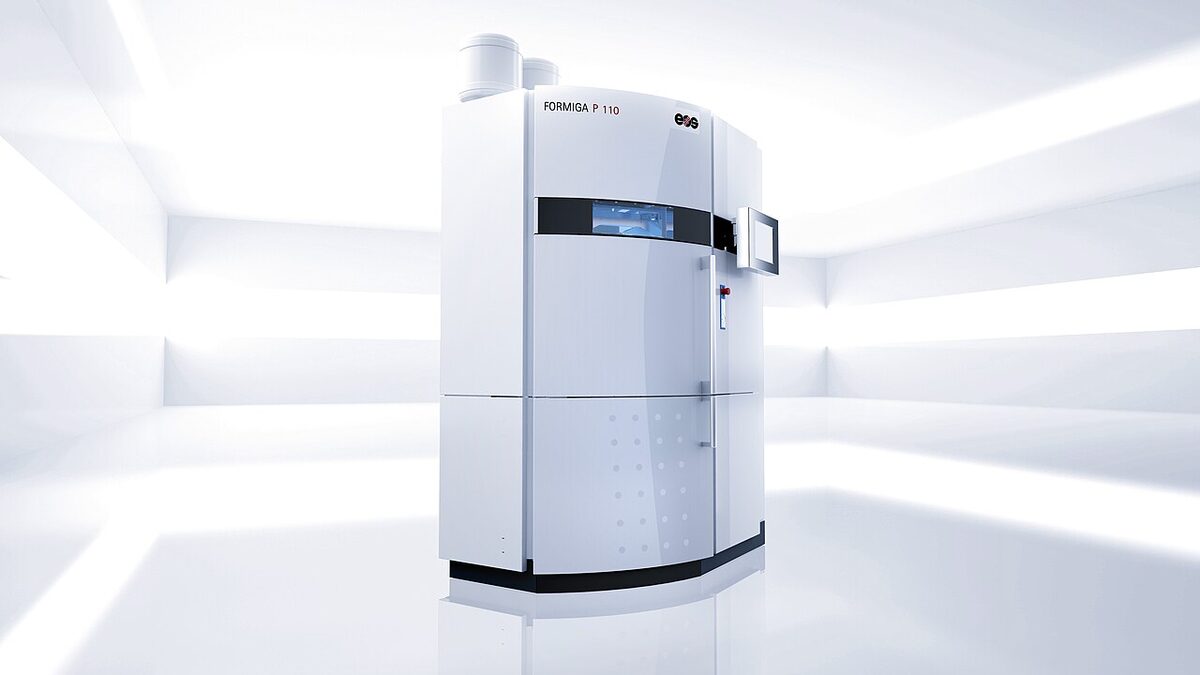
The last manual step in AM Solutions' polymer powder chain was a small one: someone had to move conditioned powder from the company's F1 handling station to the printer through an adapter. According to an AM Solutions press release, that step is now gone. Two new products, the Powder Management System (PMS) and the Direct Feeding System (DFS), carry powder from the F1 back to EOS selective laser sintering (SLS) machines automatically, turning what had been a mostly automated process into a closed powder loop. Both are commercially available now, and the company says they will be shown publicly for the first time at this year's Formnext.
Neither system changes how parts are printed. What they change is the plumbing around the printer, and for anyone who has run a powder-bed polymer machine, the plumbing is where much of the labour lives.
Where the Loop Was Open
AM Solutions already sold two pieces of the post-print chain. The D1 Unpacking System handles automated unpacking of parts and powder after a build. The F1 Powder Handling System takes the recovered material, mixes it with new powder, sieves it and conditions it to the required quality so it can be used again. On paper, that covers most of the work that sits between one SLS build and the next.
The gap was the return trip. As the press release describes it, powder prepared in the F1 still had to be transferred into the printers manually by way of an adapter. The company says that created additional work, particularly in production environments with multiple machines, and unnecessary employee exposure to the powder. PMS and DFS are pitched as the extension that closes it: the D1 and F1 stay where they are, and the new hardware connects the F1's output to the printers.
Two Systems, Two Scales
The two products target different shop sizes. Details reported by TCT Magazine, which closely follows the press release, lay out how each one is built.
Direct Feeding System: one printer, minimal hardware
DFS is the smaller of the pair. It supplies a single EOS SLS printer. Working with the F1, it acts as a valve and distribution unit, controlling the transfer of powder from the connected Polybox, where the material is stored, directly into the printer through a permanently installed piping system. Rather than adding a separate conveying station, DFS reuses components already present in the F1. According to TCT, that means no additional controls, no extra powder pumps and no additional media supplies are required.
The piping itself is grounded aluminium with optimized bends, and it carries powder over distances of up to 15 metres. The plug-in piping can be adapted to different production layouts. The 15-metre figure also sets a practical layout constraint: the F1 and the printer it feeds need to sit within that run of each other.
AM Solutions says it has run the DFS in its own internal production for approximately ten months, combined with an EOS P3 NEXT and the F1.
Powder Management System: up to four printers
PMS is built for production environments with multiple printers. It can supply up to four EOS SLS printers. Instead of drawing from one container, it has two Polyboxes connected, each with a usable volume of 180 litres, for 360 litres of usable capacity across the pair. When one Polybox is empty, a valve automatically switches to the second, so the supply to the printers does not have to stop while an operator swaps containers. An integrated fill-level indicator, with LED lighting in the drum and a 360-degree beacon light, signals when a Polybox needs to be replaced or refilled.
The interface with the printers is deliberately simple. TCT reports that integrated sensors and specially developed filling nozzles allow powder to be transferred without direct signal communication between the PMS and the printer. In other words, the system does not need to talk to the printer's control system to fill it. For a shop, that suggests it can be added alongside existing EOS machines without a controls-integration project tied to the printer itself, although buyers will want to confirm site-specific requirements with the vendor. The company also says the fully enclosed system reduces dust exposure through air recirculation and filter technology, and EOS has already deployed the PMS under production conditions.
Why the Last Step Matters
It is tempting to read a powder-transfer system as incremental. A technician connecting powder through an adapter is not, by itself, a heavy burden. But manual steps compound in production. Each one needs someone available at the right time, each one is a chance for an inconsistent procedure, and each one sets a ceiling on how long machines can run unattended between interventions.
The architecture AM Solutions describes addresses that in two ways. First, the conditioned powder coming out of the F1 goes to the printer through fixed piping rather than through a person. Second, on the PMS, the dual-Polybox arrangement with automatic switchover means the supply side has a built-in buffer: one container can be depleted while the other keeps feeding. The company's own framing is that the result is a continuous loop running from unpacking through conditioning and back to the printer.
What the published material does not provide is equally worth noting. Neither the press release nor TCT's report gives pricing, throughput figures for powder delivery, or a full list of supported EOS models beyond the general description of EOS SLS printers and the EOS P3 NEXT used in AM Solutions' own DFS trial. Those are the numbers an operations manager will want before committing, and they are presumably the kind of questions the Formnext debut is meant to answer.
What It Means for Makers
For the hobbyist with a desktop FDM machine, PMS and DFS are not relevant hardware. They are industrial equipment aimed at shops already running EOS SLS printers alongside AM Solutions' D1 and F1 systems. But the launch is a useful signal for the broader maker and small-business community that has been edging toward powder-bed polymer printing.
Much of the work in SLS sits in powder handling: unpacking it, sieving it, conditioning it and getting it back into the machine. Vendors have been automating that chain piece by piece, and this release targets the final link. For a service bureau or a small production shop running one EOS machine, DFS is the more interesting option, since it reuses F1 components and avoids extra pumps and controls. For a shop running two to four EOS printers, PMS offers shared supply from 360 litres of usable powder capacity with automatic container switchover.
The practical constraints are clear from the specifications: the systems are built around EOS SLS printers, the DFS piping run tops out at 15 metres, and both assume the D1 and F1 are already part of the workflow. Shops outside that ecosystem should not expect a drop-in solution. Those inside it now have a route to removing the last manual step between conditioned powder and the next build.
Both systems are commercially available now, with their first public showing scheduled for this year's Formnext.
