
The drone that stops a poacher's truck in the Zambian bush and the drone a U.S. Army paratrooper flies into a treeline have almost nothing in common operationally — but according to a detailed preview published July 7, 2026 by 3D Printing Industry, they increasingly share a production method. Ahead of the AMAA 2026 conference on July 9, the outlet compiled a set of case studies showing that additive manufacturing has quietly moved from a prototyping convenience to the primary way a growing slice of the UAV industry actually builds flying hardware — not just brackets and fairings, but structural airframes shipped in the field.
The throughline across the examples is HP's Multi Jet Fusion (MJF) process, which several contract manufacturers cited in the piece are now using to produce UAV components at production volumes rather than one-off prototypes. Gino Balistreri, quoted in the article, described MJF's role from the manufacturing side, while Robert Miller of EyeAbove spoke specifically to the durability of HP's 5600 series systems in the field — a detail that matters more for a drone destined for a Zambian game reserve than for one that never leaves a lab bench.
A Backpack Drone That's 96 Percent Printed
The most striking data point in the preview is UAV Works' collapsible multirotor, which the article states is 96 percent 3D printed and designed to be carried in a backpack and deployed in the field. That figure is unusual even by the increasingly loose standards of "additively manufactured" marketing claims in aerospace — it implies the airframe, not just secondary structure, is being produced on a printer, which puts real pressure on part consolidation, wall thickness, and material selection to get right the first time, since a failed geometry means a redesign cycle rather than a machining fix.
Materials cited across the case studies are PA12 and TPU — a pairing that tracks with what's now standard in production-grade MJF work: PA12 for structural components that need stiffness and dimensional stability, TPU where the design calls for flexible or impact-absorbing sections. Neither material is exotic by industrial standards, which is itself notable — it suggests the UAV Works platform's weight and packability gains are coming from geometry and part consolidation enabled by MJF's build-volume freedom, not from exotic composites or metal printing.
Anti-Poaching Hardware Built Around a 0.8mm Wall
The Zambia case study centers on EyeAbove's "Bush Ranger" drone, deployed for anti-poaching surveillance in Kafue National Park. According to the preview, the airframe is mostly 3D printed and built around wall sections as thin as 0.8mm — a tolerance that's well within what MJF can hold reliably, but that only makes sense as a design choice if the manufacturer trusts the process to deliver consistent mechanical properties at that thickness, batch after batch, in a hot, remote operating environment far from a service center. Miller's comments on the HP 5600 series speak directly to that trust: printer reliability in the field is as much the story here as the part geometry itself.
Anti-poaching UAVs live a harder life than most consumer drones — heat, dust, rough handling by rangers rather than pilots, and long deployment cycles without access to spare parts pipelines. Choosing to lean this heavily on 3D-printed structure for that mission profile is a vote of confidence in the process's consistency, not just its cost or speed advantages.
The Army's $400 Drone
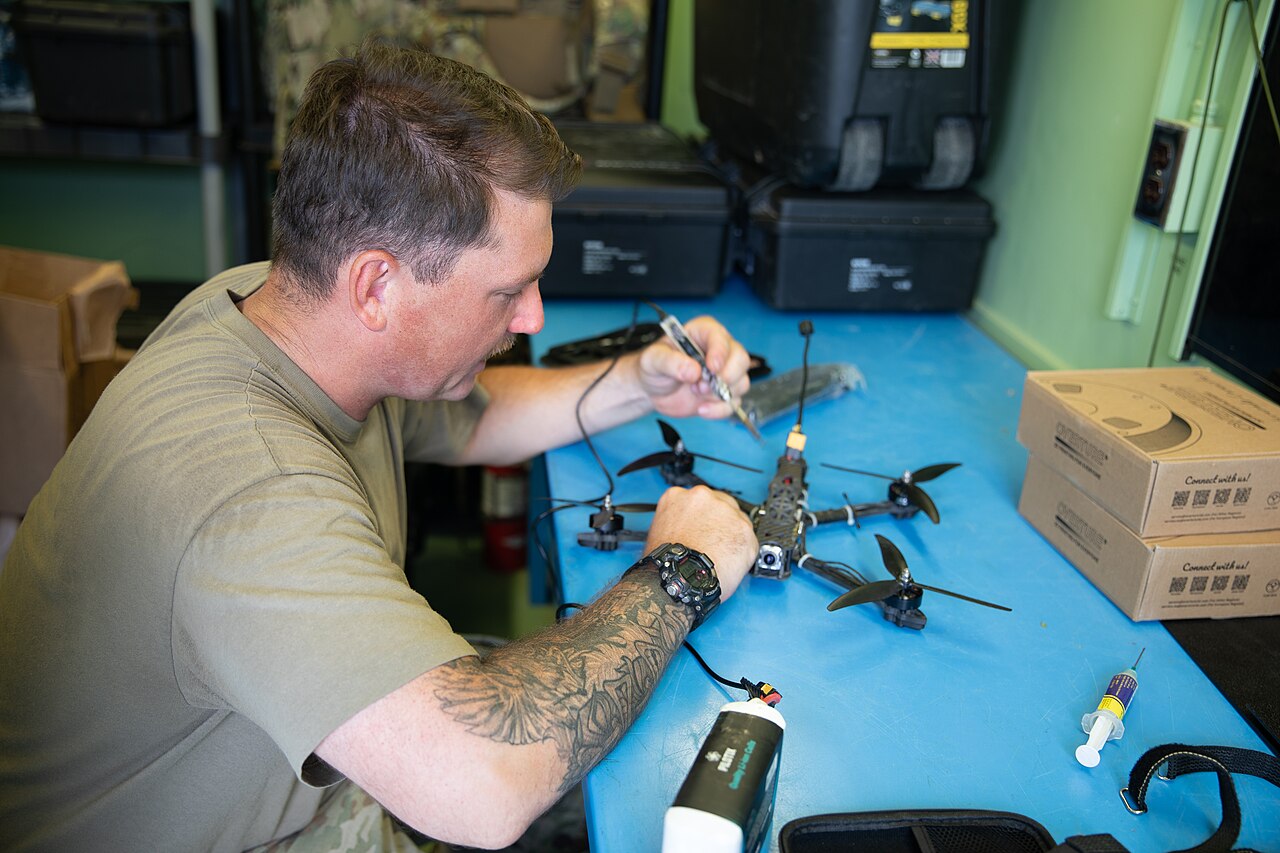
On the defense side, the preview reports that the U.S. Army's 173rd Airborne Brigade is fielding FPV drones built at a cost of $400 to $500 per unit. That price point is the headline number for a reason: it reframes additive manufacturing's value proposition in a military context away from "faster prototyping" and toward "attritable hardware" — drones cheap enough to lose in large numbers, which is precisely the tactical profile FPV strike and reconnaissance drones have taken on in recent conflicts. A $400 airframe built from printed components sidesteps the traditional defense-procurement cost curve entirely, and it does so using the same class of desktop-adjacent process that's showing up in a Zambian conservation drone half a world away.
The Blueflite platform rounds out the case studies with a different kind of number: a 25 percent weight reduction achieved across 48 separate 3D-printed components. That's a part-consolidation and topology story more than a materials story — 48 components is a lot of discrete parts to individually optimize, and the aggregate weight savings point to the kind of lattice and cavity work that's difficult or impossible to replicate with subtractive manufacturing or injection molding at the same part count.
What It Means for Makers
None of this is desktop FDM territory — MJF is an industrial powder-bed process, and the volumes and tolerances described here sit well above what a Bambu Lab or Prusa machine is built for. But the signal for the maker community is still worth reading closely. When the U.S. Army is fielding sub-$500 printed FPV airframes and a conservation nonprofit is trusting 0.8mm printed walls in the field, it validates a design philosophy that scales down cleanly: part consolidation, in-place flexible sections instead of bolted joints, and treating the printer as a production tool rather than a prototyping one. Hobbyist and small-shop drone builders using PA12-equivalent nylon filaments or resins, and TPU for shock-absorbing mounts, are already working from the same material logic these manufacturers are — just at a different scale and cost basis. The gap between "backyard FPV build" and "military FPV production run" is narrower on the materials science side than it looks.
Bottom Line
AMAA 2026 itself, confirmed as an online conference on July 9 featuring speakers from NASA, Safran, Velo3D, America Makes, and other aerospace and defense AM organizations, is squarely focused on qualification, certification, and production scale-up — the unglamorous infrastructure work that turns case studies like these into repeatable, auditable manufacturing processes. The UAV examples previewed ahead of it are a useful preview of what that infrastructure is already enabling: airframes that are 96 percent printed, walls thin enough to worry a machinist, and unit costs low enough to change how militaries and conservationists alike think about what a drone is allowed to cost.
