
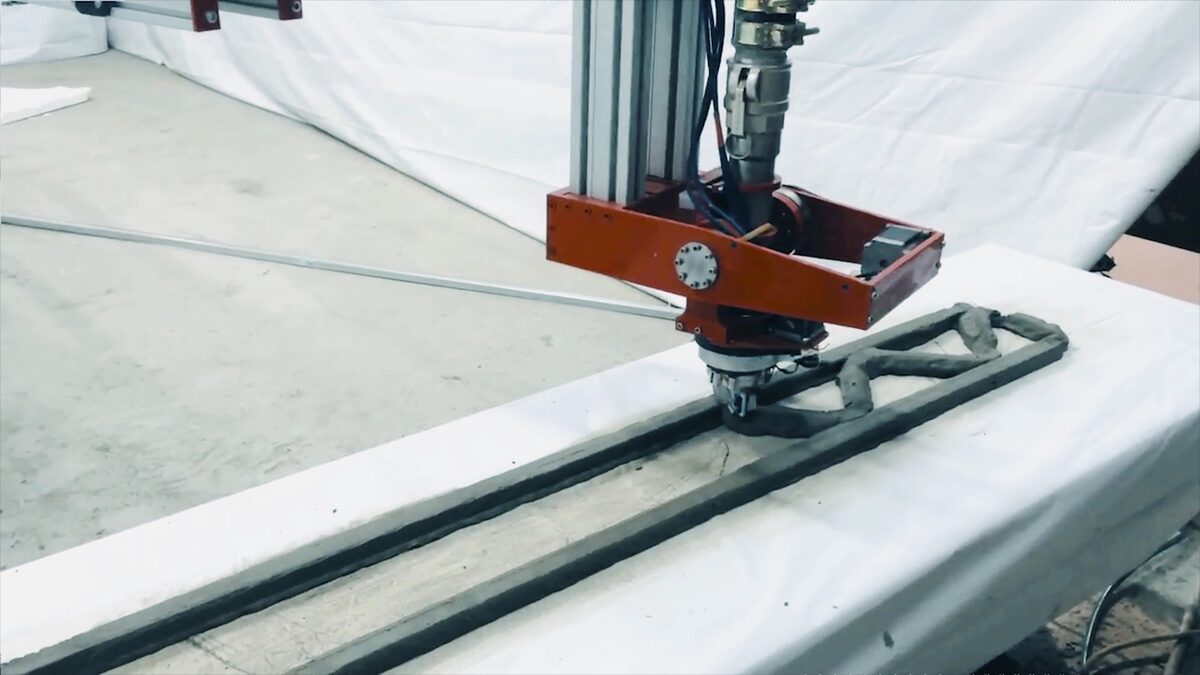
India has sunk its first batch of 3D-printed artificial reef modules into the Gulf of Mannar, the result of a partnership between Chennai construction-printing startup Tvasta and the Visakhapatnam Regional Centre of ICAR's Central Marine Fisheries Research Institute (CMFRI), as reported by 3DPrint.com. The deployment, completed in June off the coast of Ramanathapuram, marks the country's first use of additive manufacturing for large-scale marine habitat restoration — and it's a useful case study in how print-in-place geometry can do a structural job that conventional casting struggles to match.
The modules themselves are unglamorous by 3D-printing-hobbyist standards: roughly one tonne apiece, made of concrete, destined to sit on the seafloor for decades. But the fabrication method separates this project from the artificial reefs that navies, fisheries departments, and dive operators have been sinking for half a century. Instead of pouring concrete into a mold around a welded rebar cage — the standard approach for cast reef blocks — Tvasta's printer deposits the concrete layer by layer directly into the final shape, with no iron reinforcement at all.
Why Skip the Rebar?
Removing steel reinforcement isn't a cost-cutting shortcut; it's a durability fix. Steel rebar in a submerged concrete structure is a slow-motion liability: seawater is an efficient electrolyte, and once chlorides work their way through the concrete cover to reach embedded steel, corrosion sets in, the rebar expands, and the surrounding concrete cracks and spalls. That failure mode is a known weak point in conventional cast marine infrastructure, and it's exactly the kind of problem additive construction is well suited to solve — a printed structure can achieve the needed load paths and stability through geometry (thicker walls, ribbing, arches, interlocking print paths) rather than through embedded tension members that don't tolerate a marine environment. According to the reporting on the project, the Ramanathapuram modules were engineered specifically without iron reinforcement for this reason, betting entirely on the printed concrete geometry to survive decades in seawater without the corrosion-driven degradation that plagues rebar-based reef blocks.
Printing for Biodiversity, Not Just Structure
The other advantage 3D printing brings to reef-building is one that traditional formwork simply can't deliver economically: geometric complexity tuned to specific species. According to Newswire's coverage of the deployment, CMFRI-Visakhapatnam developed six distinct reef designs for the program, each incorporating different crevice sizes, folds, and attachment surfaces. A cast concrete block can offer maybe one or two standardized cavity shapes because every additional mold feature adds cost and demolding complexity. A printed module can carry dozens of different pocket geometries in a single pour, because the print head doesn't care whether it's tracing a smooth face or a fractal-like lattice of undercuts — it just follows the toolpath. That matters ecologically because reef fish, crustaceans, and coral larvae are picky about surface texture and cavity size. A juvenile grouper wants a tight, shaded crevice; encrusting coral wants high surface area with the right roughness for larval settlement; certain fish species preferentially colonize southeast- or northwest-facing cavities depending on light and current exposure. Increasing structural complexity and surface area per module — the two properties 3D printing lets fisheries scientists dial in directly — has been correlated in reef ecology research with higher species diversity and faster colonization on conventional artificial reefs, and the CMFRI/Tvasta team is explicitly designing for that outcome rather than treating it as a side effect of a boxy concrete shape.
The Program Behind the Reef
The Ramanathapuram deployment isn't a standalone pilot; it's described as the final phase — the "last leg," per Newswire's reporting — of a 213-artificial-reef-site program across Tamil Nadu, undertaken under the Pradhan Mantri Matsya Sampada Yojana (PMMSY) — India's flagship fisheries development scheme — as part of its second phase. The modules were sunk roughly two nautical miles off the Ramanathapuram coast in the Gulf of Mannar, a stretch of coastline already recognized for its coral cover and marine biodiversity, making it a logical testbed for a habitat-restoration technology that's meant to eventually scale to hundreds more sites. Tvasta, the company doing the printing, is a Chennai-based, IIT Madras-incubated construction-technology startup that has built its reputation on 3D-printed buildings and infrastructure elsewhere in India. Applying that expertise to marine habitat work is a notable pivot from architecture to ecology, but the underlying technology — large-format concrete printing with tuned mix design and toolpath-driven geometry — transfers directly. Dr. Joe K. Kizhakudan, principal scientist and head of ICAR-CMFRI's Visakhapatnam Regional Centre, framed the payoff in terms of that same structural flexibility, telling reporters the reef modules provide "immense possibilities" because they "allow greater structural complexity, higher surface area, and species-specific habitat design" compared to conventional cast reef blocks.
What It Means for Makers
Nobody reading this is going to print a one-tonne reef block on a desktop FDM machine, but the underlying lesson scales down just fine. This project is a clean, real-world demonstration of additive manufacturing's core value proposition: geometry that would be prohibitively expensive or physically impossible to mold conventionally becomes free (or nearly free) once a print head is tracing the path instead of a foundry pattern. Concrete printing, ceramic printing, and even hobbyist FDM habitat projects — bee hotels, fish tank ornaments, birdhouses with species-specific cavity dimensions — all live in that same design space, where complexity and customization scale with print time rather than tooling cost. It's also a reminder that "no rebar" isn't a corner-cutting shortcut in these contexts — it's an engineering decision that additive methods make viable by moving structural performance into the shape itself. That's the same principle behind lattice infill in a 3D-printed bracket replacing a solid, heavier machined part: let geometry do the work steel or bulk material used to do. Watch this space if you're into concrete printing or environmental fabrication — a 213-site program that started as a pilot is exactly the kind of project that either quietly disappears or becomes the template every coastal state copies.
