
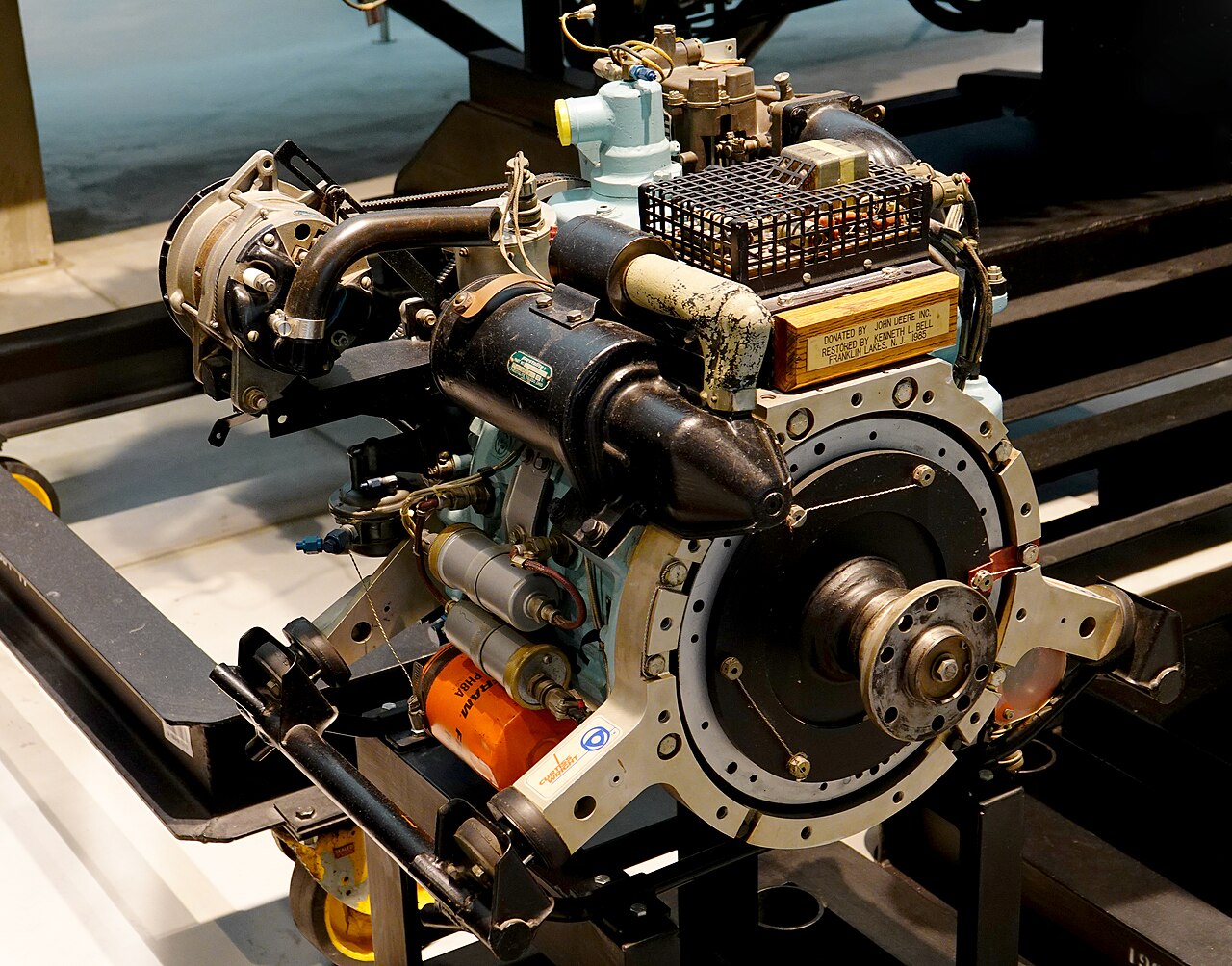
The U.S. Army's main research lab says it has flown something new in additive manufacturing: a heavy-fuel rotary engine made with metal 3D printing, running as the generator half of a hybrid-electric drone. On November 2, 2026, the DEVCOM Army Research Laboratory posted the announcement on its official news page under the headline "Army research leads to first 3D-printed heavy-fuel engine." According to VoxelMatters' report on the flight, the engine drove an electric motor-generator in a series-hybrid layout and flew in a Group 3 unmanned aircraft built with industry partners, Griffon Aerospace among them.
Plenty of things have been called "the first 3D-printed" something. This claim is worth reading closely anyway. It is not a printed bracket, a printed fuel nozzle or a printed manifold bolted onto a conventional engine. The Army describes the engine itself as the printed article, and as the first heavy-fuel engine of its kind. The engine has also flown, which a test-cell demonstration would not have shown.
What Actually Flew
The reported facts are short. The powerplant is a rotary engine designed to burn heavy fuel, and its hardware was made by metal additive manufacturing. It is air-cooled. It sits in a series-hybrid arrangement: the engine drives a generator rather than the aircraft directly. It spins a newly developed 400-volt motor-generator, and that electrical output powers the aircraft. VoxelMatters reports that the motor-generator was built to support vertical takeoff and landing in contested environments.
The aircraft is the VICTOR UAS, which stands for Versatile Intelligence Controlled Tactical Operational Reconnaissance and Attack. VoxelMatters describes it as a midsized drone, developed with industry partners including Griffon Aerospace. The full ARL article, hosted on army.mil, was not reachable for this report. So the details here come from ARL's headline and program pages and from VoxelMatters' coverage. Figures such as power output, displacement, endurance and the printing process or alloy used have not been confirmed, and we have left them out instead of guessing.
Why a Clean Sheet and Why a Rotary
VoxelMatters says ARL took a clean-sheet approach. The team used computational fluid dynamics modeling to work out how to burn heavy fuel cleanly in a rotary engine, instead of adapting an existing design. That order of work matters. When a team plans to print an engine from the start, the geometry that comes out of a CFD study does not have to be cut back to fit what casting or machining can produce. Internal passages, chamber shapes and wall features can follow what the simulation calls for.
The air-cooled choice is the other half of the design argument. In remarks reported by VoxelMatters, program manager Dr. Chol-Bum Kweon said air cooling reduces the engine's size and removes the need for liquid coolant. On a small aircraft, a liquid cooling loop means a radiator, pump, plumbing, fluid weight and more places for leaks. Removing all of it makes the package simpler.
The series-hybrid layout ties the design together. In principle, an engine that only has to run a generator can be tuned for a narrow operating band instead of throttling up and down with the aircraft's demands, leaving the electric side to handle the variable load. The sources do not describe how ARL tuned this engine, so that is an inference about the layout, not a reported result.
The Program Behind It
The engine came out of ARL's Versatile Tactical Power and Propulsion (VICTOR) essential research program, which Kweon manages. ARL's program page says VICTOR is meant to move knowledge into practice to raise the readiness and mission availability of future unmanned aircraft. Its stated goals line up closely with what flew. They include longer range and endurance, hybrid-electric propulsion with reliability and low noise, the ability to run unmanned air and ground vehicles on a wide range of fuels, and a smaller acoustic signature.
The program is large. VoxelMatters reports that VICTOR drew on more than 30 universities, more than 13 federal laboratories and more than 20 industry partners. It produced hundreds of journal papers and tens of patents. The flight demonstration is the most visible result of a long research effort, not a one-off stunt.
The lessons will feed into PULSAR, the Persistent Unmanned Aircraft System for Logistics, Strike, Autonomy, and Reconnaissance. VoxelMatters describes it as a swarm concept. The public reports do not say how the printed engine or the hybrid drivetrain will carry over into PULSAR hardware.
What It Means for Makers
Nobody reading this will print a flight-rated heavy-fuel rotary engine in a garage, and the Army hasn't released the process details that would let anyone try. VoxelMatters adds that metal printing let the researchers rapidly redesign engine components based on lessons from experimentation, and that the CFD redesign improved fuel atomization and vaporization and cut leakage of compressed air and fuel vapor. The demonstration still matters to the wider additive community for several reasons.
It is a strong data point for printing as the primary manufacturing route. The usual pitch for metal AM in aerospace is part consolidation: fewer joints and fewer fasteners in a part that was already conventionally made. A combustion engine designed clean-sheet with printing in mind goes further. Thermal management, combustion geometry and structure get solved together in one build. When a program like VICTOR does that and then flies the result, it suggests printed parts can hold up in a demanding thermal and mechanical environment.
Simulation-first design is the workflow worth copying. ARL's approach, as reported, started from CFD and let the printed geometry follow. Makers working at far smaller scale do the same thing whenever they model airflow in a printed duct or a hotend cooling shroud before printing it. Here the same logic is applied to combustion.
Hybrid-electric drivetrains are where small engines and printing meet. A generator-only engine that runs in a narrow band is a more forgiving target for a new manufacturing process than an engine that must handle every throttle condition. For anyone building large hobby or research UAS, the series-hybrid structure is a useful reference point. Printed engine or not, separating power generation from propulsion simplifies both.
Watch the supply chain, not just the engine. The program lists more than 20 industry partners and tens of patents. That is how defense research usually spreads into commercial suppliers, materials and qualification practices that the rest of the industry can use later.
Bottom Line
The Army has put a 3D-printed engine in the air, and the engine was printed by design, not adapted to the process afterward. The open questions are the numbers: power density, fuel consumption, durability and how many printed engines the Army plans to build. Until ARL's full article or later technical papers fill those in, the confirmed facts are the ones above: a printed, air-cooled heavy-fuel rotary, a 400-volt generator and a hybrid drone that flew.
