
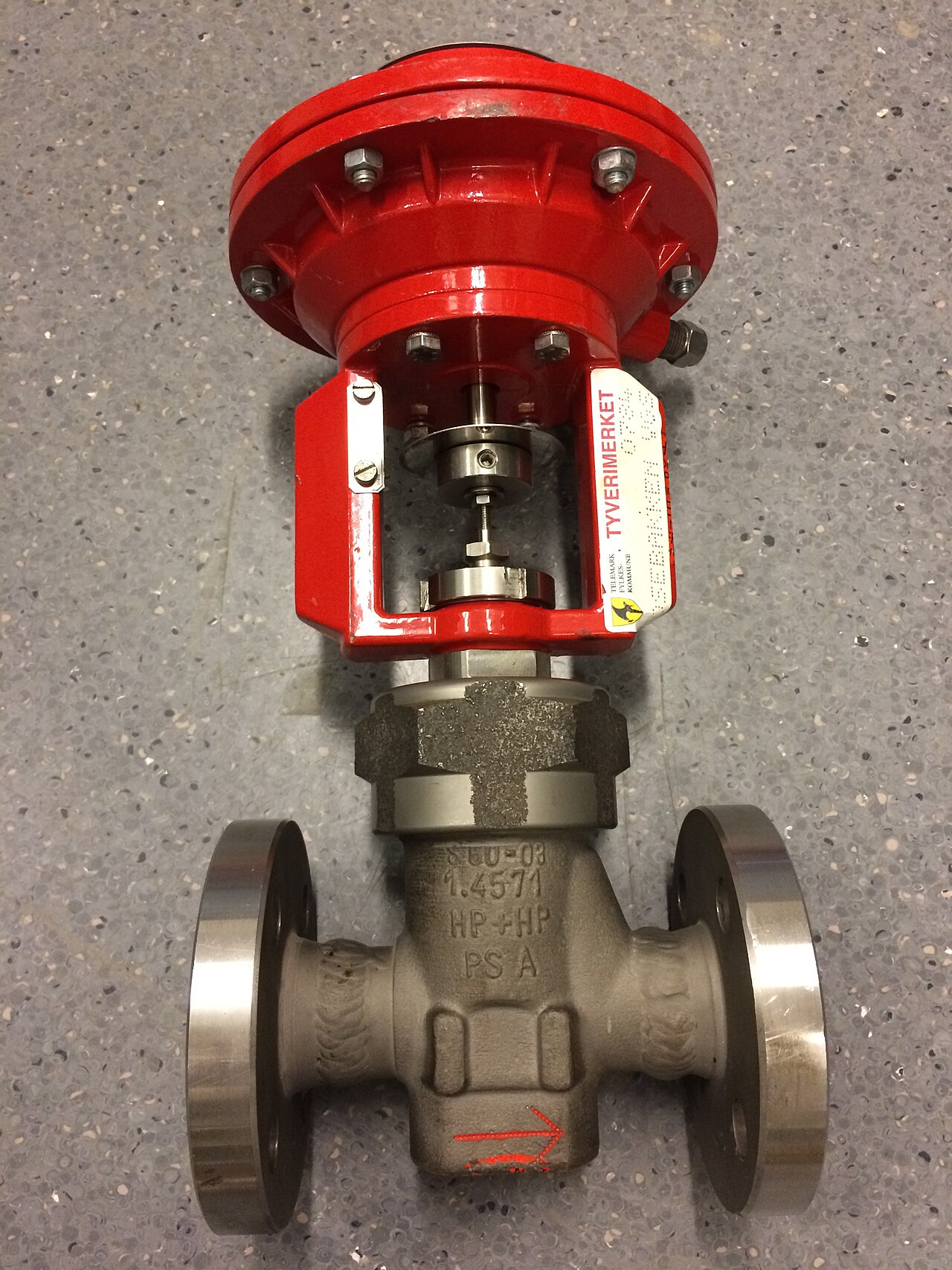
Metal additive manufacturing has spent years proving itself in brackets, manifolds and tooling, the parts where a failure is expensive but rarely dangerous. A new deployment in the Danish energy sector moves it closer to the hard end of the scale. According to an IMI case study on sour-service valves, TotalEnergies has installed nickel-based alloy valve trims made by laser powder bed fusion (LPBF) in sour gas service. IMI describes it as the first time TotalEnergies has installed additively manufactured nickel-based alloy components in a sour-gas environment. The parts went into seven anti-surge valves, and the qualification behind them matters as much as the parts.
A note on timing: the IMI case study is dated May 29, 2026. The project got wider attention with a 3D Printing Industry report published October 30, 2026. So this is less a brand-new announcement than a closer look at work that had already been documented.
What Was Actually Printed
The printed components are disk stacks, the multi-layer internal parts of a valve trim that control how flow passes through the valve. IMI's case study says the production disk-stack parts were produced by LPBF in outside diameters from 5.88 to 9.75 inches. That makes them substantial printed parts, not small inserts. According to the case study, the problem that started the project was valve passing issues in TotalEnergies Denmark's anti-surge systems, and the operator wanted a replacement that could withstand sour-gas conditions, preferably one that was 3D printed.
The 3D Printing Industry report places the installation at TotalEnergies EP Denmark and says the disk stacks come from IMI's Retrofit3D program, which designs custom 3D printed control valve trims that fit into existing valve bodies. These trims use IMI's DRAG technology, which sends fluid through a multi-stage, multi-path trim to reduce differential pressure. In a Retrofit3D upgrade only the internal trim changes; the pressure boundary and the actuation are untouched. The point is that the printed trims replace internals in valves already in service rather than requiring a new valve design.
According to the same report, tests showed the printed parts performed as well as conventionally manufactured nickel-alloy components. For an operator weighing a new manufacturing route, that is the result that counts. Matching the incumbent part is the bar.
Why Sour Gas Is the Hard Case
Sour gas contains hydrogen sulfide. The service conditions in this project are given as H2S partial pressures up to 3.3 kPa. The case study frames the challenge as more than performance: corrosion resistance, reliability and qualification all had to be shown. It also notes that, although the nickel-based alloy is well known in oil and gas applications, there was little to no track record of its use in H2S service, and previous industry studies showed inconsistent corrosion performance.
That is where printed metal invites scrutiny. An LPBF part is built from fused powder, layer by layer, and its as-built microstructure is not the same as wrought material made by conventional processing. Engineers cannot assume a printed nickel alloy behaves like its wrought equivalent just because the chemistry on the powder certificate matches. They have to demonstrate it.
The Qualification Path
IMI and TotalEnergies qualified the parts under DNV-ST-B203 at Additive Manufacturing Class (AMC) Level 3. The IMI case study says the process included Build Process Qualification and full production testing, and that the coupons and disk stacks were printed under DNV supervision. In practice, that means the qualification covered the way the parts were made, not only a final inspection of finished pieces. The case study lists tensile, impact, hardness, microstructure and porosity checks among the DNV production tests.
To compare the printed material against the conventional option, the team benchmarked it against wrought material using two ASTM corrosion tests:
- ASTM A262, for susceptibility to intergranular corrosion
- ASTM G61, for pitting corrosion behavior
Both are well-established methods, and that is the point. Instead of inventing a new acceptance scheme for printed parts, the project measured them against the yardstick already applied to conventional material and used wrought performance as the reference. In the A262 testing, IMI reports no cracking or fissures on either the printed or wrought samples after 15 hours of exposure. In the G61 potentiodynamic tests, the case study reports comparable pitting potential between printed and conventional material, around +398 mV versus +373 mV SCE.
One detail in the case study stands out. IMI and TotalEnergies developed a customized heat treatment for the printed parts, aimed at improving both corrosion and mechanical performance. Post-processing is often where AM metallurgy succeeds or fails, and the fact that a custom heat treatment was part of the qualified route tells you where the engineering effort went. The case study describes the results, including higher hardness of roughly 50 HRC, but does not publish the heat treatment parameters.
The result was approval for seven anti-surge valves. The 3D Printing Industry report includes comments from Bertrand Maillon, who leads Retrofit3D at IMI, and Bertrand Levaché, TotalEnergies' Head of Additive Manufacturing, which signals that the work had backing on both the supplier and operator sides.
Reading Between the Lines
It helps to be clear about what this project shows and what it does not. The sources describe seven valves at TotalEnergies EP Denmark, qualified for service with H2S partial pressures up to 3.3 kPa, with parts reported to perform as well as conventional ones. They do not describe fleet-wide adoption, cost comparisons, lead-time savings or long-term service data, and it would be a mistake to infer those.
What the project does show is a full template: a recognized classification-society standard, supervised builds, a qualified build process, corrosion benchmarking against wrought material using standard tests, and a heat treatment developed for the printed part. That template is arguably the more durable result. Another operator or part family has a documented example to learn from, although nothing in the sources says one is following it.
What It Means for Makers
Few readers will print nickel-alloy valve trims in a garage, but the lessons carry down to the bench.
Printed has to be proven against the incumbent. The project's central effort was showing that LPBF material could match wrought material on corrosion tests chosen for the risk at hand. The same thinking applies to a polymer part replacing a molded one: decide which property matters for the application, then test that property against the incumbent part instead of assuming parity.
Post-processing is part of the material. A dedicated heat treatment was part of the qualified route. Hobbyists who anneal PLA or nylon, or cure resin prints, are working on the same idea at a smaller scale: the finished part's properties depend on what happens after printing.
Process qualification beats part inspection. DNV-ST-B203's Build Process Qualification and supervised printing focus on making the process repeatable, not just checking individual parts. For makers selling functional parts or running small print farms, locking down settings, materials and post-processing, and documenting them, is how a lucky part becomes a reliable product.
Retrofit is the opening. The Retrofit3D trims are designed to fit into existing valve bodies. That is the same angle many makers already take with replacement knobs, brackets and obsolete spares: replace an existing part rather than redesign the whole system. Here, that approach has reached sour-gas service.
