
Most of the bioprinting stories that cross a maker's desk are about hardware and materials — new print heads, better hydrogels, higher-resolution deposition. This one is about money, and the size of it says something about where the field is headed. According to Aspect Biosystems' newsroom, the Vancouver-based company has secured $79 million from the Government of Canada to expand its work on bioengineered cellular medicines — the latest installment of a $280 million multi-year partnership the company and Ottawa announced in April 2026. It is the kind of government-scale check that rarely lands on a 3D-printing platform, and it reframes bioprinting from a lab curiosity into an instrument of national industrial and health policy.
The headline number is worth sitting with. Aspect, founded in 2013 as a University of British Columbia spinout by Tamer Mohamed and Simon Beyer, has now raised more than $500 million in total. The company runs on roughly 130 employees. That is a lot of capital and a comparatively lean headcount, which tells you the money is going into a long, expensive regulatory and manufacturing runway rather than into scaling a workforce. Cellular medicines do not ship the week after you print them; they move through years of preclinical and clinical work before a single patient sees a dose.
What Aspect Actually Prints
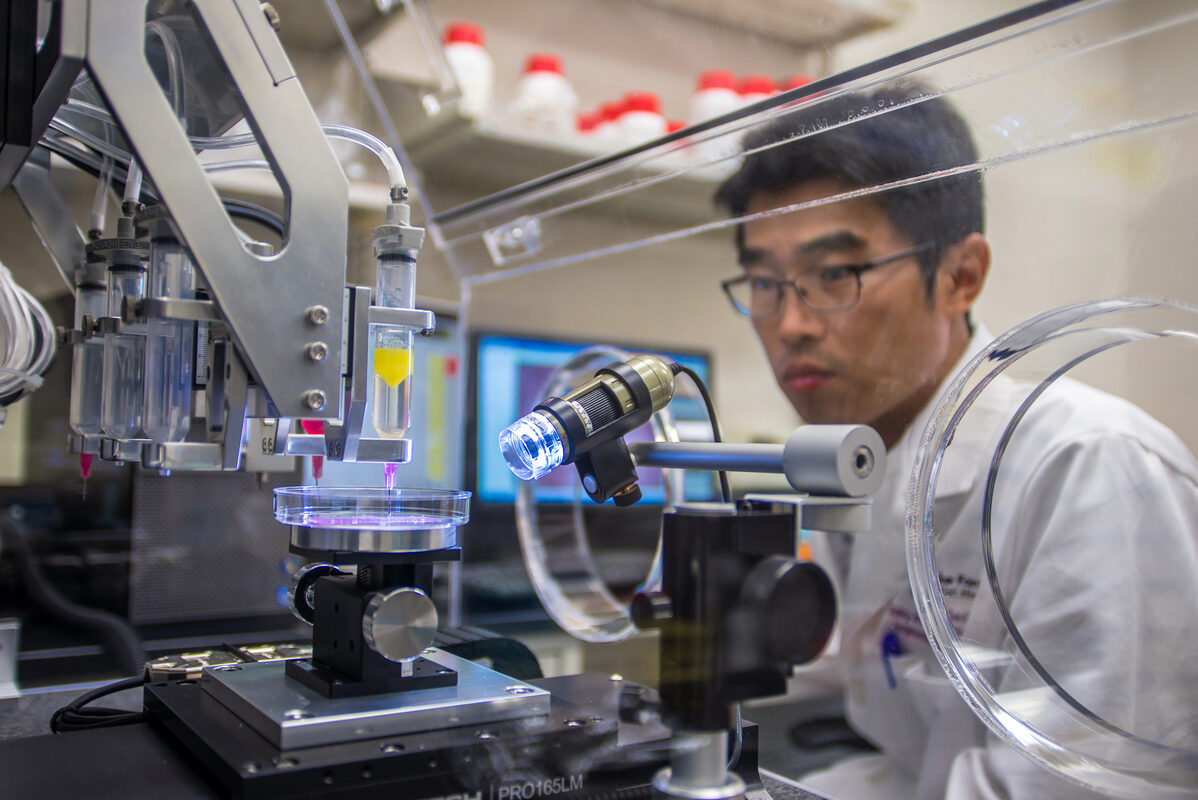
The distinction that matters here — and the one that separates Aspect from the desktop and industrial printers most FilamentFeed readers know — is that the "material" is living cells, and the print is only the first step. Aspect's platform uses AI to program human stem cells into specific, functional cell types, then bioprints them into structures engineered to survive inside a patient. Two problems dominate that work: getting cells to behave like the tissue you need, and keeping the recipient's immune system from destroying the graft. Aspect's approach tackles both, pairing the programming of cell identity with a shielding strategy that hides the printed cells from immune rejection.
The lead application is Type 1 diabetes, and it is a clean illustration of why bioprinting is attractive here. In Type 1 diabetes, the immune system destroys the pancreatic islet cells that produce insulin. Aspect's goal is to print replacement islet cells that sense blood glucose and release insulin in response — a self-regulating implant rather than a device the patient has to manage. The immune-shielding piece is not a nice-to-have; it is the whole ballgame. Transplanted islets have existed in various forms for years, but keeping them alive without lifelong immunosuppression has been the wall the field keeps hitting. A printed graft that the body tolerates on its own would be a genuine shift.
Why a Government Is Writing the Check
Governments do not typically co-invest in manufacturing platforms unless they see strategic value, and Canada's involvement here has a track record behind it. The current $79 million sits inside a $280 million initiative, and it follows a roughly $200 million federal and British Columbia co-investment in 2024. That is two rounds of public money inside two years, which reads less like a one-off grant and more like an attempt to anchor a biomanufacturing capability on Canadian soil. For a country trying to build domestic advanced-manufacturing and life-sciences capacity, a homegrown bioprinting company with a diabetes program is exactly the kind of asset worth keeping — and worth keeping onshore.
The public funding does not stand alone. Aspect also holds a $2.6 billion partnership with pharmaceutical giant Novo Nordisk, the Danish company whose name has become synonymous with diabetes and metabolic medicine. That pairing is telling. Government money de-risks the platform and signals confidence; the Novo Nordisk deal supplies the commercial pathway and the deep-pocketed partner that can carry a therapy through late-stage development and eventual manufacturing at scale. When a platform attracts both government capital and a multi-billion-dollar pharma alliance, the market is saying the science has moved past proof-of-concept.
Chief executive Tamer Mohamed framed the funding around momentum toward getting therapies to patients — the standard language of a company that has spent a decade in the lab and now has the resources to push toward the clinic in earnest. The subtext, for anyone reading the financing rather than the press release, is that Aspect has assembled the three things a cellular-medicine company needs at once: a technology platform, patient capital, and a commercial partner.
What It Means for Makers
Let's be direct: nobody reading this is going to print islet cells on a hobby machine, and Aspect's platform has essentially nothing in common with the FDM and resin printers on your bench. The deposition physics, the "ink," the entire quality-control regime — all of it lives in a different world. So the practical takeaway is not technical. It is what this financing signals about the trajectory of the broader field you already work in.
Bioprinting has spent years as the perennial "someday" story — impressive demos, cautious timelines, and not much money that a serious industrialist would recognize. A $79 million government installment inside a $280 million partnership, layered on top of a $2.6 billion pharma deal and half a billion in total raised, changes that framing. It marks bioprinting as a category that can now absorb government-scale and pharma-scale capital, which is the clearest signal you get that a technology has crossed from research into industry. For makers who care about where additive manufacturing is going as a whole, that maturation matters: it pulls talent, tooling, and standards into the additive space, and the norms that get built for a regulated, high-stakes application tend to ripple outward.
It is also a useful reminder of how wide "3D printing" has become as a term. The same verb covers a $200 desktop machine squirting PLA and a Vancouver lab programming stem cells into glucose-sensing implants backed by a G7 government. The gap between those two is enormous — but they share a lineage, and the money now flowing into the far end of that spectrum is a sign the whole field is being taken more seriously than it was even two years ago.
Bottom Line
Aspect Biosystems has turned a decade of bioprinting research into government-scale backing and a blue-chip pharma partnership, with printed insulin-producing islets for Type 1 diabetes as its lead swing. The therapy still has a long clinical road ahead, and the science is unrelated to anything on a maker's workbench. But the financing is the story: when governments and pharma giants start writing nine- and ten-figure checks against a bioprinting platform, the field has stopped being a promise and started being an industry.
