
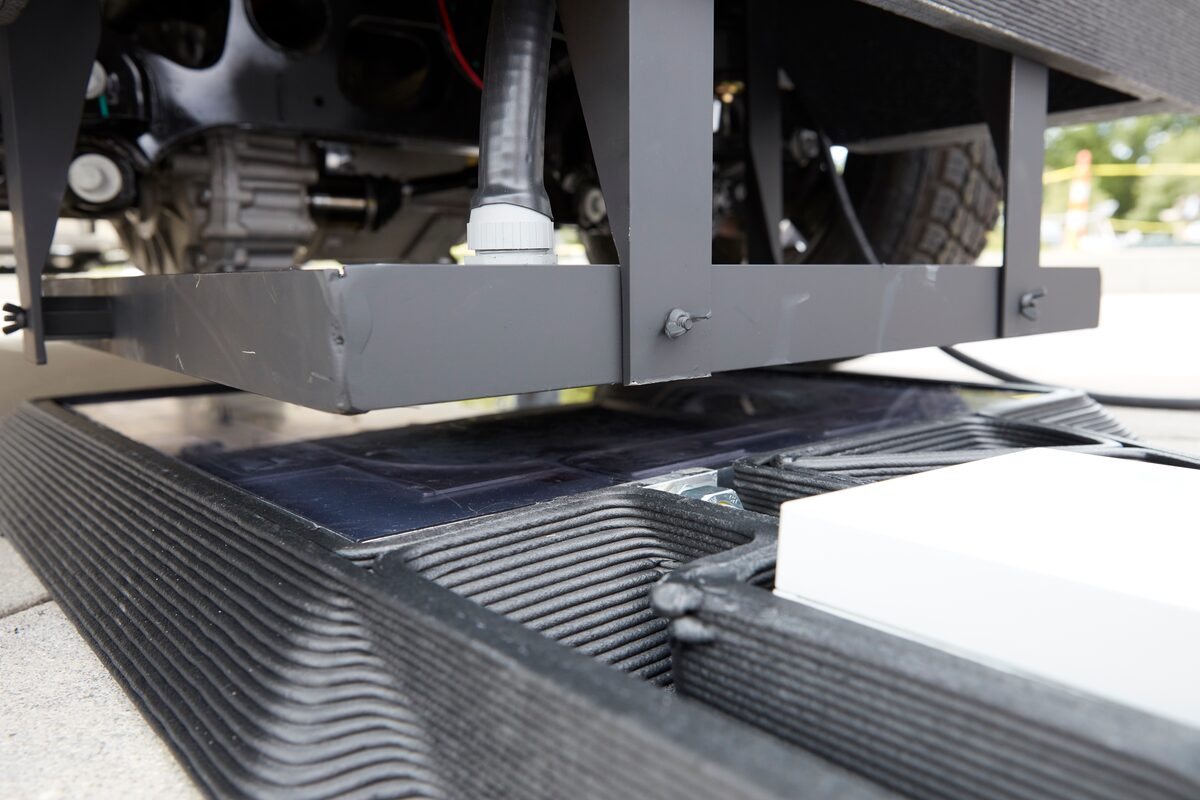
A truss that started its life as a stack of discarded water bottles just helped the U.S. Army Corps of Engineers cross a Massachusetts wetland. According to MIT News, Atlas Building Composites — a spinout of MIT's HAUS research group — has commercialized a waterless recycling process that shreds single-use plastic, fuses it with American-made fiberglass, and 3D prints the resulting composite into structural trusses, foundations, and decking. The company says the technology is no longer a lab curiosity: it's already load-bearing infrastructure in the field.
For makers who spend their weekends coaxing PETG and PLA into brackets and enclosures, Atlas's pitch lands differently. This isn't a desktop printer extruding filament through a 0.4mm nozzle — it's an industrial system printing building-code-relevant structural members, and it's doing it with feedstock that would otherwise end up in a landfill or an incinerator.
From HAUS Lab to Load-Bearing Structure
Atlas grew out of MIT HAUS — Home Architecture for Universal Sustainability — and was founded by A.J. Perez, who earned his MIT PhD in 2023 and now works as a research scientist, and Matt Pouliot, a former Maine senator. That pairing of a materials researcher and a policy veteran shows up in how the company talks about its mission: not just a better composite, but a manufacturing model meant to slot into housing supply chains at scale.
The core process is deceptively simple to describe and, per MIT News, genuinely waterless: shredded plastic waste — the kind sourced from single-use bottles — is melted and fused with fiberglass rather than processed through the water-intensive washing and pelletizing steps typical of conventional plastics recycling. The resulting composite feedstock is then extruded through a large-format 3D printer into structural shapes.
What comes out the other end isn't decorative. According to Tech Xplore, which corroborates the MIT HAUS origin story, Atlas's printed trusses come off the machine in under 13 minutes and support more than 4,000 pounds — a figure the company says exceeds building code standards for the application. For context, that's the kind of load-bearing performance builders expect from engineered lumber or steel framing members, not from something that started as beverage packaging.
A Bridge Is the Proof of Concept That Matters
Claims about strength are one thing; field deployment is another. Both sources confirm that Atlas supplied the Army Corps of Engineers with composite trusses for a 40-foot bridge project in a Massachusetts wetland, and that the structure went in in under a day. Wetland sites are a notoriously unforgiving proving ground — poor access, sensitive ecosystems that limit heavy equipment and staging time, and moisture exposure that would degrade untreated wood far faster than a sealed composite. Handing that job to a federal engineering agency, rather than a residential contractor doing a backyard deck, is a meaningful signal: it suggests the trusses have cleared at least some level of structural scrutiny beyond marketing copy.
The American-made fiberglass component is also worth noting for anyone tracking supply chain resilience in construction materials. Rather than relying on imported reinforcement fiber, Atlas has kept that half of the composite domestic, which — combined with sourcing plastic waste locally — points toward a manufacturing model built around regional, rather than globalized, supply.
Scaling the Factory, Not Just the Printer
The most interesting numbers in MIT's writeup aren't about the trusses themselves but about throughput. Atlas's commercial hardware, branded the "Atlas Factory Stack," runs at 150 to 200 pounds of composite per hour. That's roughly double to triple the 60 to 80 pounds per hour Atlas was getting out of MIT lab-scale test rigs — a jump that matters enormously for anyone evaluating whether this is a lab demo dressed up as a company or an actual production process.
Atlas's stated ambition for that throughput is to let a single factory cell produce framing for roughly one small home per day. The company frames this inside a much larger goal — helping build 1 billion homes — which is the kind of number that should be read as a north star rather than a near-term roadmap. Still, the mechanism behind it is coherent: if localized "factory cells" can each turn regional plastic waste streams into a home's worth of structural framing daily, that decouples housing material supply from both lumber markets and long-haul steel shipping in a way that's genuinely novel.
What It Means for Makers
This is industrial-scale large-format printing, not something you're replicating on a Prusa or a Bambu — but it's a useful data point for anyone in the 3D printing community thinking about recycled and composite filaments. Atlas's results are a strong existence proof that waste-plastic-plus-fiberglass composites can hit structural performance numbers that matter, when the process (waterless melt-fusion, in this case) and the print parameters are dialed in at scale. That's directionally relevant to the growing ecosystem of desktop recyclers and recycled-content filament brands, even though the physics and tolerances of a 4,000-pound truss and a desktop-printed bracket are worlds apart.
It's also a reminder that "recycled filament" doesn't have to mean lower performance. The narrative in consumer 3D printing has often treated recycled material as a sustainability compromise — good for the planet, but weaker, less consistent, harder to print. Atlas's numbers, if they hold up under broader third-party scrutiny, argue the opposite: with the right fiber reinforcement and process control, waste-stream plastic can outperform a traditional building material like wood on a direct strength comparison. For makers building anything load-bearing with reinforced or recycled filament — furniture, outdoor structures, functional prototypes — that's worth watching as the underlying science and process controls trickle down to smaller-format equipment.
Bottom Line
Atlas Building Composites has moved a genuinely interesting materials-science result — waterless plastic-to-composite recycling — out of the MIT HAUS lab, rooted in research dating back to 2019, and into a real federal infrastructure project that is already bearing load in the field. The 4,000-pound truss rating, the sub-13-minute print time, and the Army Corps bridge deployment are concrete, verifiable milestones rather than vague sustainability promises. The bigger question, as with any manufacturing startup claiming a path to planetary-scale impact, is whether the Atlas Factory Stack's throughput gains continue to compound as the company adds cells and customers. For now, the wetland bridge is standing, and it's holding weight on plastic that used to be a water bottle.
