
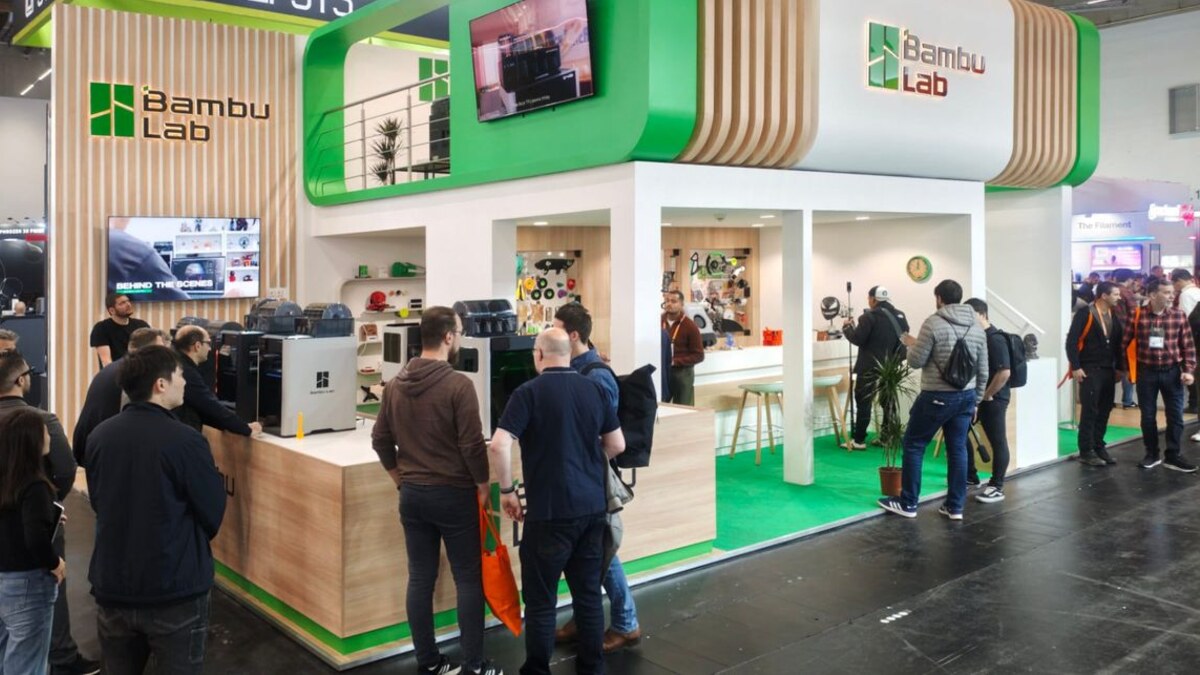
Bambu Lab's hardware usually gets the headlines at trade shows. At Formnext 2026 the company's most interesting announcement is a business programme. In a post on the Bambu Lab blog, the company introduced Bambu Circle, an authorised network of local entrepreneurs who will service machines, sell printers and materials on a small scale, run print services and teach classes, all built around Bambu's ecosystem and its MakerWorld model platform. Bambu Lab says it will coordinate, train and certify the members. The pilot starts in the Netherlands. Germany and France are due to follow in early 2027, and a waiting list is already open to applicants anywhere in Europe.
Formnext runs November 17 to 20 in Frankfurt. Bambu is in Hall 12.1, Booth G01, at its fourth appearance at the show. The H3C and the R1 laser cutter are on the stand too. Still, Circle may matter more in the long run than either machine, because it shows how Bambu wants to grow its relationship with the people who already own its printers.
What Bambu Circle Actually Is
Bambu describes Circle as an authorised network of local entrepreneurs, and the scope it lists is broad. Partners can offer four kinds of service:
- Local machine servicing. Repairs and maintenance done by someone nearby, without shipping a printer back.
- Small-scale retail of printers and materials. A local shop selling hardware and filament.
- 3D printing services. Print-on-demand for customers who don't own a printer or need more capacity.
- Training and educational programmes. Courses and workshops, presumably for beginners, schools and small businesses.
All four sit inside Bambu's ecosystem, and Bambu names MakerWorld, its model-sharing platform, as part of that foundation. How the two will connect is still unclear. As 3D Printing Industry noted, the company has not detailed how MakerWorld will fit into partner operations. It could mean commissioned prints of MakerWorld designs, licensing arrangements with designers, referrals, or something else. That detail will shape a lot of how the programme works in practice.
Bambu also says it is leaving the door open to new ideas, and invites people with their own vision of how to serve a local community to get in touch.
Why the Netherlands Goes First
Bambu's reason for the Dutch pilot is a survey result. According to the company, 58 percent of Dutch users in a recent survey said they wanted to earn side income from 3D printing. Neither source gives the sample size or method, so the figure works better as a reason to pick a pilot market than as evidence about European makers in general. It does fit what anyone who has browsed a local marketplace has seen: plenty of hobbyists already sell prints, fix friends' machines or run informal workshops. Circle would turn some of that into an official, certified role.
Bambu pitches Circle as a complement to its existing support, with local expertise so that there is always an option close to home. Some owners just want someone to look at their printer in person, and others want a place to meet people who share the hobby. The Dutch pilot is a way to see whether that model can find enough customers before Germany and France follow in early 2027.
The One-Hour Goal
Bambu's stated long-term aim is that every Bambu user in Europe should be within a one-hour drive of an authorised partner. That is ambitious. Across a continent with large rural areas, it would take a lot of partners, and they would only be viable where there is enough local demand for servicing, sales, print jobs and classes to keep them going.
The goal also points at a long-standing weakness of consumer 3D printing: support after the sale. Printers break, owners get stuck, and the usual fixes are forum threads, video tutorials, ordering spare parts and doing it yourself. Many makers enjoy that. Many newer owners, and most small businesses, don't. A certified technician an hour away is a different kind of support, and it would bring Bambu closer to how established tool and appliance brands handle service.
Bambu framed the announcement with its own history. The company recalls that in May 2022 its Kickstarter drew 5,575 backers who pledged more than $7 million, and says Circle takes that relationship one step further by giving makers a chance to earn money from it. That reads partly as marketing, but it also shows how Bambu sees its customers: as people who might help run its business, not just buy printers.
What We Don't Know Yet
The announcement, at least as published in the two sources we read, leaves out the details that matter most to anyone thinking of joining. Bambu has not disclosed:
- Financial terms. Whether there are entry fees, wholesale margins on printers and materials, revenue sharing on services, or payment for warranty work.
- Partner requirements. What certification involves, what equipment or premises partners need, and whether existing businesses are preferred over individuals.
- MakerWorld integration. As noted above, how partners will use the platform hasn't been explained.
Until those details are public, signing up for the waiting list is a way to register interest, not a business decision.
What It Means for Makers
For Bambu owners who already sell prints or fix printers on the side, Circle could bring official status, training and possibly better access to stock and parts. Customers tend to treat a certified badge differently from a stranger on a marketplace, and that trust is valuable to a small operation.
There are trade-offs. Circle is built around one company's ecosystem. A partner whose income depends on Bambu certification, Bambu supply and maybe MakerWorld integration has tied part of their business to Bambu's decisions. That isn't unusual, since authorised dealer and service networks work this way in many industries, but you should be clear about it before joining. A shop that also services and sells other brands may find the arrangement fits less comfortably, depending on the requirements Bambu hasn't yet published.
For ordinary owners, the main benefit is easier service. If the network reaches anything like its one-hour target, a dead printer could mean a short drive, not a support ticket and a shipping box. That would matter most to users with no interest in rebuilding a toolhead themselves, and as printers become more of an appliance, that group keeps growing.
For the wider market, Circle shows Bambu extending beyond equipment and online platforms into a locally operated service network in Europe. As 3D Printing Industry put it, the Dutch pilot and the planned expansion will give the first indication of how the model works across different markets.
Bottom line: If you're in the Netherlands and already make money from printing, the waiting list costs nothing and is worth joining. Everyone else, especially in Germany and France, should wait for the financial terms and partner requirements before reading much into the programme.
