
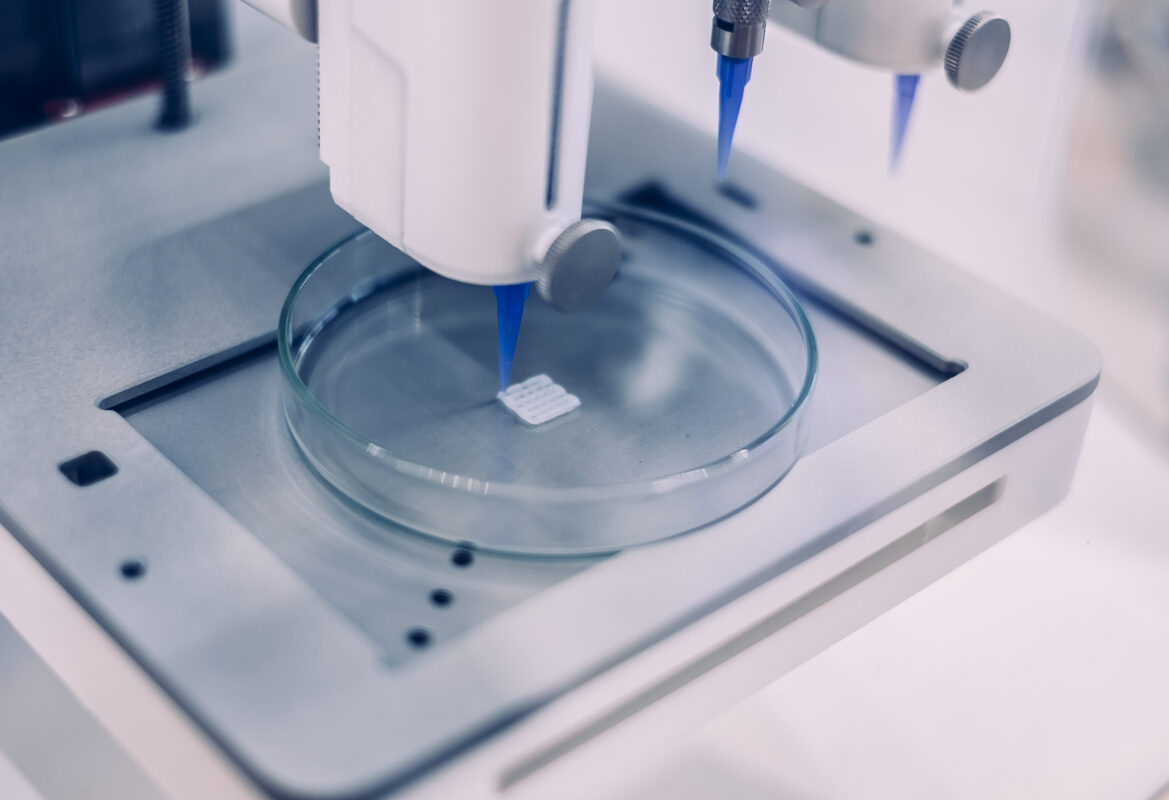
Most 3D-printing milestones are measured in parts, print time, or dimensional tolerance. This one is measured in patients. As of mid-2026, 3DPrint.com — “BellaSeno Completes Two Clinical Trials on 3D Printed Resorbable Breast Implants” reports that 30 Australian women have undergone restorative breast surgery using scaffolds printed entirely from a single, unglamorous engineering material: medical-grade polycaprolactone. If you have ever spooled PCL through a hobby extruder and been annoyed by how low it melts, this is the story of what that same low-temperature polyester can do when it is printed to medical spec, implanted, and then allowed to vanish.
The number spans two clinical trials. The first, a first-in-human safety study, enrolled 19 patients and ran from 2021 to 2023. The second, a pivotal trial, launched in January 2026 and has treated 11 patients so far, with more already enrolled. Add the cohorts and you arrive at the 30-patient figure BellaSeno and the trade press are pointing to this week. It is a modest total by pharmaceutical standards, but for a load-bearing, fully bioresorbable printed implant, it represents an unusually long real-world track record.
The material is the whole trick
Polycaprolactone is not new, and that is precisely the point. It is a biodegradable polyester that has been used for years in absorbable sutures — the kind that dissolve on their own instead of needing removal. Surgeons and regulators already understand how the human body handles it. BellaSeno's contribution is not a novel chemistry but a novel geometry: taking a well-characterized, body-safe polymer and printing it into an open, porous framework shaped like breast tissue.
That framework does no cosmetic work by itself. It is not a filler and not a fixed prosthetic. Instead, the scaffold is implanted and seeded with the patient's own fat, harvested from elsewhere on the body. The printed lattice acts as scaffolding in the literal, structural sense — a temporary trellis that gives transplanted fat cells a stable, vascularizable place to take hold and organize. Over the following one to two years, the body regenerates breast volume and shape inside and around the structure. As living tissue fills in, the PCL does what PCL does: it slowly hydrolyzes and is resorbed, leaving the patient's own regenerated tissue behind and no permanent foreign object in place.
It is a deliberately different philosophy from a silicone implant, which is designed to stay inert and stay put. Here the engineered object is meant to be transient. The scaffold's job is to hold a shape long enough for biology to take over, then get out of the way.
What the trials have shown so far
The safety study is the one with mature follow-up data, and its results are the reason a pivotal trial exists at all. According to reporting from VoxelMatters, that first-in-human cohort showed no scaffold-related complications, and patients retained a mean of 83 percent of their breast volume at the two-year follow-up mark. For a structure engineered to dissolve, volume retention is the whole ballgame: it is the direct evidence that regenerated tissue actually replaced the scaffold rather than collapsing as the polymer disappeared.
The pivotal trial, launched in January 2026, is the larger and more rigorous test that a therapy has to pass on its way toward broader clinical use. With 11 patients treated so far and additional enrollment underway, it is still early — but the fact that it began at all signals that the safety data cleared the bar to justify a bigger, more formal study.
What It Means for Makers
If you print with PCL, or have watched it sit in the "specialty filament" bin next to the flexibles, this milestone is worth internalizing for a few reasons.
First, it is a concrete demonstration that additive manufacturing's advantage in medicine is not just patient-specific shape — it is patient-specific porosity. A cast or molded PCL blank could match an outline, but the open, interconnected lattice that lets fat and blood vessels infiltrate is exactly the kind of internal architecture that 3D printing produces natively and traditional manufacturing struggles to. The value here lives in the internal structure, not the silhouette.
Second, it reframes what "a good print material" can mean. In the maker world we prize materials that are stable, strong, and permanent. This application inverts every one of those instincts: the entire therapeutic value depends on the polymer being temporary and predictably degradable. PCL is desirable here because it disappears on a known timeline. That is a useful reminder that material selection is always about matching properties to the job, and sometimes the job is to not stick around.
Third, it is a reality check on timelines. Nothing about this is fast. The material has a suture-grade safety pedigree stretching back years, the safety study alone ran roughly 2021 to 2023, and outcomes are measured on a one-to-two-year regeneration window. The lesson for anyone excited about medical 3D printing: the printing is the quick part. Validation is the long part.
The bottom line
Thirty patients across two trials is not a market, and BellaSeno's scaffolds are not something you will read about at your local print meetup as an off-the-shelf product. What the number represents is durability of an approach — a bioresorbable, 3D-printed polyester implant that has now accumulated years of human follow-up, an 83 percent mean volume-retention figure at two years in its first cohort, and no reported scaffold-related complications in that group, all while moving into a pivotal trial.
For a field where "we printed an organ" headlines tend to outrun the clinic by a decade, a printed PCL lattice that is quietly resorbing inside 30 real patients is the less flashy but more meaningful kind of progress. The scaffold's success is defined by its own disappearance — and so far, on the evidence available, it appears to be disappearing on schedule.
