
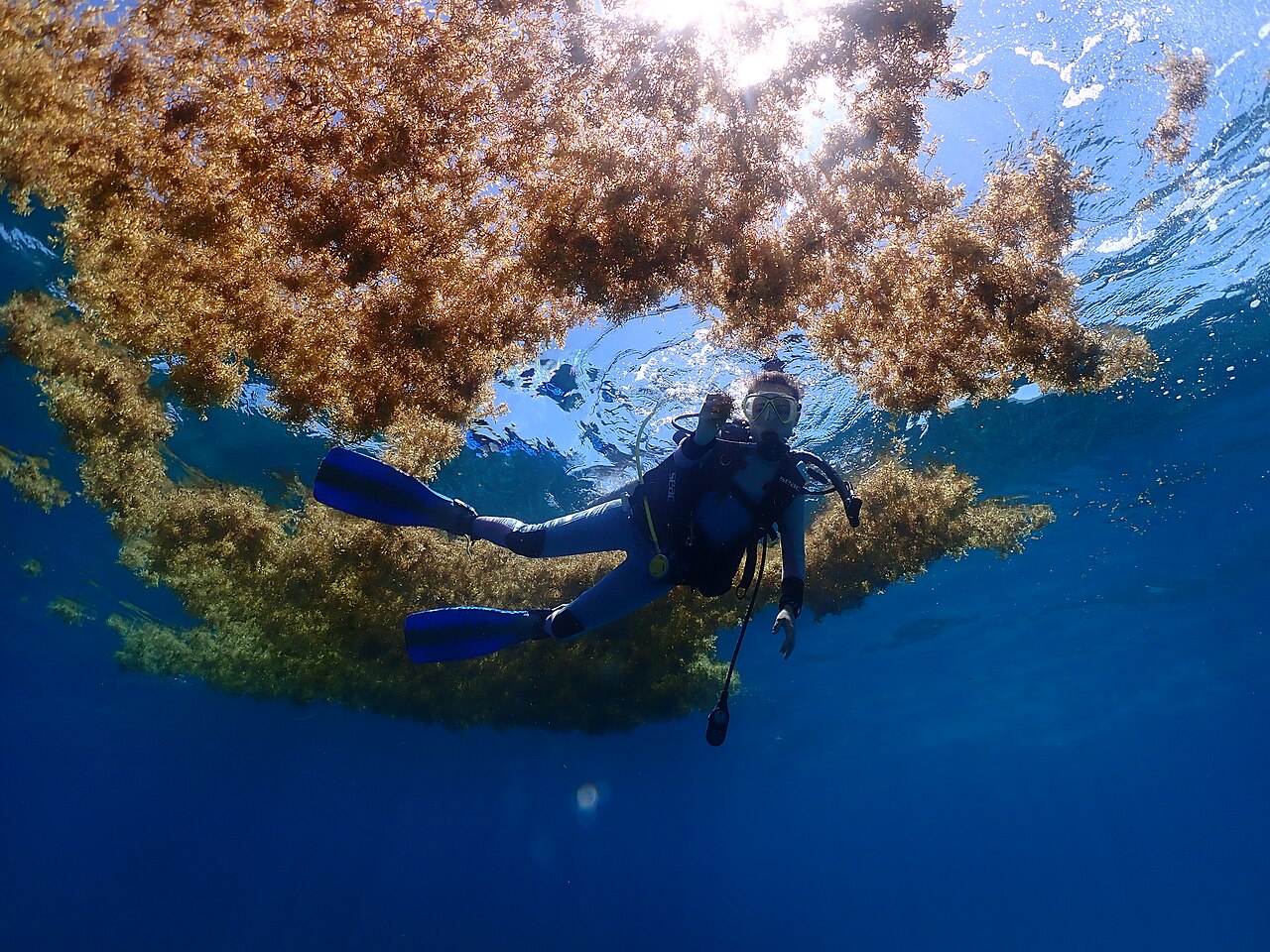
Florida has two water problems that rarely get mentioned in the same sentence: toxic algal blooms choking Lake Okeechobee, and sargassum — the brown seaweed that arrives in vast, unwelcome quantities. A new project at Florida Atlantic University proposes to point one problem at the other. FAU has been awarded an $800,475 grant from the U.S. EPA's Gulf of America Division to 3D print water-treatment structures out of sargassum that has been chemically modified with lanthanum, a rare-earth element with a strong appetite for phosphorus. Deployed into the lake, the printed structures are designed to adsorb phosphorus — the nutrient that feeds harmful algal blooms — from both the water column and the sediments below, and then do something today's treatments cannot: come back out of the water to be regenerated and redeployed.
The three-year project began July 1, 2026, with Lake Okeechobee serving as the testbed. The principal investigator is Masoud Jahandar Lashaki, Ph.D., an associate professor in FAU's Department of Civil, Environmental and Geomatics Engineering, joined by FAU co-investigators Yalan Liu, Ph.D., and Mohammed Abdellatef, Ph.D., with Huichun Zhang, Ph.D., of Case Western Reserve University participating as a sub-awardee. The award, Lashaki says, "provides an exciting opportunity to transform how we manage one of the most persistent causes of harmful algal blooms."
The problem with powders
Phosphorus is the lever that matters in freshwater algal blooms, and the current tool of choice for pulling it out of lakes is a powdered one: lanthanum-based materials typically applied as fine powders. Lanthanum is highly effective at capturing phosphorus, which is why these products work at all. But as coverage from 3DPrinting.com notes, the powdered approach has a structural flaw. Once dispersed, the particles settle into the lake sediments, where they are effectively unrecoverable — and from there they can slowly release lanthanum back into the environment, leaving a rare-earth residue in the lake they were meant to help. Every application is a one-shot consumable, and the lakebed becomes the permanent home of whatever you put in.
The FAU team's answer is to change the form factor rather than the chemistry. By loading the lanthanum onto a printable, seaweed-derived feedstock and fabricating discrete structures instead of loose powder, the adsorbent becomes an object — something with a location, a handle, and a service life. A saturated structure can be hauled out, stripped of its captured phosphorus, regenerated, and put back to work. That converts phosphorus removal from a disposal problem into a recovery loop — a deploy-retrieve-regenerate-reuse cycle the university says significantly reduces waste.
Why print it from seaweed?
The choice of sargassum as the base material is the kind of move that makes this project interesting to anyone following sustainable feedstocks. Rather than starting from a virgin polymer or a mined mineral carrier, the team is building its adsorbent from biomass — and not just any biomass, but a naturally abundant marine macroalga that Florida knows all too well. The lanthanum modification gives the material its phosphorus-trapping function; the printing process gives it geometry.
Geometry is not a cosmetic detail here. An adsorbent's usefulness depends on how much active surface it exposes to the water and how well water can move through it, and additive manufacturing is uniquely good at producing open, high-surface-area shapes that would be impossible to mold or extrude conventionally. It also allows the same material to be produced in different configurations for different jobs — a structure sitting on contaminated sediment has a different task than one intercepting phosphorus in open water, and the FAU design targets both. The university's release emphasizes that the structures capture phosphorus from the water column and from lake sediments alike, which matters because phosphorus stored in sediments can keep feeding blooms even after new inputs are cut.
Machine learning picks the recipe — and the spot
The second half of the project is computational. Formulating an adsorbent involves a large design space — how the seaweed is processed, how the lanthanum is incorporated, what structure it's printed into — and testing every permutation at the bench is slow. The team is applying machine learning to identify the most effective adsorbent formulations rather than brute-forcing the search.
The same toolkit extends to deployment. Where you place a phosphorus trap in a lake the size of Okeechobee matters enormously, and the models will integrate environmental monitoring data with land-use records, weather patterns, fertilizer applications, livestock operations, and septic system information to determine optimal deployment locations and predict where phosphorus removal will have the greatest impact on preventing blooms. In effect, the project treats the lake as a system to be instrumented and optimized, not just a body of water to be dosed. It's a notably different posture from the dose-and-hope model that powdered treatments impose.
What It Means for Makers
Nobody reading this is going to load sargassum filament into a Prusa next month, but the project is worth watching for three reasons.
First, it's a serious, federally funded validation of bio-derived printing feedstocks doing functional — not decorative — work. Much of the sustainable-materials conversation in desktop printing revolves around recycled PETG and bio-based PLA, materials chosen for what they avoid rather than what they do. A printed structure whose material chemistry is the product, and whose value comes from adsorption performance, is a different category: functional materials, where the print is a chemical device.
Second, the retrievability argument generalizes. The core insight — that giving a functional material a printed macrostructure turns a consumable into a serviceable, regenerable asset — applies well beyond lake remediation. It's a design pattern makers working on filtration, catalysis, or environmental sensing projects can borrow today with materials they already have.
Third, the pairing of additive manufacturing with machine-learning-driven formulation and siting is a preview of how environmental hardware gets designed when the geometry is free. When you can print any shape, the bottleneck shifts to knowing which shape, which formulation, and which location — and that's a data problem.
The bottom line: an $800,475 bet by the EPA that a printed seaweed lattice can out-perform a loose powder is a small line item in the agency's budget, but it's exactly the kind of project that moves 3D printing's materials story forward. If Lashaki's team can show phosphorus coming out of Okeechobee on structures that go back in for another pass, the technique won't stay confined to one Florida lake.
