
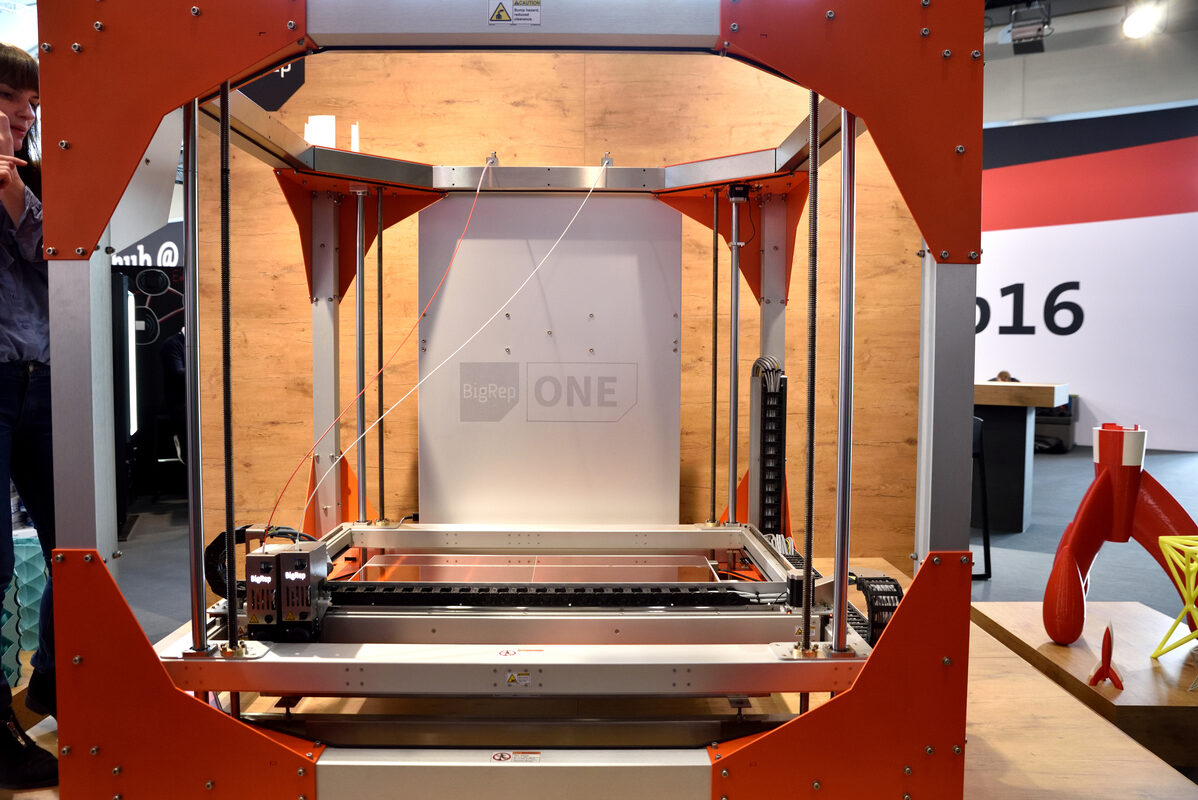
BigRep, the Berlin-based pioneer of large-format fused filament fabrication, is separating its business from its stock-market shell. According to a report from VoxelMatters, the management board and supervisory board of BigRep SE have approved the sale of operating subsidiary BigRep GmbH to a group of three buyers — De Krassny GmbH, Koehler Invest GmbH, and HAGE Holding GmbH — and plan to delist the publicly listed parent company from the Frankfurt Stock Exchange and place it into voluntary liquidation under Luxembourg law, pending a shareholder vote at an extraordinary general meeting.
The practical upshot for makers and shops running BigRep hardware: the machines, the software, and the company that builds and services them keep operating. What's disappearing is the public holding structure that sat above the business — the SPAC-listed entity that gave BigRep its brief run as a publicly traded 3D printing company.
How BigRep Ended Up on a Stock Exchange
BigRep's path to Frankfurt was unusual for a hardware startup. In November 2023, the company merged with HAGE3D, an Austrian maker of high-temperature industrial 3D printers, consolidating two players in the demanding end of industrial FFF hardware under one roof. That combined entity then went public on July 31, 2024, not through a traditional IPO but via a reverse merger with SMG Technology Acceleration SE, a special-purpose acquisition company (SPAC) that had already been trading on the Frankfurt Stock Exchange since autumn 2023. The merger created BigRep SE as the listed parent, with BigRep GmbH as its German operating subsidiary actually building printers and serving customers.
SPAC mergers let private companies access public markets faster than a conventional IPO, but they also saddle the resulting company with the SPAC's own capital structure and investor base — one that isn't always aligned with the patience a hardware manufacturer needs to scale. BigRep's timeline suggests exactly that mismatch played out. The company's share price declined through late 2024, and by May 2025 BigRep SE needed a capital increase to keep the business funded. Even that raise wasn't enough to resolve what VoxelMatters describes as the company's "underlying financing pressure."
On June 29, 2026, BigRep SE issued an ad hoc notification — the kind of disclosure publicly listed European companies are legally required to make when material developments occur — announcing the board-approved sale of BigRep GmbH and the parent's intent to delist. VoxelMatters' report on July 13 lays out the plan: three buyers acquiring the operating company once the deal closes, and BigRep SE winding itself down through voluntary liquidation, with the delisting and liquidation both still contingent on shareholders voting to approve them at an extraordinary general meeting.
Why It Happened: Financing Pressure and a Cold US Market
Two reasons stand out in the reporting. First, the financing pressure that predated the 2025 capital raise never fully lifted — a public listing generally requires an ongoing case for growth that satisfies shareholders, and BigRep's share price trajectory suggests that case grew harder to make as 2024 wore on. Second, and notably specific, VoxelMatters reports that BigRep pursued development partnerships and distribution deals in the strategic US market, but that the company failed to adequately support those expansion efforts "in terms of visibility and in reaching strategic customers." For a company selling six-figure large-format industrial printers, landing a handful of major North American accounts — aerospace suppliers, automotive tooling shops, foundries building sand-casting patterns — can matter more to the bottom line than broad market awareness. BigRep apparently didn't land enough of them to offset softness elsewhere.
No purchase price for BigRep GmbH has been disclosed. VoxelMatters reports the sale was conducted at fair market value based on an independent valuation, which is standard practice for related-party or board-approved transactions of this kind — it establishes that the buyers didn't get an insider discount and gives the outgoing shareholders of BigRep SE a defensible number when the liquidation proceeds are eventually distributed.
The buyer group is worth a second look. De Krassny GmbH, Koehler Invest GmbH, and HAGE Holding GmbH are the entities approved to take over BigRep GmbH. HAGE Holding's presence is the least surprising of the three — HAGE3D was the company BigRep merged with back in 2023, and a return of HAGE-affiliated capital to the ownership table suggests continuity with that side of the business rather than a clean break to an outside strategic buyer. VoxelMatters' report doesn't detail the buyers' individual stakes or broader portfolios beyond naming them, so it's not yet clear whether this is a straightforward buyout by existing insiders regrouping around the operating business, or a mix of new financial backers stepping in alongside them.
What It Means for Makers
For anyone who owns, services, or is evaluating a BigRep printer, the headline fact is reassuring: BigRep GmbH — the entity that actually manufactures the machines, ships parts, and runs support — is set to keep operating under its new owners once the sale closes and the parent's wind-down proceeds. This is a change of ownership structure at the holding level, not a shutdown of the printer business. Existing service contracts, spare parts pipelines, and software support should in principle carry over with the operating company, though buyers of any newly private company are worth watching for changes in support responsiveness or pricing as new ownership settles in.
The bigger story is about what happens when hardware companies chase public capital markets before their fundamentals are ready to support the scrutiny. A SPAC merger got BigRep onto an exchange relatively quickly, but a listing doesn't manufacture demand — it just exposes a company's revenue and cash position to daily market judgment. When that judgment turned negative through late 2024 and a follow-on raise in 2025 didn't fix it, the company's boards apparently concluded the operating business was more valuable separated from the public shell than trapped inside it. That's a rational move for the printer business itself, even as it marks an unusually fast round-trip from public debut to delisting: roughly two years from SPAC merger to liquidation notice.
It's also a data point for the wider large-format and industrial AM sector, where consolidation among European hardware and service players has been a running theme — echoed elsewhere in 2026 by deals like 3D Prod's acquisition of Sculpteo. Capital-intensive printer makers serving industrial customers are finding it easier to raise money and demand through M&A and private ownership than through public markets that expect quarterly growth from a segment still selling relatively low-volume, high-cost machines. BigRep's restructuring won't be the last of its kind this year.
