
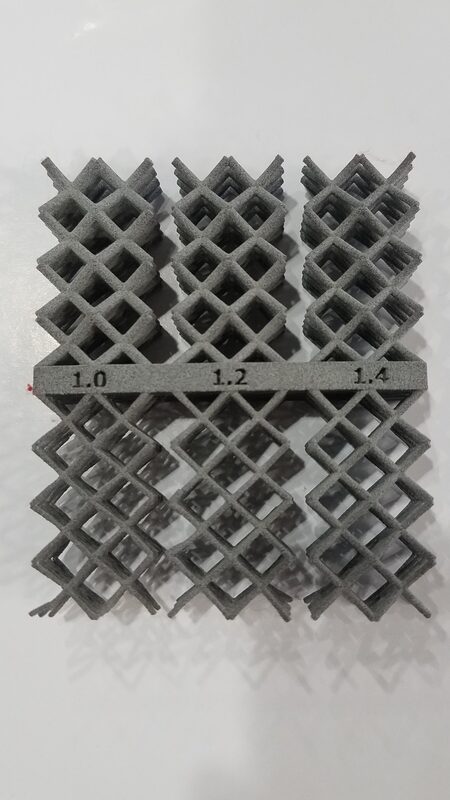
For as long as lithium-ion batteries have powered our phones, cars, and cordless drills, their cathodes have looked essentially the same: a flat layer of active material coated onto a metal foil, stacked and rolled into a cell. A team at Caltech, led by Professor Julia Greer, is questioning whether that flat architecture is actually the right shape at all. As 3DPrint.com reports, Greer's group used a 3D printing process called hydrogel infusion additive manufacturing (HIAM) to build a cobalt-free lithium iron phosphate (LiFePO4) cathode with an intricate, lattice-like internal geometry — rather than a conventional slab.
Greer holds a joint appointment as Professor of Materials Science, Mechanics and Medical Engineering at Caltech, and her lab has spent years pushing architected materials — structures engineered at the micro- and nanoscale to behave differently than the bulk material they're made from. Applying that philosophy to a battery electrode is the interesting part here: instead of asking "what chemistry works best," the team asked "what shape lets a known-good chemistry work better."
Why Geometry Matters Inside a Battery
In a standard lithium-ion cell, ions have to migrate from the electrolyte into the solid cathode material, travel through it, and reach a current-collecting surface where the electrochemical reaction actually happens. In a flat, densely packed layer, that means some lithium ions are traveling relatively long, tortuous paths through solid material before they reach an active surface — a bottleneck that limits how fast a cell can charge and discharge, and how efficiently it can be used.
According to Caltech's own research communications, the Greer lab's 3D-architected electrode addresses this directly: a complex lattice structure gives lithium ions shorter, smoother pathways to reach active material, compared to the meandering routes forced by a conventional flat/planar electrode. Rather than every ion having to fight through a thick, undifferentiated layer, the printed lattice opens up channels and surfaces throughout the structure, so more of the material is doing useful electrochemical work with less distance for ions to travel.
The chemistry itself — LiFePO4 combined with carbon — isn't new or exotic. LFP cathodes are already popular in EVs and grid storage because they're stable, long-lasting, and don't rely on cobalt, a material tied to problematic and expensive supply chains. What Greer's team changed is not the ingredient list, but the structure that ingredient list is built into. The work was published in ACS Energy Letters in 2026 under the title "Structure–Transport Relationships in Microarchitected LiFePO4–Carbon Li Ion Battery Electrodes," and was funded by DARPA, NASA's Jet Propulsion Laboratory, and Caltech itself — a funding mix that signals interest well beyond consumer electronics, into aerospace and defense applications where energy density and reliability carry outsized value.
How Hydrogel Infusion Additive Manufacturing Works
HIAM is not your garage FDM printer. The technique uses a hydrogel — a water-swollen polymer network — as a scaffold or carrier that gets infused with the target material, then processed to leave behind a precisely architected structure at very fine length scales. It's part of a broader family of methods Greer's lab and others have used to fabricate lattices and micro-architectures that would be effectively impossible to machine or mold conventionally. For a battery electrode, that precision matters: the whole point is controlling pore size, wall thickness, and connectivity at a scale fine enough to actually change how ions move, not just how the part looks.
This is fundamentally different from most "3D-printed battery" stories that circulate in the maker world, which typically involve printing battery holders, custom enclosures, or novel cell form factors around off-the-shelf 18650s or pouch cells. Here, the print process is shaping the active electrode material itself, at a microstructural level, to change the physics of how the battery works.
What It Means for Makers
Nobody should expect to print a lattice cathode on a desktop printer anytime soon — and it's worth being direct about where this research actually stands. 3DPrint.com's coverage is explicit that the work is still in the research phase, with real scaling challenges ahead before anything like this reaches commercial cells. HIAM is a specialized lab process, not a filament or resin you'll find on a spool, and there's no announced timeline or partner for scaling it to manufacturable battery production.
That said, this is a useful data point for anyone tracking where additive manufacturing is headed beyond prototyping and functional parts. It's a reminder that 3D printing's real long-term leverage isn't just "make a shape faster" — it's "make a shape that was previously impossible, and get a physical benefit from that shape." Architected lattices already show up in maker projects for lightweighting brackets, shoe midsoles, and heat exchangers; seeing the same structural logic applied to something as fundamental as a battery electrode suggests the toolkit is expanding into materials science territory that used to be strictly the domain of specialized fabrication.
For makers building electric vehicles, drones, or robotics projects who keep half an eye on battery tech, the practical takeaway is patience rather than action: cobalt-free LFP chemistry is already commercially available and worth using today for its stability and ethical sourcing advantages, but the specific structural trick Caltech is demonstrating — shorter ion paths via 3D architecture — is a research result, not a product. It's the kind of advance that, if it scales, would show up years from now as an incremental jump in charge rate or energy density in commercial LFP cells, quietly inherited rather than something you'll ever print yourself.
The Bigger Picture
What makes this worth watching is less the specific result and more the direction it points. Battery researchers have spent decades mostly optimizing chemistry — new cathode materials, new electrolytes, new coatings. Greer's work is a reminder that the physical architecture of an electrode is its own lever, one that additive manufacturing is uniquely suited to pull because it can build geometries that casting, extrusion, or coating simply cannot. As HIAM and similar micro-architecture printing techniques mature, expect more battery labs to treat electrode geometry as a design variable in its own right, not just a byproduct of how the material happens to get deposited.
