
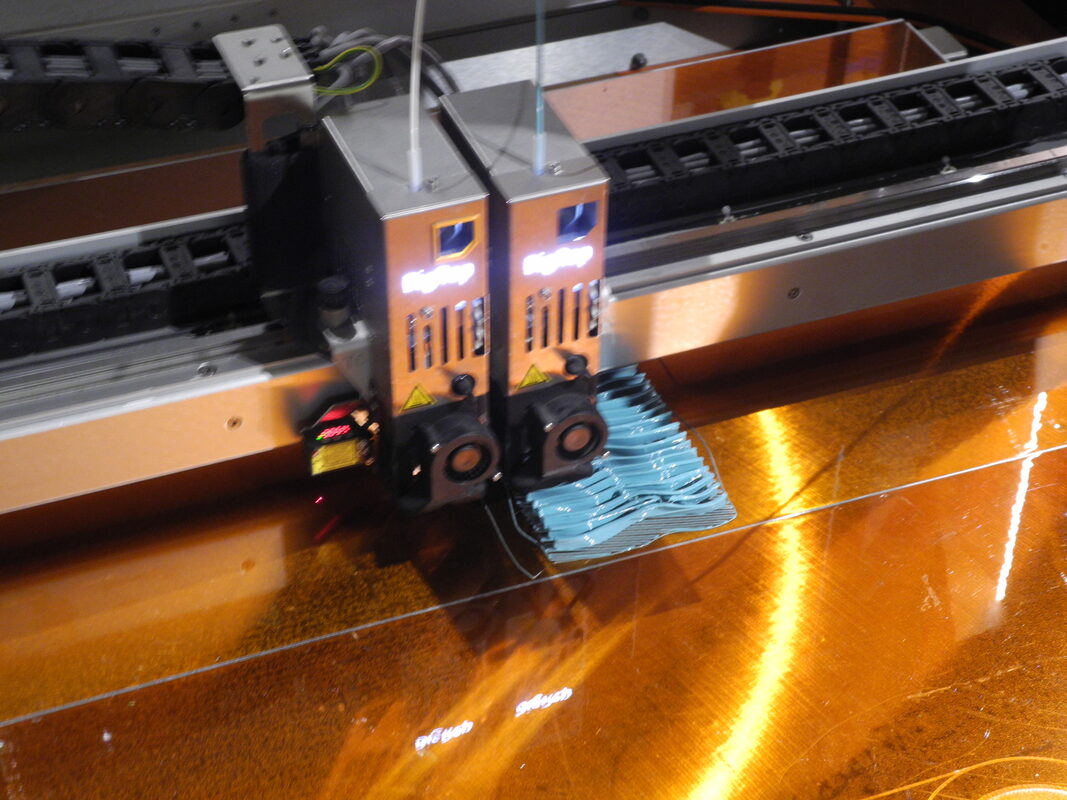
Most FDM printers spend their entire working life doing one thing: pushing solid plastic through a nozzle. Jan, the maker behind the open-source Roetz-End co-extrusion hotend, is testing what happens when you stop doing that — replacing the solid core of an extruded bead with a stream of compressed air, so the plastic becomes nothing more than a thin shell wrapped around a gas channel. The goal is continuously printed tubing that carries far more of its cross-section as air than as plastic.
It's a strange idea on its face. Printers already make hollow parts constantly, just not this way — sparse infill and vase mode both leave voids, but they do it by tracing walls around an empty interior, one closed loop at a time. Jan's approach instead tries to co-extrude a shell and a gas core simultaneously, so a single continuous pass produces tube rather than a printer tracing a tube-shaped outline. If it works, it turns tubing from a laboriously walled print into something closer to how a factory extrudes drinking straws or pneumatic hose — just fed directly by a hotend instead of a die.
How the Shell-Around-Air Setup Works
According to Hackaday's writeup published August 9, 2026, the experimental setup takes in two strands of filament, melts them, and extrudes them as a shell around the outlet of a compressed-air line, so the molten plastic wraps around the gas rather than filling the cross-section solid. The air supply started out pressure-regulated — a fixed pressure fed continuously into the melt zone — but that proved too blunt an instrument: as the shell of molten plastic around the air gets thinner, it offers less resistance to further ballooning, so the bubble keeps expanding until it bursts. Jan switched to volume-based control using a peristaltic pump instead, metering a set quantity of air per unit of extrusion rather than holding a static pressure, and got much more consistent results.
That swap matters because pressure and shell behavior fight each other constantly during extrusion. Hold pressure too high relative to the shell's stiffness at that instant and the tube bulges or ruptures; let it sag and the shell can collapse inward before it sets. Metering by volume instead of pressure is an attempt to decouple the air supply from those moment-to-moment swings in how stiff the molten shell happens to be.
The Roetz-End hardware itself wasn't built with this experiment in mind — it's a four-channel co-extrusion hotend Jan designed for directional, purge-tower-free multi-material and multi-color printing, with independent melt channels rated for flow rates up to 200 mm³/s depending on filament. Each channel is driven by its own Ø6mm × 20mm, 24V, 50W heater cartridge, and both the hot end and cold end are SLM-printed aluminum terminating in a standard RepRap M6 nozzle. The project is released under a CC BY-NC-SA 4.0 license and currently sits in "Open Beta," meaning the hardware that's now being repurposed to blow air through molten plastic was originally solving an entirely different problem: keeping multiple materials separate and directional inside one hotend.
Where It's Breaking
The results so far are mixed in informative ways. With PLA, Hackaday reports the setup was capable of extruding airtight tubes, but it had a tendency to blow bubbles and produce inconsistent tube diameter — the shell wasn't holding a steady cross-section as it left the nozzle, even though the gas itself stayed sealed inside. Switching to TPU greatly improved layer adhesion, and the finished TPU structures expanded slightly when inflated with compressed air, but they still leaked air. In other words, the two materials failed in opposite ways: PLA sealed but couldn't hold a clean, consistent shape, while TPU held its shape and adhered better but didn't reliably seal. Neither material has yet delivered both a consistent cross-section and an airtight shell at once.
A second, more mundane problem compounds the first: the extruder's stainless steel has low thermal conductivity, and combined with the cooling effect of the compressed air itself, that caused filament to sometimes solidify inside the extruder during testing — heat wasn't reaching the filament fast or evenly enough, letting plastic freeze in the path before it could be extruded as a coherent shell.
Jan isn't alone in exploring this territory. Hackaday notes that TU Darmstadt has already carried out related research into blow extrusion — a reminder that hollow, air-carrying printed structures are a live research interest well beyond one maker's workbench, even if the specific pressure-regulated-to-volume-metered approach here is Jan's own.
What It Means for Makers
None of this is ready to drop into a slicer profile. What's being demonstrated is closer to a proof-of-concept than a technique — bubbling PLA and leaking TPU are failure modes, not caveats on an otherwise-working process. But the direction is worth watching for a few reasons. First, the material-use case is real: a tube whose interior is mostly air rather than plastic uses less filament than an equivalent solid-walled part built from stacked vase-mode loops, and it does it in one continuous pass rather than many. Second, an air-cored shell could in principle deposit thicker, lighter layers than a fully solid bead of the same diameter, which matters for anyone chasing print speed on large-format or tubing-heavy prints. Third, it's another data point on what purpose-built co-extrusion hardware like the Roetz-End can be pushed toward once it's out in the open — Jan designed the hotend for directional multi-material deposition, and it's now being used to route gas through it instead of a second polymer.
The honest summary is that pressure control is the whole ballgame here, and it isn't solved. Until the shell can hold both a consistent cross-section and a reliable seal against a moving air core — in either PLA or TPU — this stays a workbench experiment rather than a technique other makers can replicate. Anyone curious to follow along should watch the Roetz-End repository directly, since it's an active open beta rather than a finished release, and the co-extrusion hardware itself remains useful for its original purpose regardless of how the air-core work turns out.
