
Eighteen months after opening its doors, large-format metal printing specialist DEEP Manufacturing says it is now running certified wire arc additive manufacturing (WAAM) production around the clock at two facilities, a milestone the company frames as proof that large-format metal printing has moved from pilot project to production line.
The claim rests on a credential that, as far as the company and its trade press coverage indicate, no other European manufacturer currently holds: full DNV Approval of Manufacture (AoM) for WAAM, covering pressure vessels, pressure vessels for human occupancy, and hull structures and equipment. DEEP Manufacturing first secured that approval in a certification announced in September 2025, and the company is now marking 18 months since its January 2025 launch as the point where that certification has translated into sustained, end-to-end production rather than a one-off qualification exercise.
What WAAM Actually Is, and Why DNV Cares
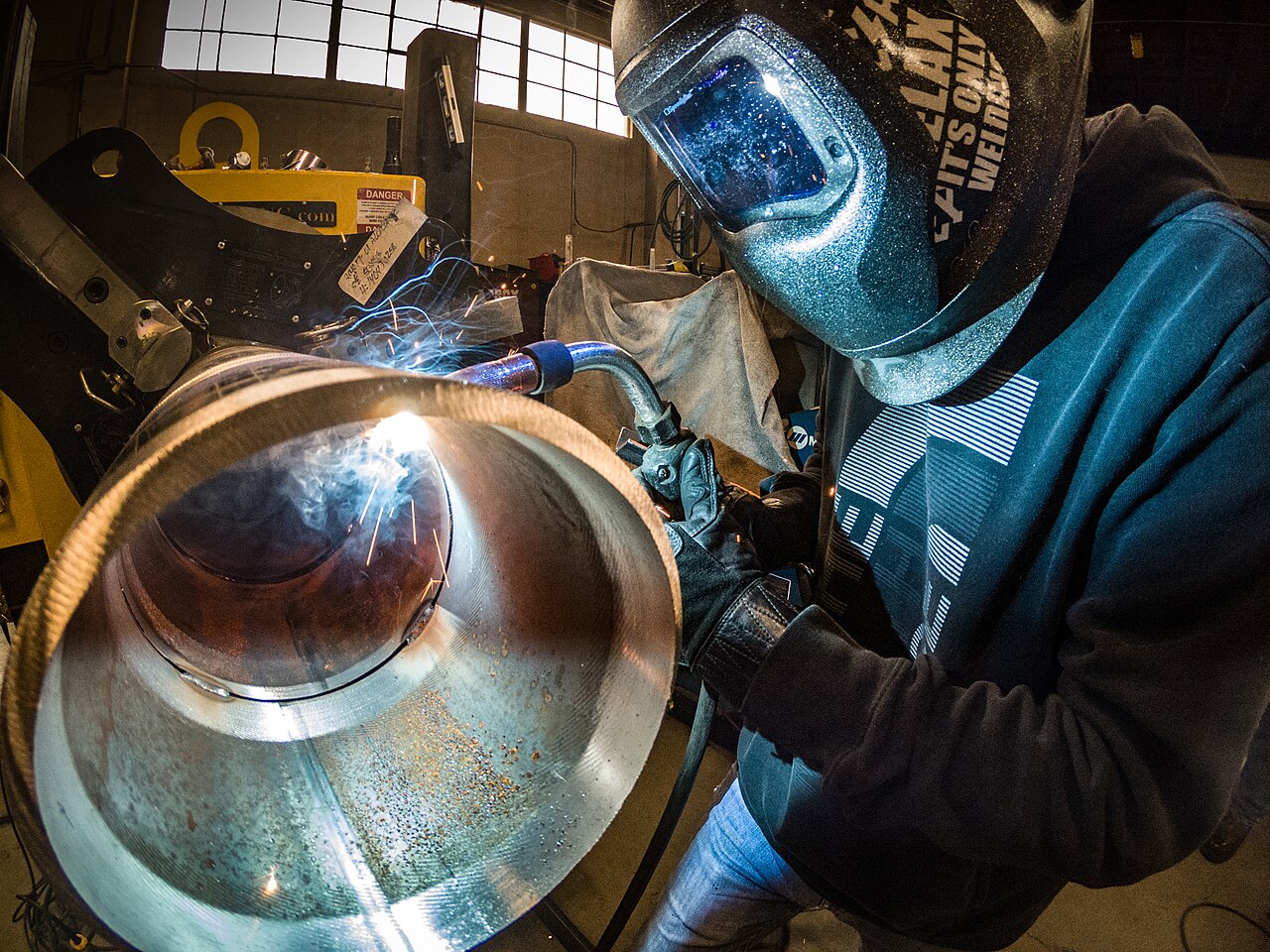
Wire arc additive manufacturing is the industrial cousin of the wire-fed 3D printing hobbyists know from filament extrusion, except the "filament" is metal wire and the "hot end" is a welding arc mounted on a robot arm. A robotic welding torch deposits bead after bead of molten metal wire, building up near-net-shape parts layer by layer at a scale and deposition rate that powder-bed metal printers can't match. It's the method of choice for large, thick-walled components — think ship propellers, pressure vessels, or structural brackets — where powder-bed fusion would be too slow and too small-format to be practical.
The catch with WAAM has always been qualification. A welded or printed pressure vessel destined for a ship, a reactor, or a piece of offshore equipment doesn't just need to look right — it needs a paper trail proving that the process, the operators, and the material itself meet a classification society's standards, every time. DNV, the Norwegian classification and certification body used heavily across maritime and energy industries, is one of the toughest gatekeepers in that world. An Approval of Manufacture from DNV means a company's process itself is certified, not just individual parts — a distinction that lets a customer order production parts without commissioning a fresh qualification campaign for each job. According to DEEP Manufacturing, DNV Maritime's Head of Materials & Welding, Thorsten Lohmann, confirmed the certification, and DEEP Manufacturing CEO Peter Richards called it a "landmark achievement" when it was first announced.
Two Sites, New Hardware
Per the 3D Printing Industry report, DEEP Manufacturing now operates facilities in Bristol, UK, and Houston, Texas, both running DNV-approved certified production on a single site rather than splitting fabrication and inspection across locations. The Houston addition matters for the company's stated target markets — defense, aerospace, energy, and maritime customers — since it puts DNV-certified large-format metal printing within easier reach of the U.S. Gulf Coast energy and shipbuilding corridor rather than requiring transatlantic logistics for every certified part.
The company has also added equipment on the shop floor: a next-generation "Rollerbot 2.0" system, additional WAAM robots, and new CNC machining capability for finishing printed parts to final tolerance. WAAM parts come off the build platform close to net shape but still require machining to hit the surface finish and dimensional accuracy that pressure-vessel and structural applications demand, so in-house CNC capacity is as much a production-throughput story as the printing hardware itself — it removes a subcontracting step that would otherwise sit between an as-printed part and a certified deliverable.
A Broader Materials Menu
The 3D Printing Industry piece also details an expanded materials portfolio, which is arguably the more consequential change for prospective customers than the new hardware. DEEP Manufacturing now lists carbon steel, stainless steel (ER316LSi), duplex and super duplex stainless (UNS S32750), nickel aluminium bronze (ER CuNiAl), copper alloy (ERCuNi30), and aluminium (ER2319/2219) as qualified WAAM feedstocks.
That spread is notable because it covers alloys used across genuinely different service environments. Duplex and super duplex stainless are workhorses in offshore and chemical-processing equipment because of their corrosion resistance; nickel aluminium bronze is a staple for marine propellers and seawater-exposed hardware; copper alloys and aluminium open the door to thermal-management and lightweight structural parts. Qualifying that many alloys under a single DNV-approved process, rather than one or two, is what lets a company pitch itself as a general-purpose large-format metal supplier instead of a specialist limited to one material family.
Richards framed the moment less as a surge and more as market catch-up: "We're not seeing a spike in demand for large-format additive manufacturing. We're seeing the market arrive at where we always believed it was heading." The company is also claiming lead times up to three times faster than casting or forging for the industries it serves — a figure worth treating as a company claim rather than an independently verified benchmark, since neither source publishes the underlying comparison methodology.
What It Means for Makers
None of this touches desktop or prosumer printing directly — WAAM operates at a completely different scale, cost, and certification burden than anything running in a home shop or even most makerspaces. But it's worth watching for two reasons. First, WAAM is one of the clearest examples of additive manufacturing actually displacing traditional metal fabrication (casting, forging) in regulated industries, rather than just supplementing prototyping — that's a data point for anyone tracking whether "3D printing" claims about disrupting manufacturing are backed by real qualified production or just marketing. Second, the qualification playbook DEEP Manufacturing is following — process-level certification from a body like DNV rather than part-by-part sign-off — is the same pattern gradually working its way down into other metal AM processes, including powder-bed systems more likely to eventually touch smaller-shop and prosumer-adjacent metal printing. Watching how classification societies handle additive processes now is a reasonable proxy for how quickly metal AM certification broadly will mature.
