
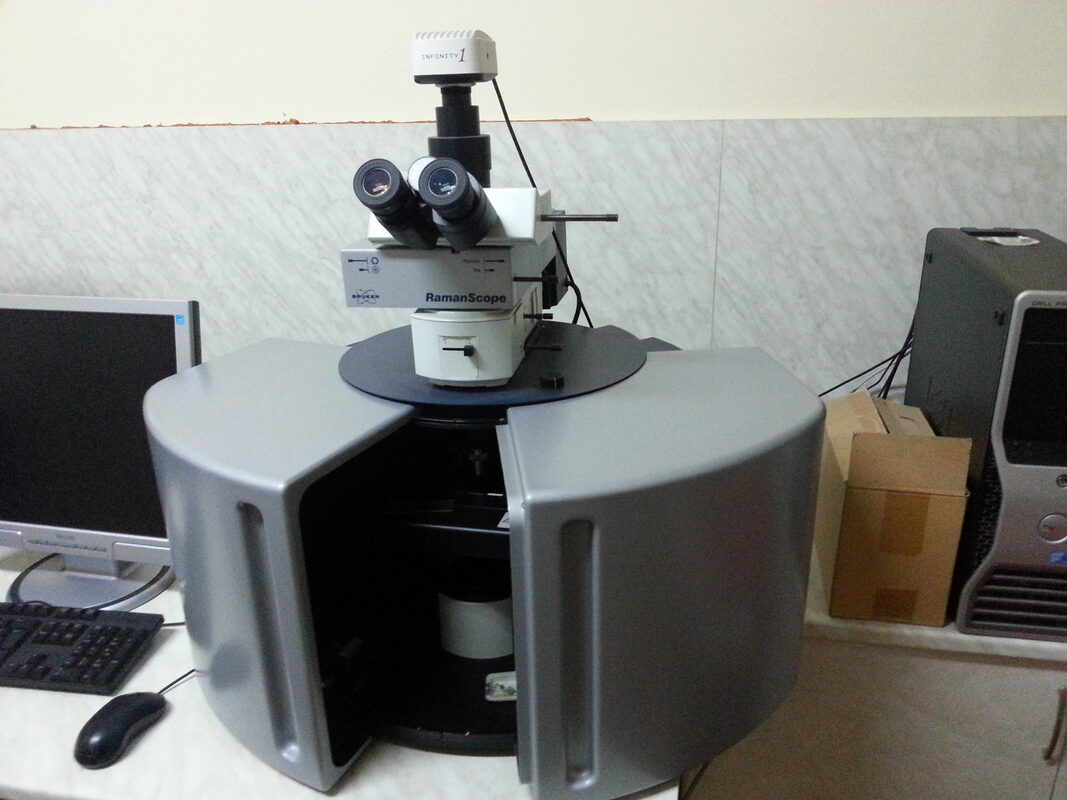
Raman spectroscopy is the kind of technique that normally lives behind a five- or six-figure price tag, bolted to an optical bench in a materials-science lab. A maker going by the handle Allegedly Science decided that was unacceptable, and built CubeRaman, a 3D-printed Raman spectrometer submitted to Hackaday's 2026 Frikkin Lasers Challenge, that replicates the core function of those lab instruments using printed plastic, magnets, and a cheap laser diode.
The project, posted to Hackaday.io on March 18, 2026, is built around the idea that molecule-identifying spectroscopy shouldn't require an institutional budget. Raman spectroscopy works by shining a laser at a sample and analyzing the tiny fraction of scattered light whose wavelength has been shifted by interactions with the sample's molecular vibrations. That shift acts as a fingerprint, letting you identify chemicals, polymers, pharmaceuticals, and minerals without touching, dissolving, or destroying the sample. The catch has always been that isolating a faint, shifted signal from an overwhelming flood of reflected laser light takes precision optics and mechanically stable mounts, which is exactly the kind of thing that gets expensive fast.
What's Actually Inside the Cube
CubeRaman's optical engine is a roughly 30 mW, 532 nm (green) laser module, paired with filters that have a 550 nm cut-on point. That combination sets the instrument's usable Raman shift measurement range at approximately 600 to 3000 wavenumbers (cm⁻¹) on the Stokes side of the spectrum, according to the project's build log, a band wide enough to cover a large share of the vibrational modes chemists and mineralogists actually care about.
A write-up published by Hackaday on July 5, 2026, lays out the beam path in more detail. Laser light first reflects off a 45-degree dichroic mirror, then passes through a microscope objective that focuses it onto the sample. Raman-scattered light coming back from the sample travels back through that same objective and dichroic mirror, then through a long-pass filter that blocks the original laser wavelength while letting the shifted light through. An achromatic lens then focuses what remains onto the slit of a spectrometer, which does the job of splitting the light by wavelength so the shift can be measured.
None of those individual components — a diode laser, a dichroic mirror, bandpass and long-pass filters, a microscope objective, an achromatic lens — are exotic. What made past DIY attempts at this kind of instrument brittle was holding them all in precise, repeatable alignment. CubeRaman's answer is a fully 3D-printed cube-shaped housing built around kinematic mounts, the same basic principle used in commercial optical mounts: three points of contact constrain a mirror or filter's position so it can be adjusted and returned to exactly the same spot. Instead of machined springs and thumbscrews, Allegedly Science's design uses magnet-tipped adjustment screws printed directly into the housing, a detail that keeps the whole assembly cheap to reproduce while still giving the fine-tuning needed to get a scattered signal onto a narrow spectrometer slit.
Proof of Concept: A Raw Diamond
The real test of any homebrew spectrometer is whether it actually produces a recognizable, physically meaningful result rather than noise that merely looks plausible. According to Hackaday's coverage, the first serious test target was a raw diamond, and it worked: the instrument clearly showed the expected Raman shift associated with diamond's carbon lattice. That's a meaningful validation point, since diamond's Raman peak is well-characterized and sharp, making it a good sanity check for a new instrument before pointing it at unknowns.
Not every test went as cleanly. Attempts to analyze chemicals stored in ordinary glass bottles mostly returned a signature dominated by silica — the glass itself — rather than the chemical inside. That's a known headache in Raman work: if your sample container scatters more strongly, or masks the signal from, whatever you're trying to measure, you're effectively measuring the wrong thing. The build log's conclusion is a practical one for anyone trying to replicate the setup: measurements need thin-walled cuvettes rather than repurposed glass bottles to get the container itself out of the way of the actual signal.
What It Means for Makers
CubeRaman lands in an interesting spot for the maker community because it's not a toy demonstration — it's a functioning analytical instrument built from a materials list that wouldn't look out of place in a laser-cutting or optics-hobbyist parts bin. A cheap 532 nm laser module, off-the-shelf bandpass and long-pass filters, a dichroic mirror, a microscope objective, and a surplus spectrometer are all things that already circulate in maker supply chains. The genuinely novel contribution is the housing and mount design: proving that 3D-printed kinematic mounts, held in adjustment with embedded magnets rather than machined precision hardware, can achieve the alignment stability Raman spectroscopy demands.
That matters beyond this one project. If printed kinematic mounts can reliably hold optical alignment for Raman work, the same approach becomes a template for other precision-optics builds that have historically been gated by access to a machine shop — interferometers, other forms of spectroscopy, or custom microscopy rigs. For makers with a 3D printer, a diode laser, and patience for optical alignment, CubeRaman offers something concrete: a documented, reproducible path to a technique for chemically identifying an unknown sample, sitting on a desktop instead of behind a lab door. The glass-bottle result is also a useful heads-up for anyone tempted to replicate the build — budget for actual cuvettes, because container scatter can swamp the signal you're actually after.
The project remains an active build log on Hackaday.io as part of the 2026 Frikkin Lasers Challenge, and Allegedly Science's documentation of both the wins and the failure modes — like the glass-bottle silica problem — gives other makers a real head start if they want to build their own.
