
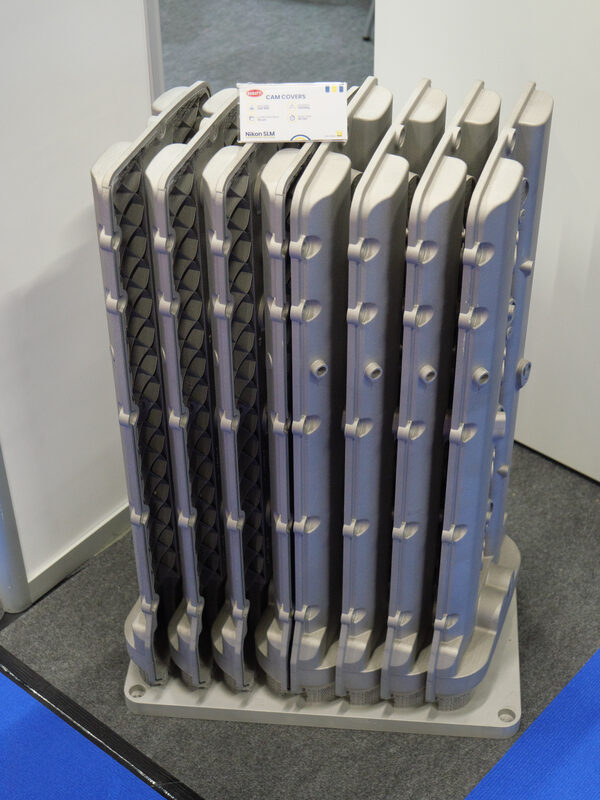
EOS is bringing a new aluminum powder to its metal laser powder bed fusion lineup, and the headline feature is what it lets printer operators skip. According to a press release published July 7, 2026, the German industrial 3D printing company is partnering with French aerospace-materials specialist Constellium to bring the alloy Aheadd CP1 into its powder catalog as EOS Aluminium Constellium CP1. The material is set to become available in August 2026, and it's designed to eliminate one of the more disruptive steps in post-processing a printed aluminum part: quenching.
For anyone who has worked with aluminum in metal AM, that's not a small claim. Quenching — rapidly cooling a part from a high-temperature solution treatment, typically in water or polymer — is standard practice for hardening many aluminum alloys after printing. It's also a notorious source of headaches: rapid, uneven cooling induces internal stresses and can warp thin-walled or geometrically complex parts, which is precisely the kind of geometry that draws people to powder bed fusion in the first place. A quench-free alloy doesn't just save a processing step; it removes a whole category of dimensional risk from the workflow.
What's Actually New Here
The partnership covers two products. EOS Aluminium Constellium CP1 is the new material — Constellium's Aheadd CP1 alloy, now formally integrated into EOS's parameter sets and supply chain. Alongside it, EOS is renaming its existing EOS Aluminium Al5X1 powder to EOS Aluminium Constellium Al5X1, folding that established material under the same co-branded naming convention. Al5X1 is positioned as a high-strength, high-elongation, anodizable alloy aimed at aerospace, transportation, and motorsport parts, which gives a sense of where Constellium's metallurgy pedigree was already being put to use before CP1 arrived. That renaming signals this isn't a one-off supply deal — it's a long-term alloy-development partnership between the two companies, with Al5X1 as the established baseline and CP1 as the new high-performance option sitting alongside it.
Per the release, CP1 is pitched as delivering higher strength combined with good elongation — the property that determines how much a part can deform before it fractures, and a frequent trade-off point in high-strength aluminum alloys. Beyond skipping quenching, EOS says the alloy supports flexible heat-treat cycles, meaning users aren't locked into one rigid post-processing recipe, and offers thermal stability for parts that will see elevated service temperatures. Corrosion resistance and anodizability round out the mechanical and cosmetic profile, both of which matter for parts that ship as finished, visible components rather than staying buried inside an assembly.
One detail aimed squarely at process engineers: EOS describes CP1 as having no volatile magnesium or zinc content, which the company says enables more stable processing at high laser power. Mg and Zn are common alloying elements in high-strength aluminums (think the 5000- and 7000-series families), but they vaporize readily under a laser melt pool, which can spatter, contaminate the build chamber's optics, and destabilize the melt pool at aggressive laser settings. An alloy chemistry that avoids that volatility should, in principle, let EOS push laser power higher for faster builds without the process becoming a fight against its own alloying elements.
EOS's chief technology officer Joachim Zettler and Constellium's senior VP of Manufacturing Excellence and chief technical officer Ludovic Piquier are both quoted in the release, framing the deal as a joint materials-development effort rather than a simple licensing arrangement. Constellium — a Paris-headquartered, NYSE-listed aluminum specialist (CSTM) that posted roughly $8.4 billion in revenue in 2025 — brings decades of aluminum alloy metallurgy from its aerospace and automotive business, while EOS brings the printer parameter development and industrial AM customer base.
Coverage from VoxelMatters, also published July 7, corroborates the press release and adds useful framing: this move expands EOS's aluminum alloy portfolio and is intended to accelerate industrial-scale qualification of the material for both EOS and AMCM systems. AMCM is EOS's subsidiary focused on large-format and custom metal printers, so the qualification push spans both standard EOS machines and AMCM's bigger builds.
What It Means for Makers
This is squarely an industrial-metal-AM story, not a desktop one — EOS's laser powder bed fusion systems and metal powders are enterprise-tier equipment, priced and supported for production shops, not hobbyists loading a spool. But it's still worth understanding for a few reasons.
First, the target applications named in the release — heat exchangers and semiconductor hardware — are a tell. Both demand complex internal channels and thin-wall lattice structures that benefit from AM's geometric freedom but are exactly the parts most vulnerable to quench-induced warping. A quench-free alloy that holds its shape through post-processing widens the design envelope for the kind of organic, channel-dense geometries that are otherwise a fight to keep dimensionally accurate in aluminum. If you've ever designed a printed heat exchanger and watched a thin fin distort during heat treatment, this is the class of alloy chemistry meant to fix that.
Second, the "no volatile Mg/Zn, stable at high laser power" detail hints at where alloy development is generally headed across the industry: printer vendors and metallurgists are increasingly co-designing chemistries specifically for the thermal behavior of a laser melt pool, rather than adapting alloys that were originally formulated for casting or wrought processing. That's a slower, more deliberate approach than early metal AM's habit of just running legacy aerospace and automotive alloys through a laser and seeing what stuck, and it tends to produce materials with fewer process-induced surprises.
Third, the renaming of Al5X1 to EOS Aluminium Constellium Al5X1 is a small but telling business signal — it suggests this partnership is structured as an ongoing co-development relationship rather than a single powder release, and that makers and service bureaus who buy EOS aluminum going forward should expect the Constellium name to be a fixture of EOS's aluminum lineup rather than a one-time collaboration credit.
For makers running desktop or prosumer metal printers, none of this is directly actionable yet — EOS Aluminium Constellium CP1 isn't shipping until August 2026 and there's no indication of pricing or availability outside EOS's qualified industrial channel. But alloy innovations that debut in industrial LPBF systems have a track record of eventually informing parameter sets and powder chemistries further down the metal-AM market, so this is worth filing away as a bellwether for where quench-free, high-strength aluminum printing is headed industry-wide.
