
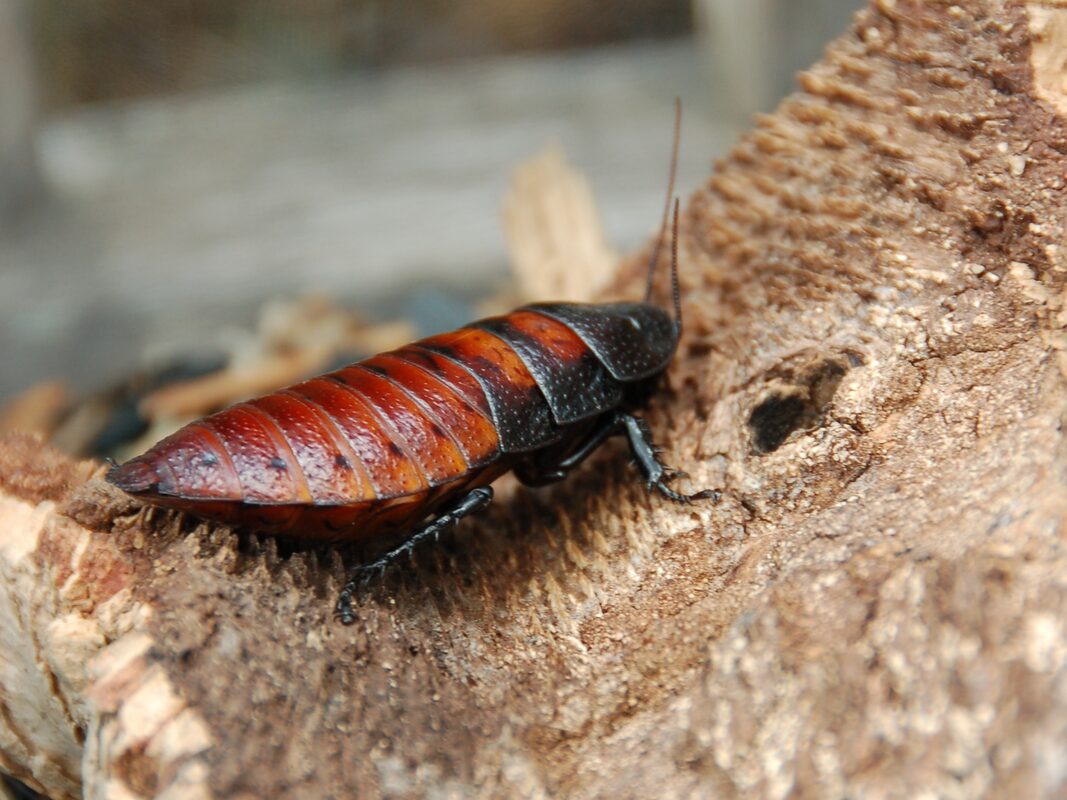
Researchers at Nanyang Technological University Singapore and Waseda University have given a live cockroach a diving suit — and it is, unmistakably, a 3D printed one. In a paper published in Nature Communications titled "Underwater Suit-Wearing Cyborg Insect Capable of Hours-Long Diving and Terra-Aqua Travel," the team describes a 10x10mm photopolymer backpack that lets Madagascar hissing cockroaches survive and move underwater for up to three hours, a dramatic jump from the roughly two minutes an unsuited insect can manage before its spiracles flood and it drowns.
This is not the first cyborg insect to come out of Hirotaka Sato's lab at NTU Singapore — his group has spent years building electronically steerable roaches for search-and-rescue applications. What's new here is the life-support hardware, and specifically how it was manufactured. The backpack is a 3D printed part small enough to sit on an animal that weighs a few grams, built from a PMMA-like photopolymer resin and produced with enough dimensional precision to seal against water intrusion while still being light enough for the roach to carry and crawl with. The finished diving suit weighs about 5.5 grams — close to the average cockroach's own body weight — and these insects can carry a payload of up to roughly 15 grams, leaving headroom for the battery, sensors, and wireless controls already used in Sato's steerable cyborg roaches.
The Engineering: A Life-Support Backpack the Size of a Fingernail
The core problem with taking an air-breathing insect underwater is straightforward: cockroaches don't have lungs, they breathe through small openings along their exoskeleton called spiracles, and those spiracles were never evolved to handle submersion. Flood them, and the insect suffocates in minutes. Sato's team solved this with a miniaturized oxygen-generation module housed inside the 3D printed shell. Rather than carrying a compressed-gas tank, the system relies on a chemical reaction — manganese dioxide catalyzing diluted hydrogen peroxide into oxygen and water — to generate breathable gas on demand inside the sealed backpack.
Getting that oxygen from the backpack to the insect required a second piece of custom-printed hardware: two 3D printed spiracle connectors that interface directly with the roach's breathing openings and route gas through silicone tubing. The two connectors aren't identical — one is a spoon-shaped cover that fully encloses the roach's larger prothoracic spiracle valve, while the other is a fine tube, about 0.3mm inner diameter and 0.4mm outer diameter, sized to insert directly into the much smaller mesothoracic spiracle opening — tolerances of a few tenths of a millimeter, scaled to fit a living substrate that can't be clamped in a jig. The flexible waterproof suit itself needed to accommodate the cockroach's own movement without cracking, tearing, or losing its seal, which is why the team describes the shell as flexible rather than rigid.
The numbers behind the headline figure show why three hours was achievable at all. Oxygen concentration inside the sealed suit spikes to roughly 47% within the first eight minutes as the reaction gets going, then settles to a sustained level of around 15% by the three-hour mark — still enough to keep a roach alive, given the insects consume oxygen at roughly 2.3 to 3.8 milliliters per hour at rest versus while walking. Underwater, the suited cockroaches moved at about 78 mm/s, only around 10% slower than their roughly 87 mm/s pace on land, though turning slowed more, dropping 40 to 50%.
Why Print It Instead of Machining or Molding It
At 10x10mm, this backpack sits well within the resolution range of high-end resin 3D printing, and 3D printing offers something injection molding and CNC micromachining don't at this scale: fast iteration on organic, insect-conforming geometry. A cyborg roach backpack isn't a simple box — it has to route two spiracle connectors to the exact breathing ports on a living animal, seal against water pressure, and stay light enough not to impede locomotion. Printing lets researchers cycle through fit and seal revisions without the cost and lead time of a new mold for every design change — the same logic makers lean on with resin printers for gaskets and small waterproof enclosures, just applied at the extreme low end of scale and the extreme high end of consequence, since a bad seal doesn't just ruin a part, it drowns the test subject.
The Application: Search-and-Rescue Robots That Are Also Bugs
The motivation isn't novelty. Sato's broader research program builds cyborg insects as low-cost, highly mobile search-and-rescue platforms that can go where wheeled or legged robots struggle — through rubble, narrow gaps, and collapsed structures. Extending that underwater opens up a different category of disaster environment: flooded pipes, tunnels, sewers, and submerged infrastructure that's dangerous to inspect with conventional robotics after a flood, earthquake, or industrial accident. In one demonstration, a suited cockroach traversed a 1.7-meter tunnel with a carbon-dioxide-filled section followed by a flooded one — the mixed-hazard route that's the target use case. A roach that can walk into a collapsed structure, then continue into a flooded section without swapping platforms, is a more capable rescue tool than one that stops working once the terrain goes underwater.
What It Means for Makers
You are not going to print this exact backpack in your garage — it requires a specific photopolymer resin, a live insect as a chassis, silicone micro-tubing, and a chemical oxygen-generation payload that most home labs have no business handling. But the design philosophy is directly applicable to anyone doing small-scale waterproof enclosure work on a resin printer. The core lesson: at millimeter scale, seal geometry and material flexibility matter more than raw strength — a rigid, over-engineered shell would have cracked against the roach's own movement, while the flexible photopolymer suit survives because it flexes with its substrate instead of fighting it. That's transferable to anyone printing small waterproof housings for sensors, cable glands, or micro-robotics: design for the flex, not just the seal. It's also a reminder that resin printing's real edge over molding and machining isn't just surface finish — it's iteration speed on organic, fitted geometry, whether the unit is a custom enclosure or, in this case, an individual cockroach.
The work also lands as a data point in the broader trend of 3D printing moving into biohybrid and bio-integrated robotics, a space where print tolerances have to satisfy both engineering requirements and the tolerances of a living organism. Expect more of this kind of hardware — small, flexible, chemically active, and printed rather than molded — as cyborg and soft-robotics research leans on additive manufacturing for exactly the rapid, low-volume, high-precision parts that made resin printing valuable to makers in the first place.
