
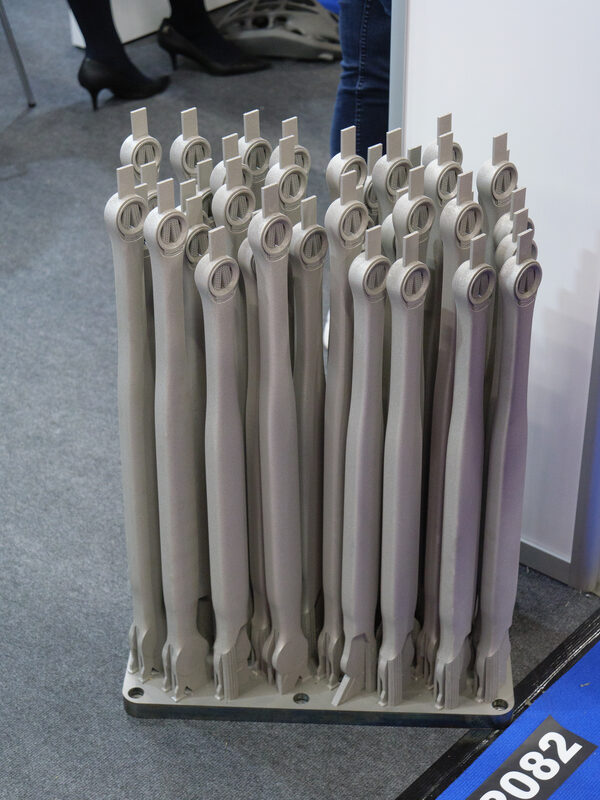
German industrial 3D printing manufacturer EOS is broadening its metal materials catalog through a new partnership with Constellium, a France-based aluminum specialist, according to an official press release from EOS. The deal brings a new high-strength aluminum powder to EOS's laser powder bed fusion (LPBF) lineup this summer and folds an existing EOS alloy into the same joint branding, with both companies signaling that more collaborative alloy development is on the way.
For an industry where metal AM users have long relied on a fairly narrow set of aluminum casting alloys adapted for powder bed fusion, a dedicated materials partnership between a major printer OEM and an alloy producer is a notable structural move — one that says as much about where the metal AM market is heading as it does about any single powder.
What's Actually Changing
The centerpiece of the announcement is Constellium's Aheadd CP1 alloy, which will enter the EOS portfolio as "EOS Aluminium Constellium CP1" starting in August 2026. Per the EOS release, the alloy is pitched as delivering higher strength with good elongation compared to the aluminum-silicon alloys that dominate metal AM today, along with a simplified heat treatment process that skips the quenching step typically required after printing. EOS also lists strong thermal stability and corrosion resistance among the alloy's selling points.
One detail worth flagging for anyone who has fought spatter and plasma instability on an aluminum build: EOS says CP1 contains no volatile elements such as magnesium or zinc, which the company frames as enabling more stable processing at high laser power. Volatile alloying elements vaporize readily in the melt pool, and that vapor plume can scatter or absorb laser energy, contribute to spatter, and complicate process control — an issue anyone who has tuned parameters for AlSi10Mg or similar alloys has likely run into at the margins. Removing that variable is a meaningful process-engineering claim, not just a materials-properties one. EOS is positioning CP1 as a potential alternative for many applications that currently use AlSi10Mg — specifically heat exchangers and semiconductor-industry parts like heat sinks and wafers, applications where thermal performance and dimensional stability under thermal cycling matter as much as raw strength.
The second piece of the announcement is a rebrand rather than a new product: EOS's existing Al5X1 alloy is being renamed "EOS Aluminium Constellium Al5X1" to reflect the new joint relationship. That alloy is described as high-strength and high-elongation with anodizing capability, aimed at aerospace, transportation, and motorsport applications — sectors where both mechanical performance and a finishable, corrosion-resistant surface are typically non-negotiable requirements.
Notably, EOS frames this as a starting point rather than a two-product deal. The press release describes a long-term framework intended to extend beyond CP1 and Al5X1 into future joint development of next-generation aluminum alloys, suggesting more aluminum options could follow on a similar cadence.
Why an Alloy Producer, Not Just a Powder Supplier
Constellium isn't a niche metal-AM powder shop — it's an established aluminum products manufacturer with roots in the aerospace and automotive supply chains, where alloy design, rolling, and forming expertise is decades deep. Per the EOS release, Constellium is a NYSE-listed (CSTM) global aluminum producer that generated $8.4 billion in revenue in 2025 across aerospace, packaging, and automotive markets — a very different scale and profile than the specialty powder-atomization vendors that typically supply metal AM OEMs. Pairing that materials science background directly with an LPBF machine builder is a different model than the more common arrangement where OEMs qualify third-party powder against their own process parameters after the fact. Here, the alloy appears to be developed and validated in tandem with the printing process itself, which is the kind of vertical integration that has driven adoption of engineered polymer and nickel-superalloy powders in other corners of AM over the past several years.
As VoxelMatters reported on July 7, EOS CTO Joachim Zettler framed the tie-up in similar terms: "Together, we are enabling higher performance, greater productivity, and faster industrial adoption for customers." VoxelMatters also notes that users of both EOS and AMCM (EOS's high-power, large-format LPBF subsidiary) systems will get access to these alloys with validated process parameters and applications support already in place — meaning the parameter development work that normally falls on early adopters of a new alloy should already be largely done.
What It Means for Makers
This announcement sits squarely in the industrial end of the market — EOS's LPBF systems are six- and seven-figure production machines, not desktop or prosumer printers, and CP1 and Al5X1 will ship as EOS-branded powders for EOS and AMCM hardware specifically. Nobody running a desktop metal printer, bound-metal system, or open-material LPBF rig is going to load these alloys tomorrow. That said, the announcement matters to the wider metal-AM-aware maker community for a couple of reasons. First, AlSi10Mg has been the default aluminum workhorse for LPBF for close to a decade, largely because it was adapted from casting rather than purpose-built for powder bed fusion; a purpose-designed, no-quench, high-power-stable alternative aimed squarely at replacing it in heat-exchanger and electronics-cooling work is a sign of where the broader aluminum-for-AM conversation is heading, and materials that debut on industrial systems have a track record of trickling down — in spirit if not in exact chemistry — to more accessible platforms as licensing and powder-atomization economics shift. Second, a dedicated OEM-alloy-producer partnership model, rather than ad hoc third-party powder qualification, is likely to become more common as metal AM matures. Anyone tracking material roadmaps for future hardware purchases, or advising a shop on which vendor ecosystem to commit to, should note that EOS is explicitly promising more joint alloys down the line, not just this one release. For now, the practical takeaway is narrower: production shops running EOS or AMCM LPBF systems for heat exchangers, semiconductor tooling, or motorsport components have two new (or newly rebadged) aluminum options to evaluate starting this August, with process parameters and support already validated by the OEM.
