
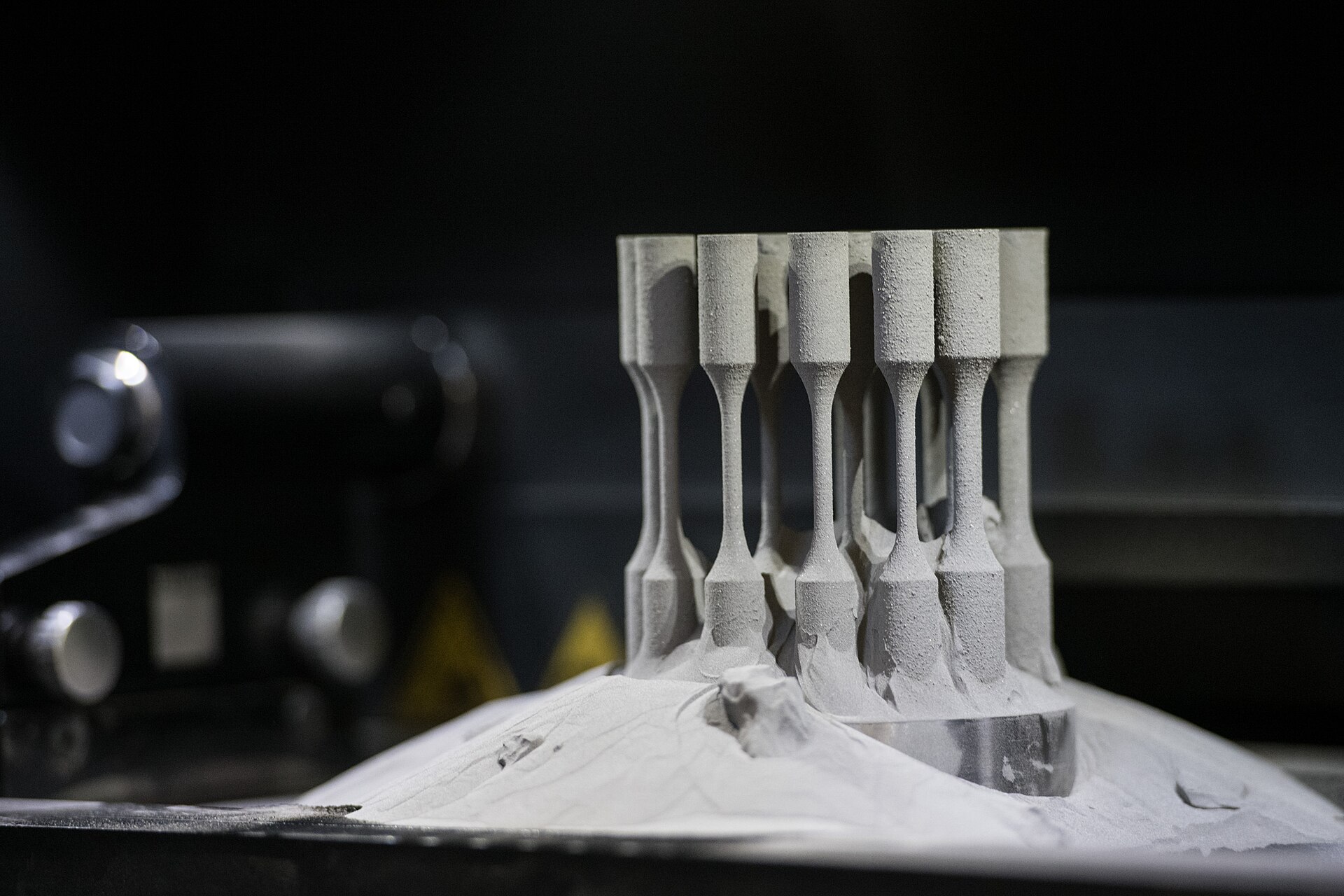
EOS will bring its M4 ONYX metal laser powder bed fusion platform to North America for the first time at IMTS 2026, September 14-19 at McCormick Place in Chicago — but the machine on the stand isn't the interesting part. The M4 Onyx has been shipping since Q1 2026, and was unveiled at Formnext 2025 in Frankfurt before that. The genuinely new thing is a variant that hasn't shipped: the M4 ONYX FLX, due Q3 2026, which throws out the six-laser architecture and replaces it with four kilowatt-class beam-shaping lasers.
That swap is a bet worth understanding even if you will never be within a hundred meters of a titanium powder handling station.
Two ways to go faster
Metal LPBF has a throughput ceiling, and everyone knows exactly where it comes from. A laser melts a pool of powder, and that pool has to be small — a few hundred microns — because melt pool physics gets ugly fast when you dump too much energy into one spot. Keyholing, spatter, porosity, evaporation of the low-boiling-point alloying elements. So you get a small, well-behaved spot and scan it across a 450 mm bed one hairline at a time. The build takes days.
There are two obvious escapes. The first is the one the industry has run for a decade: add more lasers. Two, then four, then eight, each with its own galvo scanner scanning its own patch of the bed. This is brute force, it works, and it brings second-order problems — overlap stitching where two lasers meet at a zone boundary, cross-contamination when one laser's plume drifts into another's optical path, gas flow that must sweep condensate off the entire bed uniformly, and calibration that must hold all those optical trains in agreement over a 450 mm square.
The standard M4 ONYX takes this route with six 400 W lasers, and EOS claims 50% higher throughput than its previous systems as a result.
The second escape is the one the FLX takes: stop making the spot smaller and start making it smarter. Beam shaping means actively controlling the spatial energy distribution of a single much larger spot — rings, cores, arbitrary profiles — instead of accepting the Gaussian your fiber laser wants to give you. Done well, you can run a kilowatt-class laser without the melt pool tearing itself apart, because the energy lands in a distribution the pool can absorb rather than a single scorching peak. Four lasers at 1.5 kW each is 6 kW of optical power against the six-laser machine's 2.4 kW, through fewer optical trains with fewer boundaries to stitch.
If it works, it is a cleaner answer than adding a seventh and eighth laser. If it doesn't, it's four expensive lasers producing porous parts. EOS has published no process data either way, and the FLX is a quarter away.
A specification discrepancy worth flagging
Two numbers in circulation don't agree.
VoxelMatters, reporting the IMTS debut on July 15, gives the build volume as 450 x 450 x 360 mm and describes the FLX as using four 1 kW beam-shaping lasers. EOS's own press release gives 450 x 450 x 400 mm — explicitly footnoting that the figure includes the build platform — and specifies four 1.5 kW beam-shaping lasers on the FLX.
We are going with EOS's numbers, since they come from the manufacturer, and the footnote suggests the Z discrepancy is a measurement-convention difference rather than an error: 400 mm including the platform and 360 mm of usable Z are not necessarily contradictory. The laser power gap is harder to reconcile — 1 kW and 1.5 kW are different machines — and neither source explains the difference. Treat the FLX's power figure as provisional until the machine ships.
The rest of the claim sheet
EOS's release is dense with numbers, and they're worth the appropriate amount of salt, because they are vendor claims without published methodology: a 30% reduction in part costs; up to 97% system availability (OEE), which EOS explicitly conditions on full-service contracts; more than 90% powder material recovery; up to 50% reduction in QA expenses via digital fingerprinting; automated job changeovers in under 30 minutes through a Grenzebach Dual Setup Station; and software that cuts order-to-print lead times by up to 30%. EOS also says Smart Fusion minimizes supports and enhances surface quality, and credits its beam-control capabilities with doubling build speeds. Materials at launch are titanium, nickel, and stainless steel, with more on request; VoxelMatters additionally lists aluminum alloys.
The 97% OEE figure tells you what this machine is for. Nobody quotes overall equipment effectiveness to a shop that runs one printer. That number is for a customer running a floor of them on production contracts, where an hour of downtime has a dollar figure attached and the service agreement is part of the product — precisely why EOS attaches the full-service-contract condition. VoxelMatters quotes EOS marketing director Patrick Boyd on working "closely with customers and partners across the defense and aerospace supply chain," which is the same sentence from the other direction.
The supporting cast reinforces the read: an RFS Pro powder-recovery unit EOS says cuts hazardous waste by up to 90%, and a Volkmann closed-loop powder handling system. Neither is a printer feature. Both answer what it costs to run twenty of these continuously — the only question at this tier.
No pricing was disclosed in either source, which for a machine in this class roughly means "if you have to ask."
What It Means for Makers
Directly, nothing. You are not buying a six-laser LPBF system, and the FLX will not be showing up on a Kickstarter.
Indirectly, the FLX is a live experiment in a tradeoff you already argue about. More heads or a faster head? It's the IDEX-versus-toolchanger debate, the same question every time throughput hits a wall. The desktop FFF answer has largely been "make the single head better" — high-flow hotends, better melt geometry — because coordinating independent heads over a shared workspace costs more in complexity than it returns in speed. Toolchangers exist, but they solve a materials problem, not a speed one.
EOS is running both experiments at once, on the same frame, with the same bed, where the economics are brutal enough to settle the argument on evidence rather than forum opinion. The standard machine brute-forces it with six spots. The FLX bets that larger, actively shaped spots beat adding spots.
Which architecture EOS is still selling in 2029 will tell you whether the "faster head" answer generalizes past desktop plastic. Worth watching, even from the cheap seats.
