
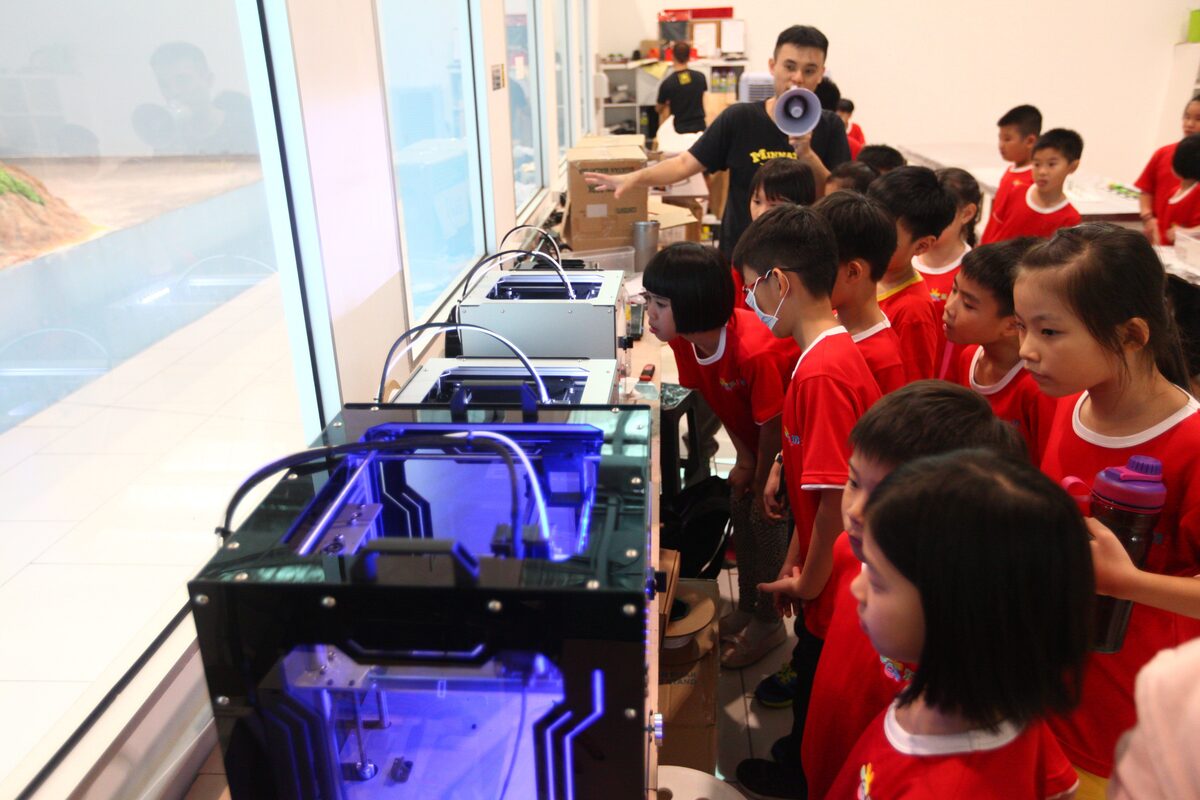
Ugee has globally launched Funbox, a fully enclosed, UL GREENGUARD-certified desktop 3D printer the Chinese hardware maker is pitching squarely at kids ages 4 to 12 — what 3DPrint.com's coverage describes as "preschool beginners to teen hobbyists" — and at adults who have never touched a slicer. The printer went on sale July 15, 2026 through shop.ugee.com, arriving 100% pre-assembled with no bed leveling required — an explicit break from the kit-and-calibrate ritual that still defines most entry-level FDM machines.
Funbox's headline feature isn't the print bed, though. It's ShapeGen, an AI tool built into the workflow that converts a spoken description, typed text, or a hand-drawn sketch directly into a printable 3D model. For a category that has historically required kids to either download someone else's STL or have a parent drive a CAD program, that's the pitch: skip modeling entirely and let a prompt do the design work.
What's Actually Under the Hood
Strip away the "kids" branding and Funbox reads like a legitimately capable machine. Ugee lists a peak print speed of 500mm/s and a minimum layer height of 0.05mm — figures that would be respectable on a printer marketed to hobbyists, let alone one aimed at a nine-year-old's desk. Connectivity is dual-band Wi-Fi 6, and the printer pairs with a companion "UFun" mobile app for monitoring and control.
The safety engineering is where Funbox differentiates itself most clearly from the current crop of kid-oriented printers. The chassis is fully enclosed with rounded edges, runs on 12V low-voltage DC power, and houses an H12 HEPA filter paired with activated carbon and a 6010 exhaust fan. Ugee doesn't publish an independent capture-rate percentage or particle-size figure for the filter stack, but the combination is aimed directly at the ultrafine particulate emissions that FDM printing is known to produce, particularly with PLA and especially with anything hotter. The printer carries UL GREENGUARD certification alongside toy-safety standards ASTM F963-23 and EN71, plus EN62115 for electrical safety in toys — a certification stack that signals Ugee built this to clear regulatory review in both the US and EU toy markets, not just to slap a "kid-safe" sticker on a repackaged adult printer.
3DPrint.com's coverage of the launch flags the practical payoff of that closed-box design: Ugee is claiming the enclosure allows "stable overnight printing inside closed carpeted rooms," a claim that only makes sense if you've watched an open-frame kids' printer get shut down by a parent worried about a hot nozzle, stray filament wisp, or an errant toddler hand. The site draws the comparison explicitly, contrasting Funbox with "open-structured rivals like Bambu Lab A1 Mini with exposed high-temperature nozzles and unfiltered exhaust" — a pointed jab at the open-frame printers that currently dominate the budget end of the market. 3DPrint.com's report also confirms Funbox includes filament runout and "spaghetti" failure detection, automatic resume-print after a power interruption, and a 2MP HD camera for remote monitoring — a feature set that has become table stakes on higher-end consumer printers over the past two years but is less commonly bundled into the sub-$300 kids' segment. The unit also comes with STEM course content baked into the app experience, positioning Funbox as much as an educational product as a toy.
Pricing and What You Get
Funbox carries a standard price of $329, with a launch/presale price of $269 that bundles seven rolls of PLA filament. At that entry price with filament included, Ugee is undercutting the sticker shock that typically comes with "safe for kids" framing — enclosed, filtered printers have historically commanded a premium over open-frame budget machines, not a discount.
What It Means for Makers
For makers who don't have kids in the house, Funbox isn't really built for you — the whole product is oriented around removing decisions, not adding control. But it's worth watching for three reasons.
First, the filtration spec matters beyond the kids' category. A HEPA-plus-activated-carbon filtration system is a legitimate answer to the ultrafine particle (UFP) concern that's dogged FDM printing in enclosed spaces for years, particularly in classrooms, dorm rooms, and home offices where ventilation is an afterthought. If Ugee's real-world filtration performance holds up under independent testing, it's a data point other manufacturers — including ones targeting adult hobbyists — should be paying attention to, since air quality has been a soft spot for the entire desktop FDM category.
Second, ShapeGen is a preview of where the on-ramp to 3D printing is heading. The bottleneck for new users has never really been the printer — it's been the modeling step. A voice-to-model or sketch-to-model pipeline, even an imperfect one, removes the single biggest barrier between "I want to print this" and an actual printable file. Whether ShapeGen's output quality is good enough to hold up outside a marketing demo is the open question; AI-generated mesh geometry has a track record of needing cleanup before it slices cleanly, and Ugee hasn't published technical detail on ShapeGen's underlying model, its file format output, or how much post-processing (if any) happens automatically before a print job starts.
Third, the print specs themselves — 500mm/s peak speed, 0.05mm minimum layers — suggest Ugee isn't cutting corners on the mechanical side to hit the price point, at least on paper. If those numbers translate to real-world performance rather than best-case marketing figures, Funbox's hardware could end up more capable than its target demographic actually needs, which would make it an interesting budget option for adults willing to overlook the kid-focused branding and app.
The bigger unknown, as with any freshly launched product, is durability and real-world reliability — HEPA filter replacement cadence and cost aren't detailed in the launch materials, nor is long-term nozzle or hotend serviceability for a machine explicitly designed to minimize user intervention. Those are the kinds of details that surface in owner reviews months after a launch, not in day-one press coverage.
Sources
- ugee Globally Launches Funbox, UL GREENGUARD Certified Kids 3D Printer — AIJourn, syndicating Ugee's official launch announcement, July 15, 2026
- Ugee Releases AI-Powered Funbox 3D Printer for Kids — 3DPrint.com, July 15, 2026
