
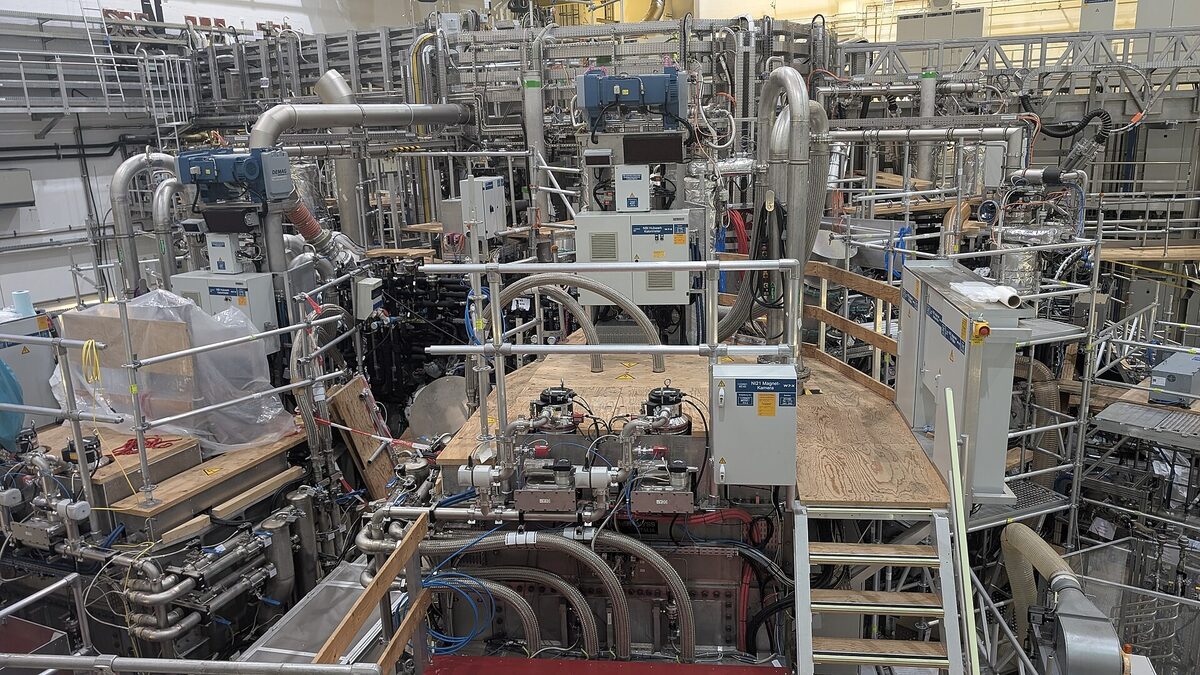
Freemelt, the Swedish manufacturer of electron-beam powder bed fusion (EB-PBF) 3D printers, has signed a memorandum of understanding with Proxima Fusion GmbH and joined the German stellarator developer's Alpha Alliance, a coalition of industrial and research partners spanning Europe and Japan that is building Alpha — a demonstrator reactor that Proxima Fusion is racing to make the first stellarator ever to achieve net energy gain, a threshold known as Q>1.
For a company whose printers are more commonly associated with orthopedic implants and aerospace brackets, teaming up on a fusion reactor is a significant strategic pivot — but it is not a cold start. Freemelt has been quietly positioning itself in the fusion supply chain for several years, and this MoU formalizes that work into a named role inside one of Europe's most closely watched private fusion programs.
Why Tungsten, and Why EB-PBF
Fusion reactors face an engineering problem that has nothing to do with confining plasma and everything to do with materials science: the components that sit closest to a 150-million-degree plasma stream — the divertor and first-wall tiles — need a material that can survive extreme heat flux and particle bombardment without melting, cracking, or shedding contaminants into the plasma. Tungsten is the leading candidate across essentially every major fusion program, including ITER, because of its very high melting point and low sputtering rate. But tungsten is also notoriously difficult to work with using conventional manufacturing: it's brittle at room temperature, hard to weld, and prone to cracking under thermal cycling, which makes it a poor fit for casting or machining complex geometries. Electron-beam powder bed fusion turns out to be well suited to tungsten specifically because it operates in vacuum at elevated build temperatures, which reduces the thermal gradients that cause cracking in other metal-printing processes — and because an electron beam couples more efficiently into a high-density metal like tungsten than a laser does. That combination is why EB-PBF has become one of the more credible manufacturing routes for tungsten plasma-facing components, and why a printer maker with real tungsten process experience is a valuable partner for a fusion company trying to move fast.
According to reporting on the deal, the company will supply its EB-PBF technology and tungsten manufacturing expertise to help design, manufacture, and validate plasma-facing components for Alpha, including tungsten parts destined for the divertor and first wall — the two subsystems that absorb the most direct thermal and particle load in a stellarator.
Freemelt's Existing Fusion Track Record
The Proxima Fusion tie-up doesn't come out of nowhere. Freemelt has previously worked with the UK Atomic Energy Authority, the body that runs the UK's national fusion research program, giving it prior exposure to the specific demands of fusion-grade component qualification. More directly relevant, Freemelt currently leads a live feasibility study for Fusion for Energy — the EU body responsible for Europe's contribution to the international ITER project — specifically aimed at qualifying tungsten as a fusion-grade printable material. That ongoing ITER-adjacent study matters because fusion components can't just be functional; they have to be qualified against exacting standards for density, microstructure, and defect tolerance before anyone will bolt them into a reactor vessel. Having that qualification pipeline already underway with a body like Fusion for Energy gives Freemelt a running start on the kind of validation work Alpha will also require, rather than starting the certification process from scratch.
What the Alpha Alliance Actually Is
Proxima Fusion, a German stellarator developer, has built the Alpha Alliance as a network of industrial and research partners to supply the components and expertise needed to construct Alpha, its planned demonstrator device. Stellarators use twisted, non-planar magnetic coils to confine plasma, in contrast to the simpler donut-shaped coils of a tokamak like ITER — a geometry that is harder to engineer but, proponents argue, offers steadier, disruption-free operation once built. Reaching Q>1, meaning the reactor produces more fusion energy than it consumes to sustain the plasma, would be a milestone no stellarator has hit before, and it's the explicit target Proxima Fusion has set for Alpha. Per reporting on the MoU, it establishes a framework for collaboration rather than a fixed purchase order or contract; the specifics of what gets built, in what quantities, and on what timeline will be negotiated as the partnership moves through design, prototyping, testing, and eventual industrialization phases. That's a normal structure for early-stage fusion supply relationships, where component specifications are still evolving alongside the reactor design itself, but it also means the concrete deliverables — how many tungsten tiles, what geometry, what schedule — aren't yet public.
What It Means for Makers
This isn't a story about a new printer or a product launch — nobody outside a research lab is printing tungsten divertor tiles on a desktop machine anytime soon. But it's a useful data point for anyone tracking where metal additive manufacturing is proving its value beyond the usual aerospace-and-medical narrative. Fusion energy has quietly become one of the more demanding proving grounds for metal 3D printing, precisely because the components involved — complex-geometry, defect-intolerant, exotic-alloy parts — are exactly the kind of thing conventional manufacturing struggles with and additive manufacturing is supposed to excel at. For EB-PBF specifically, a deal like this is a meaningful vote of confidence. The process has always lived somewhat in the shadow of laser powder bed fusion in the broader industrial AM conversation, but its vacuum environment and high build-plate temperatures give it real advantages for difficult, crack-prone, high-melting-point materials like tungsten — advantages that laser-based systems don't share as cleanly. Watch for other EB-PBF vendors and tungsten-processing specialists to chase similar partnerships as more private fusion companies move from paper designs to physical demonstrators over the next few years; component supply chains for fusion hardware are still being built from scratch, and there's a first-mover advantage for printer makers who can show qualified, repeatable tungsten builds now.
